
EU Mandates Carbon Footprint Certification for XLPE Submarine Cables from July 2026
On 30 May 2026, the European Commission published the revised Green Procurement Guidelines for Offshore Energy Infrastructure, introducing mandatory lifecycle carbon footprint reporting for cross-linked polyethylene (XLPE) insulated submarine cables imported into the EU — effective 1 July 2026. This requirement directly affects manufacturers, exporters, and supply chain actors involved in XLPE submarine cable trade, especially those based in China, which accounts for 62% of global production capacity.
Event Overview
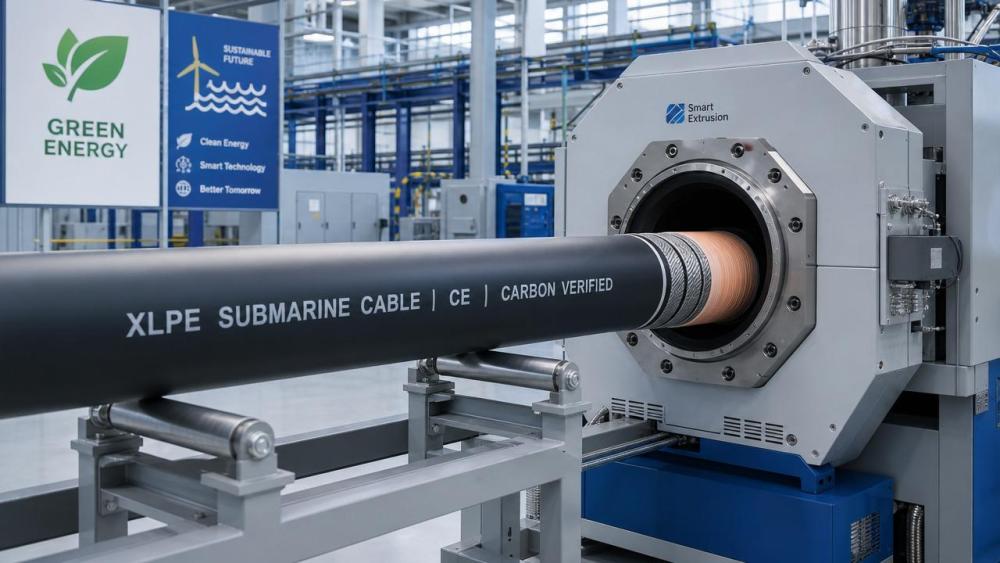
The European Commission formally released the updated Green Procurement Guidelines for Offshore Energy Infrastructure on 30 May 2026. For the first time, XLPE submarine cables are included under an extended scope aligned with the Carbon Border Adjustment Mechanism (CBAM) framework. As of 1 July 2026, all XLPE submarine cables placed on the EU market must be accompanied by a third-party-verified, full-lifecycle carbon footprint declaration — covering raw material extraction, extrusion manufacturing, armoring, and installation-readiness preparation. Non-compliant products will be denied customs clearance.
Industries Affected
Direct Exporters and Trading Enterprises
Exporters of XLPE submarine cables to the EU face immediate compliance obligations. The requirement applies at the point of import, meaning documentation must be submitted prior to customs release. Delays or rejections due to incomplete or unverified carbon reports may disrupt shipment schedules and contractual delivery terms.
Raw Material Suppliers
Suppliers of copper, aluminum, XLPE compounds, and steel wire used in cable armoring are indirectly affected. Since the carbon footprint assessment includes upstream emissions from material extraction and primary processing, downstream cable producers will increasingly require Environmental Product Declarations (EPDs) or verified emission data from their material vendors — particularly for inputs sourced outside the EU.
Manufacturers and Cable Producers
Manufacturers must now account for process-level emissions across extrusion, curing, armoring, and testing stages. The requirement extends beyond factory gate emissions to include energy sources, auxiliary materials (e.g., lubricants, cooling water treatment), and transport logistics up to the point of export readiness. This necessitates internal data collection systems aligned with ISO 14067 or PAS 2050 standards.
Supply Chain and Logistics Service Providers
Freight forwarders, customs brokers, and certification support providers will need to verify documentation completeness before submission. Their role shifts from administrative facilitation to compliance coordination — especially where verification bodies require traceable, time-stamped evidence of process parameters and energy consumption per production batch.
What Enterprises and Practitioners Should Monitor and Do Now
Track official guidance and verification body accreditation status
The European Commission has not yet published the full list of EU-recognized verification bodies for XLPE submarine cable carbon assessments. Enterprises should monitor updates from the Joint Research Centre (JRC) and national accreditation bodies (e.g., DAkkS in Germany, UKAS in the UK) to confirm which auditors are authorized to issue compliant declarations.
Identify high-risk product lines and EU-bound shipments
Not all submarine cables fall under this rule — only those using XLPE insulation and intended for offshore renewable energy infrastructure (e.g., inter-array or export cables for wind farms). Companies should audit current export portfolios to isolate affected SKUs, assess existing carbon data coverage, and prioritize verification for shipments scheduled between July and December 2026.
Distinguish policy signal from operational implementation
This is a regulatory mandate, not a voluntary initiative. However, enforcement timing and granularity — such as whether batch-level reporting or annual averaging is accepted — remain subject to national customs interpretation. Enterprises should treat initial submissions as pilot cases and retain full audit trails for at least five years.
Prepare supplier engagement and internal data protocols
Manufacturers should initiate dialogue with upstream suppliers to request emission-intensity data (e.g., kWh/MWh per tonne of copper rod; kg CO₂e/kg XLPE compound). Internally, they should map energy metering points, define system boundaries consistent with EN 15804+A2, and assign responsibility for data validation — ideally ahead of the 1 July 2026 deadline.
Editorial Perspective / Industry Observation
Observably, this measure marks the first sector-specific extension of CBAM-aligned transparency requirements beyond heavy industry into advanced electrical infrastructure components. Analysis shows it functions less as a tariff instrument and more as a procurement gatekeeper — reinforcing the EU’s broader strategy to embed climate accountability into public and regulated-private energy investments. From an industry perspective, it signals growing convergence between environmental compliance and technical qualification in offshore grid supply chains. Current monitoring should focus not just on certification mechanics, but on how this requirement influences tender evaluation criteria in upcoming offshore wind projects across the North Sea and Baltic regions.
Concluding, this regulation represents a structural shift in market access conditions for XLPE submarine cable exporters — one that elevates lifecycle transparency from a competitive differentiator to a baseline entry requirement. It is best understood not as an isolated compliance checkpoint, but as an early indicator of expanding carbon accountability across the entire offshore energy value chain.
Source: European Commission – Revised Green Procurement Guidelines for Offshore Energy Infrastructure, published 30 May 2026.
Note: Accreditation status of verification bodies and national customs implementation guidance remain under observation and are expected to be clarified in Q3 2026.
Related News
- China Issues 15th Five-Year Power Safety Plan, Raising Export Compliance for UHV and HVDC EquipmentAug 17, 2026High-Voltage Grid Architect
- China-UAE Launch Direct Sea Route, Cutting UHV and Energy Storage Logistics Time by 30%Aug 16, 2026High-Voltage Grid Architect
- U.S. Imposes Four-Year Safeguard Duty on Quartz CountertopsAug 15, 2026
- China Imposes Temporary Helium Export BanAug 14, 2026Transmission Materials Fellow