
DOE Adds 3 Chinese PCS Suppliers to U.S. QPL
On July 14, 2026, the U.S. Department of Energy updated its Grid-Scale Power Conversion Systems Qualified Products List, adding three Chinese PCS inverter manufacturers to the federal procurement whitelist. The change matters because access is tied to specific technical and interface requirements, including UL 1741 SA-2026 Version 4.2 dual-mode verification for black start and seamless islanding transfer, as well as a localized remote diagnostics interface protocol under IEEE 1547.1 Annex H. For distributors, procurement teams, certification-related service providers, and export-facing manufacturers, this is not just a product update; it is a practical compliance signal that can affect supplier screening, channel cooperation, and delivery preparation.
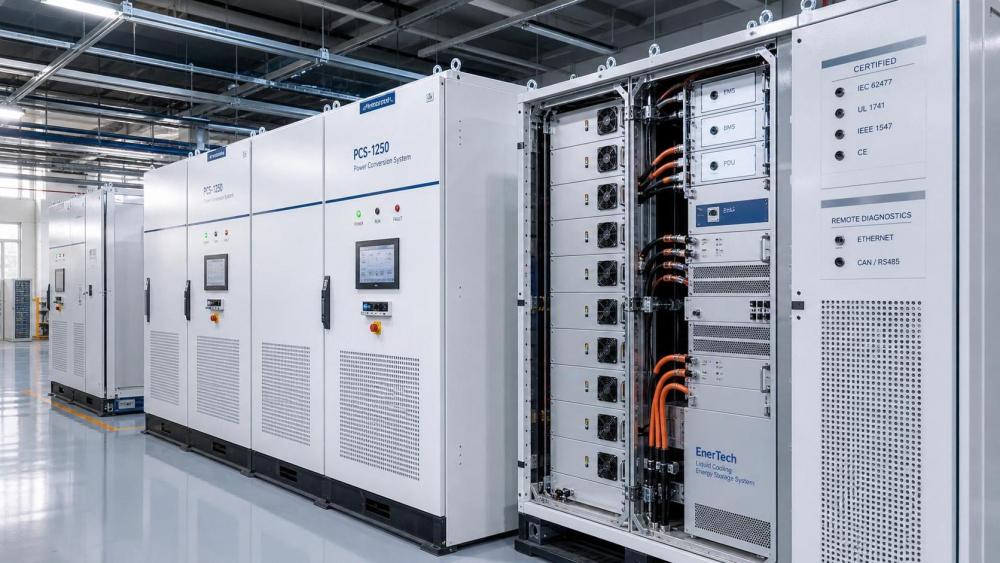
What the DOE update confirms
The confirmed facts are limited but commercially meaningful. DOE updated the Grid-Scale Power Conversion Systems Qualified Products List on July 14, 2026. The revision added three Chinese PCS inverter manufacturers to the federal procurement whitelist, including two suppliers of liquid-cooled models. Entry required passing UL 1741 SA-2026 Version 4.2 dual-mode verification covering black start and seamless switching to islanded operation, and providing a localized remote diagnostics interface protocol aligned with IEEE 1547.1 Annex H.
No additional company names, project details, procurement volumes, or wider policy measures were provided in the input. The confirmed development is the whitelist expansion itself and the stated access conditions attached to that expansion.
Where the immediate pressure points appear
For U.S. distributors and channel partners
Analysis shows this update can affect model selection and partner qualification first. When a federal procurement whitelist is revised with explicit technical admission conditions, distributors may need to recheck whether shortlisted products align with the latest bid specifications, compliance files, and after-sales support expectations. What deserves closer attention is whether product comparison now shifts more clearly toward high-reliability PCS configurations built to U.S. standards rather than legacy options that do not meet the same verification path.
For manufacturers targeting export orders
From an industry perspective, the impact is likely to fall on technical documentation, certification readiness, and deliverable configuration. Manufacturers seeking similar market access may need to pay closer attention to whether their products can demonstrate the same dual-mode verification scope and support the required localized remote diagnostics interface. In practice, that affects how technical files, test evidence, interface descriptions, and procurement-facing materials are prepared.
For procurement and project-facing buyers
Buyers and sourcing teams may be affected at the supplier screening stage. The update provides a more concrete reference point for evaluating whether a PCS offering is positioned for federal procurement pathways. Observably, this can influence how procurement teams review approved product status, compare liquid-cooled and other configurations, and assess whether compliance evidence is sufficient before order placement or tender participation.
For testing, certification, and service support functions
Certification-related companies, testing service providers, and after-sales support teams may also see direct implications. The stated prerequisites point to a narrower compliance focus around dual-mode operating verification and remote diagnostics interoperability. That means service-related participants may need to follow how test reports, protocol descriptions, and local support capabilities are being presented and reviewed in procurement or channel discussions.
What companies should review now
Check the compliance package against the stated entry conditions
Companies active in this segment should first verify whether their existing product files clearly map to UL 1741 SA-2026 Version 4.2 requirements and to the IEEE 1547.1 Annex H interface expectation cited in the update. Where those materials are incomplete, the immediate issue is not market messaging but documentation readiness.
Revisit tender documents and product qualification language
Analysis shows that bid documents, technical specifications, and supplier qualification materials deserve another review after this kind of whitelist revision. Even without broader policy detail, the procurement signal is clear enough that companies should watch for changes in how buyers describe acceptable PCS performance, diagnostics access, and model eligibility.
Prepare for closer scrutiny on delivery and service commitments
What deserves closer attention is the service side of compliance. A localized remote diagnostics interface is not only a technical item on paper; it can affect how suppliers explain commissioning support, fault response, traceability, and cross-border service coordination. Companies involved in delivery planning should review whether their support arrangements are consistent with the stated requirement.
Track whether market execution follows the whitelist signal
The current input does not provide downstream execution details, so this should not be treated as a confirmed change in all purchasing behavior. It is more appropriate to monitor whether the updated whitelist begins to influence distributor onboarding, channel negotiations, and procurement references in upcoming transactions.
Why this looks more like an execution signal than a broad policy reset
Observation rather than fact: this development is better understood as a concrete execution signal inside a procurement and compliance framework, not as proof of a wider regulatory overhaul. The reason is that the confirmed change is specific: whitelist inclusion tied to defined technical verification and interface conditions. From an industry perspective, that still matters because such signals often shape real commercial behavior before broader market conclusions can be drawn. Continued attention is warranted around later procurement language, certification interpretation, and whether market participants begin treating these requirements as a practical baseline.
How the market may best read this update for now
At this stage, the most balanced reading is that DOE's revision marks an implemented access change with immediate relevance for product qualification and channel decision-making, while the wider commercial effect still needs observation. The event should not be overstated as a full market shift, but it should not be dismissed as a routine list edit either. It is more appropriate to understand it as a rules-based procurement signal that highlights which PCS capabilities and compliance materials are gaining weight in the U.S. purchasing environment.
Basis of this article and what still needs verification
This article is based on the user-provided news title, event date, and event summary. For developments of this type, relevant source categories typically include official government announcements, regulator releases, procurement list updates, standards organization documents, industry association publications, and reporting by authoritative trade media. A specific official source link was not provided in the input, so the underlying publication path still requires ongoing verification. Further observation is also needed on detailed implementation language, certification interpretation, tender document changes, market feedback, and how companies execute against the stated requirements.
Related News
- What Are the Common PCS Inverter Failures in High-Humidity Environments?Sep 10, 2026Energy Storage Strategist
- How do PCS inverters affect battery storage round-trip efficiency?Sep 06, 2026Energy Storage Strategist
- DOE Adds 3 Chinese PCS Suppliers to U.S. QPLJul 15, 2026Energy Storage Strategist
- Saudi SEC Sets First Grid-Forming PCS Approval PathJul 04, 2026Energy Storage Strategist