
India Enforces BIS UHV Transformer Labels July 15
On July 15, 2026, a new compliance requirement took effect in India for UHV transformers rated at 800 kV and above, after BIS announced the measure on July 14. The change is not just a labeling update: it ties measured no-load loss (W) and load loss (W) data to product marking and to the BIS online regulatory platform, while also linking non-compliance directly to customs clearance. For manufacturers, exporters, buyers, certification teams, and delivery planners, the immediate issue is that market access, documentation readiness, and testing capacity now sit much closer to the shipment timeline.
What the BIS notice confirms from July 15
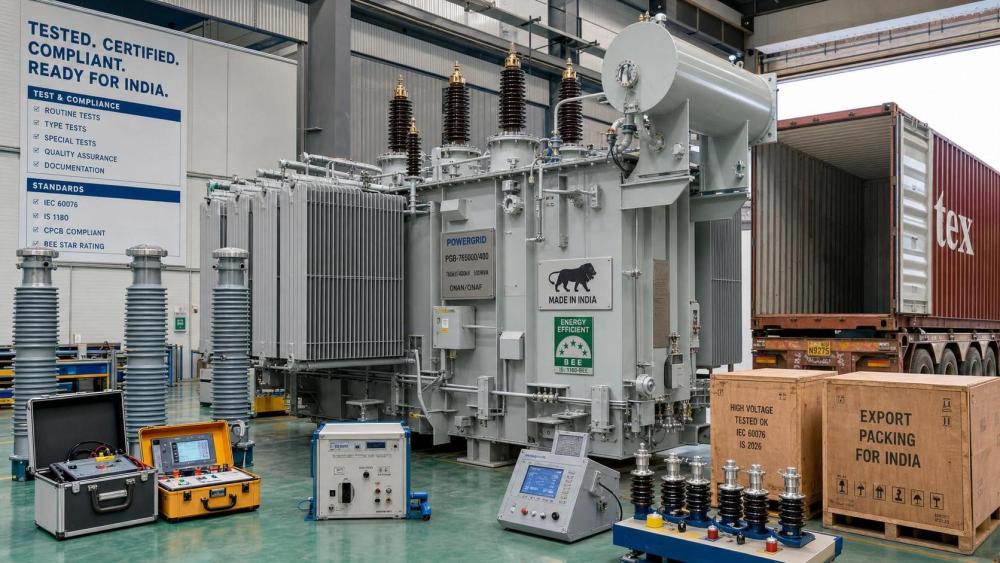
According to the provided event summary, BIS issued a notice on July 14, 2026 and began mandatory energy efficiency labeling from July 15 for UHV transformers with a rated voltage of 800 kV or higher under IS 17115:2026 Part 2.
The label must show the measured values of no-load loss (W) and load loss (W). The same information must also be connected to the BIS online regulatory platform.
The provided information also states that products without the required label, or with inaccurate data, will be denied customs clearance.
In addition, only three certification laboratories were initially opened for this requirement, including one China-based institution with CNAS recognition, and their capacity has already been fully booked through September.
Where the immediate pressure will appear in business operations
Export shipments now face a tighter compliance gate
From an industry perspective, exporters and direct trading companies are likely to feel the impact first because the rule is tied to customs clearance. The practical effect is that shipment preparation can no longer treat the label as a late-stage packaging item; the label content, measured loss data, and regulatory platform alignment now become part of export readiness.
What deserves closer attention is the risk around documentation consistency. Where shipments are planned for the Indian market, companies will need to watch the match between label information, test outputs, and submission records linked to BIS.
Manufacturing and technical teams may need to move testing earlier
For manufacturers, the rule reaches back into production release and technical documentation. Because the label must carry measured no-load loss and load loss values, the issue is not only format compliance but also whether test evidence is available in time for shipment and filing.
Analysis shows that this may affect internal sequencing between testing, nameplate or label preparation, quality sign-off, and final dispatch. Any mismatch between measured values and declared values could become a trade compliance issue rather than only a technical correction item.
Procurement and project delivery teams may need to revisit timing assumptions
Buyers, EPC-related procurement teams, and supply chain service providers may also need to reassess schedules. The provided summary confirms that only three laboratories were opened initially and that capacity is already full through September. Even without adding assumptions beyond that fact, the immediate operational signal is that certification access is constrained at the start of implementation.
Observably, this makes delivery planning, supplier confirmation, and shipment sequencing more sensitive to laboratory booking and compliance document completion, especially for orders already close to dispatch.
Certification and testing service coordination becomes more critical
For certification-related companies and testing support providers, the new requirement shifts attention toward data accuracy, traceability, and platform-linked filings. The issue is no longer only whether testing can be arranged, but whether the output can support label generation and regulatory submission without inconsistencies.
Companies involved in compliance support should therefore pay close attention to the exact presentation of measured values in technical files, labels, and any accompanying trade documents used during export and import processing.
What companies should check now
Review whether affected products fall within the scope
Companies handling transformer exports to India should first confirm whether any products in current or near-term orders fall within the stated threshold of rated voltage at or above 800 kV. This is a basic step, but it determines whether the new labeling and platform-linked compliance process is already relevant to booked or pending deliveries.
Align test data, labels, and filing records before shipment
Analysis shows that the most immediate control point is consistency. Businesses should pay attention to whether measured no-load loss (W) and load loss (W) values are ready for use across labels, technical records, and any BIS-related submission process. The provided information confirms customs consequences for unlabeled products or inaccurate data, so pre-shipment verification becomes more important.
Watch laboratory access and delivery commitments closely
The limited number of initially available laboratories, combined with bookings already extending through September, is a practical issue for order execution. Companies should monitor whether existing production and delivery commitments depend on testing or certification slots that may not be available in the required window.
It is more appropriate to understand this as an execution constraint already visible at the start of the rule rather than a purely administrative detail.
Track later clarification in enforcement practice
The provided summary does not include further operational detail on how BIS or customs will handle edge cases, document review, or transitional treatment. For that reason, companies should continue watching for later wording, procedural clarification, and any changes reflected in tender documents, customer specifications, or compliance checklists.
Why this looks like an execution signal, not just a formal update
Observably, this development is best read as a live market-access requirement rather than a distant policy direction. The rule has an effective date, a defined product scope, stated label content, a platform connection requirement, and a direct customs consequence for non-compliance. That combination makes it more than a symbolic standards update.
At the same time, analysis should remain measured. The available facts confirm the rule and the initial laboratory bottleneck, but they do not yet show how implementation will settle across procurement practice, bidding language, customs review patterns, or supplier response. Those points still require observation.
How the market may need to read this change
The immediate significance of this BIS measure is that compliance for certain UHV transformers in India now extends beyond product performance and into visible labeling accuracy, data submission, and border clearance risk. For affected companies, the near-term issue is less about broad market forecasting and more about whether testing access, document control, and shipment preparation are aligned quickly enough.
Current conditions make it more appropriate to understand this development as an implemented rule with early-stage execution pressure. The core facts are already clear, while the detailed enforcement rhythm and market adaptation still need continued observation.
Basis of this article and what still needs verification
This article is generated from the user-provided news title, event date, and event summary. For developments of this type, relevant source categories commonly include official notices, regulatory releases, customs or trade administration information, standards organization documents, industry association updates, and reporting by established professional media.
No specific official source link was provided in the input, so the exact official link still needs to be verified on an ongoing basis. Further observation is also needed on detailed implementation language, certification execution practice, tender document updates, market feedback, and how affected companies handle delivery and compliance in practice.
Related News
- US Energy Department Offers $237 Million for Grid Component and Transformer Supply ChainsNov 02, 2026High-Voltage Grid Architect
- Gansu–Zhejiang UHV Line Completes Conductor Stringing Across the YangtzeOct 28, 2026High-Voltage Grid Architect
- Gansu–Zhejiang UHV Project Completes Yangtze River Crossing Conductor StringingOct 27, 2026High-Voltage Grid Architect
- How UHV transformer transport limits shape substation planningOct 20, 2026High-Voltage Grid Architect