
SABIC-ACWA Green Hydrogen–Superconducting Cable Demo Launches
On May 17, 2026, the SABIC–ACWA Power integrated green hydrogen production and superconducting transmission demonstration project entered its cable installation phase in Saudi Arabia — marking the first overseas deployment of Chinese-made low-temperature superconducting (LTS) cables for desert-grid applications. The milestone signals a strategic inflection point for global superconductor supply chains, particularly amid tightening climate commitments and accelerated regional grid modernization efforts across the Middle East and North Africa (MENA).
Event Overview
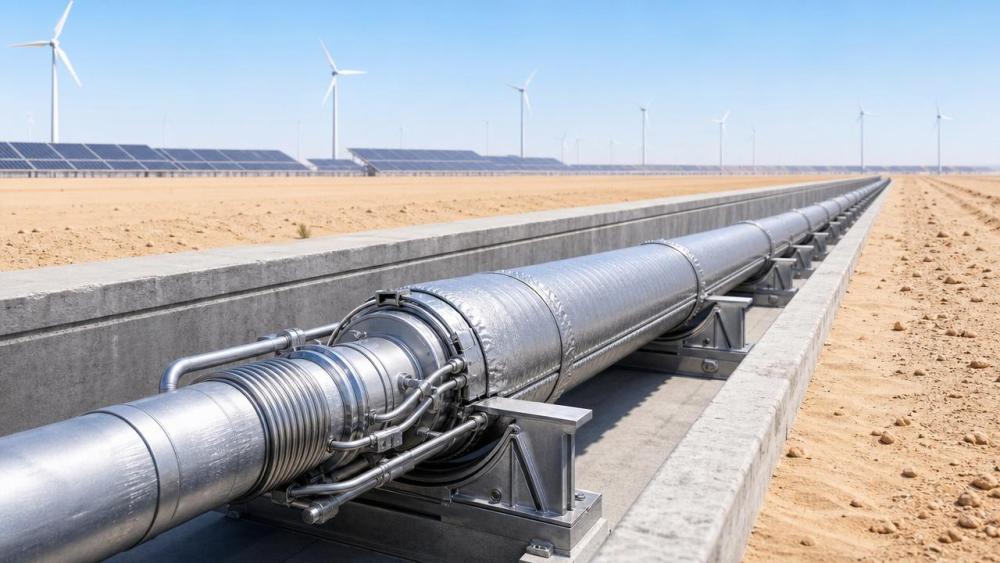
On May 17, 2026, SABIC and ACWA Power jointly announced that the ‘green hydrogen–superconducting transmission’ integrated demonstration project had commenced cable laying. A 5-kilometer segment of low-temperature superconducting cable — supplied exclusively by China’s Western Superconducting Technologies Co., Ltd. — is now being installed. This marks the first validation of domestically produced Bi-2223 high-temperature superconducting (HTS) tape under sustained desert ambient conditions (up to 55°C), with full operational stability confirmed during pre-deployment thermal cycling and cryogenic commissioning tests.
Industries Affected
Direct Export Enterprises: Companies engaged in HTS cable system exports face renewed competitive positioning — not only as component suppliers but as integrated solution providers. The award reinforces credibility in extreme-environment performance certification, potentially unlocking tenders in MENA, Australia, and the U.S. Southwest where ambient heat challenges conventional cryogenic design assumptions.
Raw Material Procurement Firms: Suppliers of bismuth-based precursor powders, silver sheathing, and specialized nickel-alloy substrates may see demand volatility. While Bi-2223 remains niche versus REBCO tapes, this project validates long-term viability of bismuth-system HTS in cost-sensitive infrastructure projects — prompting procurement reassessment of inventory depth, alloy purity specifications, and regional logistics buffers.
Manufacturing & Systems Integrators: Domestic HTS cable fabricators must now adapt production protocols to meet international desert-grade thermal margin requirements — including enhanced vacuum-jacket integrity, cryogen retention optimization, and real-time strain monitoring integration. The success elevates benchmark expectations for third-party certification (e.g., IEC 61788-12, IEEE 1954) beyond laboratory settings.
Supply Chain Service Providers: Cryogenic logistics operators, customs brokers specializing in dual-use technology classification (e.g., ECCN 3E001), and technical translation/localization firms supporting Arabic–English engineering documentation are seeing increased engagement. Notably, export compliance workflows now require explicit thermal derating verification per IEC TR 62271-302 Annex D for desert deployments.
Key Considerations for Stakeholders
Verify Ambient Thermal Derating Protocols
Stakeholders must cross-check whether existing HTS cable designs meet the newly demonstrated 55°C ambient tolerance threshold — especially for projects in GCC countries or arid zones. Relying solely on ISO 14644 cleanroom thermal specs is no longer sufficient; field-relevant thermal modeling (e.g., using ASHRAE RP-1693 methodologies) should inform bid submissions.
Assess Bi-2223 vs. REBCO Commercial Viability
This deployment does not signal a broad shift away from REBCO-based systems. Rather, it confirms Bi-2223’s role in mid-voltage, medium-distance applications (
Prepare for Expanded Certification Requirements
Future MENA tenders are likely to mandate third-party validation of thermal cycling endurance (≥1,000 cycles between −196°C and +70°C) and sand-dust ingress resistance (IEC 60529 IP6X). Engineering teams should initiate early alignment with accredited test labs in Dubai or Riyadh — rather than defaulting to European or U.S.-based facilities.
Editorial Perspective / Industry Observation
Observably, this project is less about displacing incumbent HTS technologies and more about expanding the *application envelope* for commercially mature materials. Analysis shows that Western Superconducting’s success stems not from breakthrough material science, but from rigorous system-level engineering — particularly in thermal interface management and mechanical damping under diurnal temperature swings. From an industry perspective, the greater implication lies in shifting buyer expectations: grid operators now view HTS not as a ‘lab curiosity’, but as a deployable asset class requiring lifecycle-aware procurement frameworks.
Conclusion
This milestone does not herald immediate mass adoption of HTS in desert grids. Instead, it establishes a credible, field-validated reference point for risk-informed investment decisions. A rational interpretation is that it lowers the perceived technical barrier — not the economic one — for near-term pilot deployments in high-solar, high-heat regions. Long-term scalability will depend less on material advances and more on cryoplant efficiency gains and standardized installation protocols.
Source Attribution
Official announcement: SABIC Press Release No. 2026-05-17; ACWA Power Project Bulletin Q2 2026; Western Superconducting investor disclosure (Shanghai Stock Exchange: 688122, May 17, 2026). Note: Cryogenic performance data under sustained 55°C ambient load remains proprietary pending peer-reviewed publication in IEEE Transactions on Applied Superconductivity. Further updates on commercial licensing terms and follow-on project timelines are under observation.
Related News
- China Imposes Temporary Helium Export BanAug 14, 2026Transmission Materials Fellow
- TUV Rheinland names first IEC 63019:2026 labsJul 14, 2026Transmission Materials Fellow
- TUV Rheinland Enables Local IEC 63019 Testing in ChinaJul 13, 2026Transmission Materials Fellow
- IEC 62871-3:2026 Adds Mandatory Tests for EU ExportsJul 09, 2026Transmission Materials Fellow