
IEC 62871-3:2026 Published: Cryogenic Performance Testing Mandatory for EU Market Access
On 18 May 2026, the International Electrotechnical Commission (IEC) published IEC 62871-3:2026 — the first edition of a standard mandating cryogenic performance testing for superconducting power cables seeking market access in the European Union. This development directly affects manufacturers of superconducting transmission systems targeting EU public grid interconnection, particularly those based in China and other export-oriented economies.
Event Overview
The International Electrotechnical Commission (IEC) officially released IEC 62871-3:2026 on 18 May 2026. The standard introduces three new mandatory type-test requirements for superconducting cables: liquid nitrogen circulation stability, quench propagation rate (QPR), and low-temperature mechanical fatigue resistance. It explicitly applies to all superconducting transmission systems intended for connection to the EU public electricity grid. Compliance is required to obtain the CE-IAI interoperability label; non-certified products will be excluded from grid interconnection in the EU.
Industries Affected by Segment
Direct Exporters (Cable System Manufacturers)
Manufacturers exporting superconducting cable systems to the EU are directly impacted because certification under IEC 62871-3:2026 is now a prerequisite for CE-IAI labeling and grid access. Non-compliance results in immediate market exclusion — not merely delayed approval or conditional entry.
Material & Component Suppliers
Suppliers of cryogenic insulation, stabilized conductor strands, thermal contraction-compensating joints, and liquid nitrogen circulation subsystems face upstream validation pressure. Since the standard mandates system-level performance under dynamic cryogenic conditions, component-level specifications must now align with verified QPR and fatigue tolerance thresholds — not just nominal operating parameters.
Third-Party Certification & Testing Laboratories
Laboratories accredited for high-voltage or cryogenic equipment testing must now demonstrate capability for standardized QPR measurement, controlled thermal cycling under load, and long-duration liquid nitrogen flow stability assessment. Absence of validated test protocols aligned with IEC 62871-3:2026 Annexes may limit their eligibility for issuing EU-recognized reports.
What Enterprises and Practitioners Should Monitor and Do Now
Track official EU implementation timelines and transitional provisions
While IEC 62871-3:2026 is published, its incorporation into the EU’s harmonized standards list (and thus legal presumption of conformity under the Low Voltage Directive or RED, as applicable) remains pending. Enterprises should monitor updates from the European Commission’s Official Journal and notified body announcements — especially whether a grace period applies for products placed on the market before full enforcement.
Verify applicability scope against existing product portfolios
Not all superconducting cable configurations fall under this standard’s scope. The document specifies applicability to ‘cables rated ≥ 1 kV for alternating current systems up to 52 kV’. Firms should confirm whether their exported designs (e.g., DC prototypes, sub-1 kV demonstrators, or non-grid-connected research units) are covered — avoiding unnecessary retesting while ensuring compliance where mandated.
Align internal test planning with newly defined pass/fail criteria
The standard defines quantitative thresholds for QPR (e.g., ≤ 10 m/s under specified fault energy), minimum cycles for fatigue validation (e.g., ≥ 5,000 thermal cycles between 77 K and ambient), and allowable pressure/flow variation during LN2 circulation tests. Manufacturers must update test plans, instrumentation calibration schedules, and failure analysis protocols to reflect these exact criteria — not prior internal benchmarks.
Engage early with EU-notified bodies experienced in cryogenic power equipment
Only laboratories designated as EU notified bodies — and possessing documented technical competence in cryogenic dielectric and thermal-mechanical testing — can issue valid CE-IAI supporting documentation. Pre-submission technical reviews with such bodies are advisable to identify gaps in test setup, data traceability, or reporting format before formal application.
Editorial Perspective / Industry Observation
Observably, IEC 62871-3:2026 functions less as an incremental update and more as a regulatory threshold shift — elevating cryogenic reliability from a design consideration to a legally enforceable requirement. Analysis shows that its mandatory inclusion of QPR and fatigue metrics reflects growing EU grid operator concern over system-wide resilience during fault events, rather than only steady-state efficiency. From an industry perspective, this signals a broader trend: future interconnection standards for advanced grid technologies will increasingly couple electromagnetic performance with real-world environmental durability. Current implementation status remains transitional — the standard is published, but its legal force in the EU depends on subsequent harmonization. Therefore, it is better understood as a binding technical benchmark with imminent regulatory weight, not yet a fully activated legal barrier.
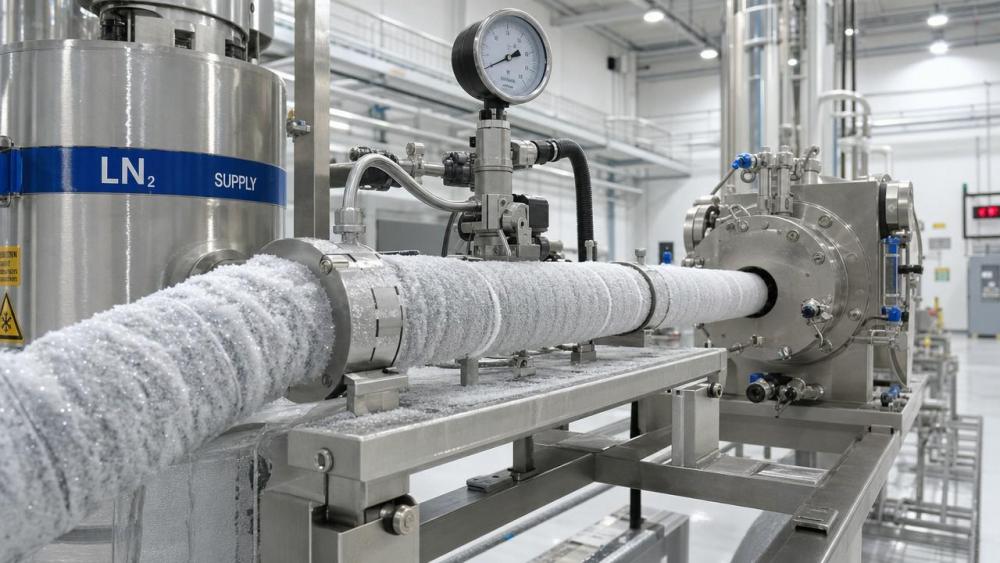
In summary, IEC 62871-3:2026 marks a structural tightening of technical access conditions for superconducting cable exports to the EU. Its significance lies not in introducing novel physics, but in converting previously voluntary or project-specific cryogenic validation practices into non-negotiable, standardized conformity requirements. For stakeholders, the most rational interpretation is that this is a definitive signal of maturing regulatory expectations — one requiring targeted technical alignment, not broad strategic overhaul.
Source: International Electrotechnical Commission (IEC), IEC 62871-3:2026 Edition 1.0 — Superconducting electrical power equipment — Part 3: Test methods for superconducting cables. Published 18 May 2026.
Note: EU harmonization status and national transposition timelines remain under observation.
Related News
- China Imposes Temporary Helium Export BanAug 14, 2026Transmission Materials Fellow
- TUV Rheinland names first IEC 63019:2026 labsJul 14, 2026Transmission Materials Fellow
- TUV Rheinland Enables Local IEC 63019 Testing in ChinaJul 13, 2026Transmission Materials Fellow
- IEC 62871-3:2026 Adds Mandatory Tests for EU ExportsJul 09, 2026Transmission Materials Fellow