K-REACH Introduces Expedited Registration for Supply-Critical Cryogenic Materials
South Korea’s Ministry of Environment launched a special registration pathway under K-REACH for chemicals designated as 'supply-critical', specifically targeting key cryogenic materials used in liquid nitrogen–cooled superconducting cables. The exact event date was not specified, though implementation is scheduled for May 2026. This regulatory adjustment directly affects manufacturers and exporters of advanced superconducting components—particularly those supplying the Korean market—and stems from an effort to alleviate supply bottlenecks in strategic clean-energy infrastructure projects.
K-REACH Special Registration Pathway for Critical Cryogenic Substances
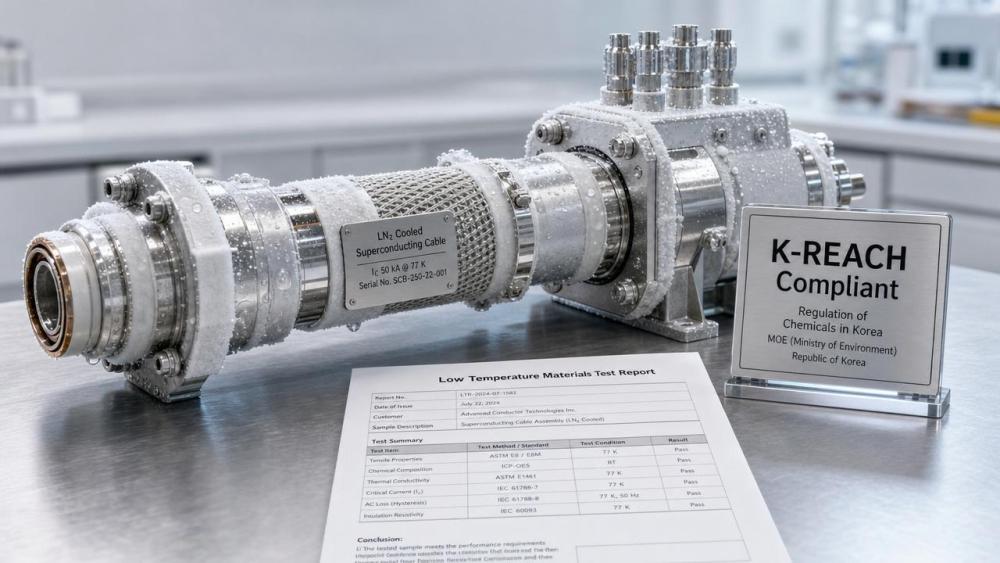
In May 2026, South Korea’s Ministry of Environment activated a K-REACH ‘supply-critical chemical substances’ registration exception. This streamlined channel applies to essential low-temperature functional materials—including YBCO-coated conductors and MgB₂ precursor compounds—used in liquid nitrogen–cooled superconducting cable systems. Under this provision, the substance registration timeline is reduced from the standard 12 months to just 30 working days. The measure is designed exclusively for substances whose shortage poses demonstrable risk to national energy infrastructure deployment timelines.
Impact Across the Superconducting Supply Chain
Export-oriented manufacturing enterprises
Chinese producers of YBCO tapes and MgB₂-based precursors will experience faster customs clearance and project qualification cycles when exporting to South Korea. The shortened registration window reduces time-to-market for material batches intended for Korean grid modernization tenders or pilot superconducting cable installations.
Raw material procurement entities
Buyers sourcing cryogenic-grade substrates, dopants, or metal organic precursors must now verify whether their suppliers have initiated—or are eligible for—the expedited K-REACH pathway. Delays in upstream registration may cascade into downstream delivery commitments, especially for just-in-time procurement models tied to Korean EPC contracts.
Component and system integrators
Firms assembling full superconducting cable systems for export must align technical documentation (e.g., composition declarations, impurity profiles, thermal cycling reports) with K-REACH’s accelerated submission requirements. Lack of harmonized test data formats may trigger re-submission or verification delays—even under the fast-track regime.
Regulatory compliance and logistics service providers
Third-party regulatory consultants and freight forwarders specializing in chemical exports to Korea must update their due diligence checklists to include eligibility screening for the supply-critical designation, pre-submission dossier readiness assessments, and post-registration notification handling under Article 10 of K-REACH.
Key Compliance Priorities for Exporters
Eligibility verification before dossier preparation
Companies must confirm whether their YBCO or MgB₂-related substances meet K-REACH’s official criteria for ‘supply-critical’ status—including documented evidence of market shortage, absence of viable substitutes, and linkage to nationally prioritized infrastructure applications.
Alignment of technical specifications with Korean regulatory expectations
Substance identification, purity thresholds, residual solvent limits, and batch traceability protocols must conform to the format and granularity expected by Korea’s National Institute of Environmental Research (NIER), particularly for cryogenic materials where thermal stability and phase consistency are critical.
Integration of registration timing into delivery scheduling
With registration now achievable in 30 working days, procurement and production planning must shift from annual to quarterly cadence—especially for firms supporting Korean smart-grid demonstration projects with tight commissioning windows.
Strategic Implications for Global Superconducting Supply Chains
Analysis shows that this K-REACH amendment reflects a broader trend: regulatory frameworks are increasingly incorporating supply-chain resilience criteria—not only environmental or toxicological risk—into chemical registration logic. From an industry perspective, it is more appropriate to understand this as a de facto ‘infrastructure-readiness’ certification layer grafted onto existing REACH-style compliance. What deserves closer attention is how other jurisdictions—such as the EU or Japan—may follow suit by introducing parallel mechanisms for critical-enabling materials in fusion, quantum, or next-generation power transmission sectors. Observably, the threshold for qualifying as ‘supply-critical’ remains narrowly defined; however, its precedent opens the door for future expansions to other high-performance functional materials beyond cryogenics.
Broader Significance for Clean-Energy Export Competitiveness
This regulatory development does not lower technical or safety standards—but rather compresses administrative latency without compromising scientific scrutiny. For Chinese and other non-Korean manufacturers, it represents a targeted opportunity to strengthen footholds in Korea’s emerging superconducting grid ecosystem—provided they treat regulatory agility as a core component of product development and commercial strategy, not merely a post-production compliance task.
Source Information and Ongoing Monitoring
This article was generated based on the user-provided title, event timing note (‘not specified’), and summary description. Specific official source links were not provided in the input and should be verified continuously. Stakeholders are advised to monitor forthcoming K-REACH guidance documents from the Ministry of Environment and NIER, particularly regarding eligibility documentation templates, third-party verification protocols, and any updates to the official list of recognized supply-critical substances. Industry feedback on early registrations and tender-level implementation practices will also be critical indicators in the coming months.
Related News
- China Issues 15th Five-Year Power Safety Plan, Raising Export Compliance for UHV and HVDC EquipmentAug 17, 2026High-Voltage Grid Architect
- China-UAE Launch Direct Sea Route, Cutting UHV and Energy Storage Logistics Time by 30%Aug 16, 2026High-Voltage Grid Architect
- U.S. Imposes Four-Year Safeguard Duty on Quartz CountertopsAug 15, 2026
- China Imposes Temporary Helium Export BanAug 14, 2026Transmission Materials Fellow