
Chile Enforces PE No.6/09:2024 for PCS Inverters Effective March 31, 2026
Effective March 31, 2026, Chile will enforce the national electrical safety standard PE No.6/09:2024 for all imported power conversion system (PCS) inverters — introducing mandatory local certification and bilingual labeling as prerequisites for customs clearance.
Mandatory Certification Takes Effect
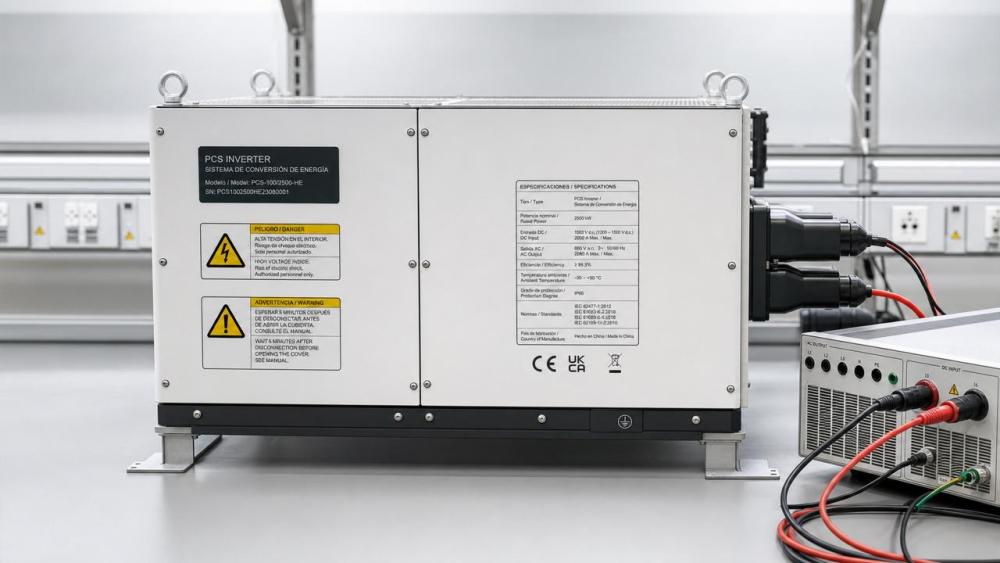
Starting March 31, 2026, all PCS inverters imported into Chile must comply with PE No.6/09:2024. This regulation requires conformity assessment by Chilean-authorized testing and certification bodies. Products must bear dual-language (Spanish/English) energy efficiency and safety labels. Non-compliant units will be denied customs release. The standard fully aligns with IEC 62109 and IEC 61850-7-42, imposing stringent requirements on DC-side protection, anti-islanding response time (≤2 seconds), and grid adaptability.
Impact Across Supply Chain Roles
Exporting Trading Companies
These entities face immediate operational impact: shipments without valid PE No.6/09:2024 certification will stall at Chilean ports. Pre-shipment verification of labeling language, test report validity, and local certification body accreditation becomes critical to avoid clearance delays or re-export costs.
Raw Material and Component Suppliers
Suppliers supporting PCS inverter manufacturers must ensure traceable compliance of key subassemblies — especially those affecting DC-side protection circuits and anti-islanding logic firmware. Documentation alignment (e.g., component-level IEC 62109–compliant test reports) is now a contractual requirement for tier-1 OEMs targeting the Chilean market.
PCS Inverter Manufacturers
Manufacturers must revise product design validation protocols to meet the ≤2 s anti-islanding detection threshold and updated grid interaction parameters. Factory production lines may require firmware updates, enhanced DC insulation monitoring, and revised type-test schedules aligned with Chilean certification timelines.
Logistics and Compliance Service Providers
Third-party service providers — including customs brokers, certification consultants, and labeling compliance auditors — will see increased demand for bilingual label verification, certificate translation and notarization, and coordination with Chilean-accredited labs. Lead-time transparency for certification cycles (typically 8–12 weeks) becomes a key service differentiator.
Key Compliance Priorities for Enterprises
Local Certification Engagement
Engage only Chilean-authorized certification bodies — not general CE or IEC-marked labs — for PE No.6/09:2024 assessment. Confirm their scope includes PCS inverters and the specific clauses covering DC protection and real-time grid synchronization.
Bilingual Label Implementation
Labels must display energy efficiency class, safety warnings, and conformity statements in both Spanish and English — using official terminology per Chilean regulatory guidance. Font size, contrast, and permanent adhesion must meet local packaging regulations, not just generic export standards.
Technical Documentation Alignment
Update technical files to reflect IEC 62109 and IEC 61850-7-42 test evidence — particularly for anti-islanding performance under diverse grid fault conditions and voltage/frequency variation profiles specified in PE No.6/09:2024 Annex B.
Procurement and Delivery Planning
Factor in minimum 10-week certification lead time for new models and ≥6 weeks for label redesign and validation. Adjust order-to-delivery windows for Chile-bound consignments accordingly; late-stage labeling changes may trigger batch rework or shipment hold.
Industry Perspective: Beyond Compliance to Capability Shift
Analysis shows that PE No.6/09:2024 functions less as a standalone safety rule and more as a de facto technical market access barrier — one that accelerates consolidation among PCS inverter suppliers capable of rapid firmware iteration, localized certification management, and multilingual regulatory documentation. From an industry perspective, the ≤2 s anti-islanding requirement signals Chile’s intent to prioritize grid stability over cost-driven hardware deployment, pushing manufacturers toward higher-fidelity simulation validation and real-world grid-edge testing. What deserves closer attention is how quickly local certifiers scale capacity — bottlenecks here could delay market entry for mid-tier exporters despite full technical readiness.
Strategic Implication for Global Energy Equipment Suppliers
This enforcement marks a shift from voluntary alignment to binding regulatory gatekeeping in Chile’s renewable integration infrastructure. It underscores that compliance is no longer a post-design checklist but a core input to R&D roadmaps, supplier selection criteria, and regional go-to-market sequencing. For global suppliers, treating PE No.6/09:2024 as a ‘Chile-only’ requirement risks overlooking its role as a potential precursor to similar harmonized rules across Pacific Alliance markets.
Source Verification Notice
This article is generated exclusively from the user-provided title, event date (March 31, 2026), and summary text. Specific official source links were not provided in the input and should be verified continuously. Stakeholders are advised to monitor updates from the Chilean National Institute of Standards (INN), the Superintendency of Electricity and Fuels (SEC), and authorized certification bodies for implementation guidelines, transitional provisions, and lab accreditation status. Ongoing observation is recommended for tender specification revisions, enforcement interpretations, and sectoral feedback on certification turnaround times.
Related News
- Australia’s NEM Battery Storage Reaches Record 20.17 GWhNov 09, 2026Energy Storage Strategist
- Global Energy Transition Report 2026 Projects $550 Billion in Grid InvestmentNov 08, 2026Ms. Elena Rodriguez
- India Approves ₹145 Billion VGF Plan for 92 GWh of Energy StorageNov 07, 2026Energy Storage Strategist
- National Energy Administration Proposes 93 AI Energy Pilot ProjectsNov 06, 2026Dr. Alistair Vaughn