
Where grid automation and transmission solutions deliver the most value
Grid automation and transmission solutions deliver their highest value where physical capacity, operating visibility, and response speed are all constrained at the same time. A line upgrade alone cannot resolve a recurring renewable curtailment problem when substations lack controllable devices or operators receive incomplete state information. Likewise, an advanced control platform produces limited value when the underlying transformer capacity, reactive-power equipment, or protection architecture cannot support the actions it recommends.
The strongest applications are therefore found at stressed interfaces: long-distance power transfer corridors, renewable collection areas, urban load pockets, weak-grid interconnections, and substations that must remain available through severe weather or equipment contingencies. The appropriate solution differs by constraint. Congestion needs a different response from voltage instability; poor fault isolation calls for a different investment than inadequate energy capacity.
Long-Distance Corridors Carrying Variable Generation
High-capacity transmission corridors create value when generation and demand are geographically separated. This is common where large wind, solar, hydroelectric, or remote thermal resources must supply distant industrial centers and cities. The physical transmission asset establishes transfer capability, while automation determines how consistently that capability can be used without approaching thermal, voltage, stability, or protection limits.
For very long AC routes, reactive power and voltage control often become limiting before conductor ampacity does. Voltage can rise under lightly loaded conditions and fall sharply when transfers increase or a major circuit trips. Shunt reactors, capacitor banks, static VAR systems, synchronous condensers, on-load tap changers, and generator excitation controls need coordinated settings rather than separate local objectives. A reactive device that corrects voltage at one bus may worsen a constraint elsewhere if its switching logic ignores network conditions.
HVDC transmission is particularly valuable where distance, asynchronous interconnection, submarine routing, or controllable power exchange justifies converter stations. Its operational advantage is not simply high transfer volume. Converter controls can regulate active-power flow more directly than parallel AC paths, which can reduce loop-flow exposure and improve restoration options. Yet that controllability must be designed alongside AC protection, commutation performance, harmonic filtering, transformer tap ranges, and emergency operating sequences. Treating the DC link as an isolated asset often leads to avoidable restrictions after nearby faults.
Automation adds value when it turns corridor limits into usable operating margins. Wide-area measurement, dynamic line ratings, contingency analysis, remedial action schemes, and coordinated setpoint control can distinguish a genuinely constrained corridor from one held below capacity because of uncertainty. Dynamic ratings should not be read as a simple substitute for conductor reinforcement. Their usefulness depends on credible weather inputs, conductor temperature models, span-specific clearance limits, and rules for sensor failure or missing communications. A favorable wind condition at one monitoring point does not automatically represent the hottest or least-cooled span on the route.
Substations Where a Local Fault Has System-Wide Consequences
Intelligent substation modernization delivers exceptional value at nodes that combine multiple voltage levels, generation connections, critical loads, and limited outage windows. In these locations, faster fault recognition and isolation can preserve healthy equipment and prevent a disturbance from becoming a broad service interruption. The result depends more on protection design quality than on the quantity of digital devices installed.
Protection zones, breaker failure logic, busbar arrangements, transformer differential settings, and interlocking schemes must reflect the actual primary configuration. Digital communications do not correct a poorly coordinated protection philosophy. They can, however, make disturbance records, time synchronization, condition data, and sequence-of-events information available quickly enough to improve diagnosis and restoration.
Station automation should separate protection-critical functions from supervisory control functions. Protection needs deterministic performance and dependable fallback behavior. Supervisory applications can support alarm rationalization, asset condition monitoring, switching workflows, and remote access, but they should not create a single point of failure for basic protection or local safe operation. A communications network designed only around normal traffic may perform poorly during an event, when multiple intelligent electronic devices send reports simultaneously and engineering access is most needed.
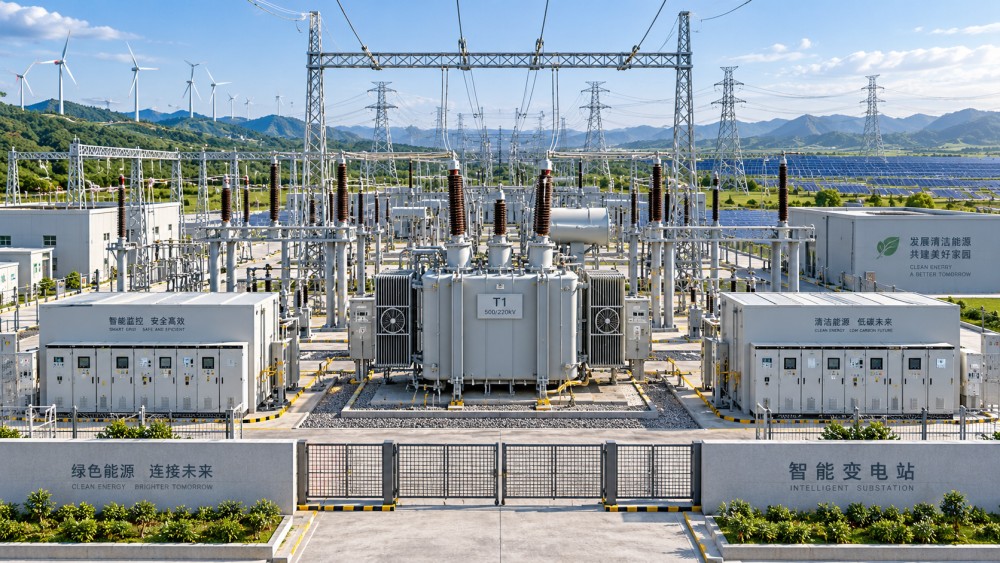
Transformer monitoring illustrates the difference between useful information and data accumulation. Oil temperature, winding hot-spot estimates, dissolved gas trends, bushing condition, cooling-system status, and tap changer operation each answer different questions. A short temperature rise can be acceptable during a managed overload if the thermal model, ambient conditions, cooling availability, and insulation ageing assumptions are understood. A gradual shift in gas patterns may require investigation even when loading remains ordinary. Combining these signals with loading history and maintenance records produces a more reliable maintenance decision than applying a single alarm threshold.
Renewable Collection Systems Need Coordinated Control, Not Just More Switching
Renewable-rich areas often show a mismatch between installed generation capacity and the grid's ability to absorb output during changing weather, low demand, or planned outages. The immediate symptom may be curtailment, but the underlying cause can be thermal congestion, insufficient reactive support, weak short-circuit strength, transient instability, or a protection setting that disconnects resources too readily during voltage disturbances.
Grid automation has high value here when it coordinates inverter-based generation, storage, transformers, capacitor banks, reactors, and network topology. Volt-var and volt-watt functions require settings that match feeder impedance and substation voltage limits. Identical settings applied across an electrically diverse network can cause simultaneous responses, voltage oscillation, or excessive reactive circulation. The control hierarchy also matters: local inverter controls must act quickly, while plant controllers and dispatch systems need clear authority boundaries to prevent conflicting commands.
Grid-forming battery energy storage can be valuable at weak connections because it can establish voltage and frequency reference behavior during islanded or low-strength conditions. That value should not be assumed from the battery's energy duration alone. Short-circuit contribution, current limits, control mode transitions, black-start sequencing, transformer vector groups, and auxiliary power availability all influence whether the system can support restoration or ride through disturbances as intended.
Storage deployed mainly for congestion relief needs a different operating strategy from storage deployed for frequency response. A battery reserved for a potential transmission overload must retain sufficient state of charge and discharge headroom when the constraint is likely to occur. If the same asset is continuously cycled for other services, it may be unavailable at the critical interval. Scheduling logic needs to account for forecast uncertainty, maintenance state, thermal derating, and the time required to return to a usable state of charge.
Urban Load Pockets Reward Faster Isolation and Flexible Capacity
Dense load areas create value through reliability and restoration speed rather than through maximum route length. Cable circuits, compact substations, underground networks, transport electrification, data-intensive facilities, and heating electrification can make local faults difficult to isolate and costly to repair. Space constraints also limit the ability to add traditional switchgear or new overhead lines.
Distribution automation is most useful where feeder segmentation, remotely operated switches, fault indicators, and accurate network models allow healthy sections to be restored without waiting for field switching. The network model must reflect normally open points, temporary ties, transformer ratings, cable limits, and protection coordination. Automatic restoration that transfers load onto a feeder already near its thermal limit can replace one outage with a larger problem.
In urban cable systems, temperature and installation conditions deserve close attention. Cable ampacity is affected by soil thermal resistivity, duct-bank configuration, burial depth, adjacent heat sources, circuit grouping, backfill quality, and seasonal moisture changes. Nameplate assumptions may not represent a congested route after adjacent utility work or redevelopment. Monitoring can improve confidence, but sensor placement should correspond to thermally limiting sections rather than convenient access points.
Flexible AC transmission devices, controllable transformers, and local storage can defer reinforcement when they address the actual constraint. They are less effective when a substation's bus arrangement, feeder exits, or civil footprint has become the bottleneck. A capacity study should distinguish between conductor loading, equipment short-circuit duty, voltage performance, protection reach, and physical access. These limitations are frequently grouped under “network capacity,” even though each leads to a different project scope.
Resilience Depends on Autonomous Behavior During Communication Loss
Extreme weather, wildfire, flooding, heat, and storm damage increase the value of automation only when local systems remain safe after communication paths degrade. Remote visibility is beneficial, but a design that requires continuous central coordination may fail at the moment it is most needed. Local protection and control should have defined fallback modes, with conservative limits and clear recovery logic after links return.
Microgrids and critical-load islands require more than a switch that separates them from the main network. Successful islanding depends on load priority, available generation, storage reserve, frequency response, voltage reference, protection sensitivity, and synchronization conditions before reconnection. A system that carries essential loads in steady islanded operation may still fail during the first seconds after separation if inverter controls, rotating equipment, and load-shedding relays respond on incompatible time scales.
Black-start capability has similar dependencies. Energy storage or generation equipment must energize auxiliary systems, establish a stable local reference, manage transformer inrush, and accept staged load without excessive voltage or frequency deviation. The restoration sequence should account for communications recovery, fuel or auxiliary supply, manual switching requirements, and the availability of a safe synchronization point. Declaring black-start capability without testing the sequence from de-energized conditions leaves major uncertainties unresolved.
Where Investment Choices Commonly Go Wrong
A frequent mistake is to judge transmission value by nominal voltage or route capacity alone. The usable transfer limit is often set by a contingency, voltage stability threshold, transformer loading, breaker duty, or an operational rule created because system state estimation is uncertain. Resolving the binding constraint may require a targeted control upgrade, a reactive-power project, or revised protection coordination before a major line expansion becomes necessary.
Another error is installing automation without establishing data ownership and model discipline. State estimation, contingency analysis, automated switching, and dispatch optimization all depend on accurate breaker status, transformer tap position, equipment ratings, outage records, and communications health. Incorrect topology data can create plausible but wrong control recommendations. Engineering change management must therefore cover the network model, protection settings, control logic, operator displays, and field-device configuration as one coordinated release.
- Alarm volume is often misread as visibility. A control room receiving thousands of unprioritized alarms during a fault has data but little operational clarity. Alarm design should identify first-out indications, suppress consequential events where appropriate, and retain the sequence needed for diagnosis.
- Speed without selectivity can increase damage. Faster tripping is valuable only when fault detection remains secure for external faults, transformer energization, load pickup, and communication anomalies.
- Interoperability is not proven by successful commissioning alone. Devices may exchange routine data correctly yet behave differently under time loss, redundant-network failover, firmware changes, or abnormal message load.
- Cybersecurity and availability must be engineered together. Access controls, segmentation, patch processes, and logging should preserve the ability to maintain equipment safely, including during restricted communications or emergency restoration.
Design Around the Binding Constraint
The most valuable grid automation and transmission programs begin with an operational question that can be tested: which limit prevents more reliable, lower-risk, or higher-capacity service at this interface? The answer should be traced through primary equipment, protection, controls, communications, operating procedures, and maintenance conditions. A corridor constrained by stability calls for different measures than one constrained by conductor temperature. A renewable connection limited by fault strength needs different reinforcement from one limited by energy absorption over several hours.
When the physical network and digital control layers are specified together, transmission assets can operate closer to their intended capability while retaining defensible margins for faults, weather, equipment outages, and restoration. That is where automation ceases to be an added monitoring layer and becomes part of the grid's usable operating capability.
Related News
- Global Energy Transition Report 2026 Projects $550 Billion in Grid InvestmentNov 08, 2026Ms. Elena Rodriguez
- Where grid automation and transmission solutions deliver the most valueOct 11, 2026Ms. Elena Rodriguez
- Steam Turbine Supplier Evaluation: 7 Critical Quality and Delivery Checks for Procurement TeamsSep 21, 2026Ms. Elena Rodriguez
- When do battery energy storage systems need fire suppression?Sep 04, 2026Ms. Elena Rodriguez