
Commercial Insights
Steam Turbine Supplier Evaluation: 7 Critical Quality and Delivery Checks for Procurement Teams
Ms. Elena Rodriguez
Time : Sep 21, 2026
steam turbine supplier evaluation made practical: 7 critical quality & delivery checks to avoid costly failures—download the procurement checklist now.
Steam Turbine Supplier Evaluation: What Procurement Teams Must Verify Before Commitment
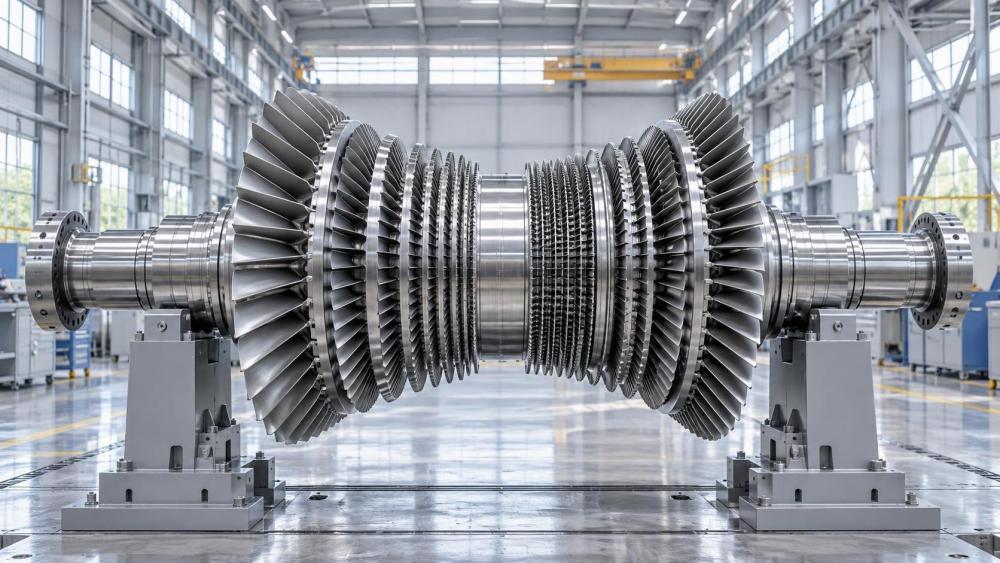
Procurement teams sourcing steam turbines face a high-stakes decision—not just in capital cost, but in long-term operational reliability, maintenance burden, and plant uptime. A single turbine failure in a combined-cycle power plant can trigger cascading downtime across multiple systems. In industrial cogeneration or district heating applications, delays or quality gaps may disrupt entire production lines or municipal services. Unlike commodity components, steam turbines operate under extreme thermal gradients, rotational stresses, and precision-balanced dynamics—making supplier capability inseparable from final performance.
This evaluation isn’t about comparing brochures. It’s about validating evidence: documented process controls, traceable material certifications, third-party verification of assembly integrity, and verifiable delivery discipline. Below are seven non-negotiable checks—each tied to real-world risk exposure—that procurement professionals should embed into RFQs, technical evaluations, and pre-award audits.
1. Material Traceability Back to Mill Certificates
Turbine rotor steel must withstand cyclic thermal loading over decades. ASTM A470/A470M specifies requirements for forged alloy steel rotors used in steam turbines. But specification compliance alone is insufficient. Procurement teams must require full traceability from forging lot number to mill certificate—including heat treatment records (time/temperature profiles), ultrasonic testing reports (ASTM E1419), and mechanical test results (tensile strength, impact toughness at operating temperature). Suppliers who batch-certify materials without lot-specific documentation introduce unquantifiable fatigue life uncertainty. A 2022 NIST study on rotating equipment failures found that 38% of premature rotor fractures were linked to undocumented heat treatment deviations—not design flaws.
2. Rotor Dynamic Balancing Certification per ISO 21940–21
Dynamic imbalance directly affects bearing life, vibration levels, and seal wear. ISO 21940–21 defines balance quality grades for rigid rotors; Grade G2.5 is typical for high-speed steam turbines. However, many suppliers issue internal balancing reports without independent verification. Procurement teams should insist on third-party certification—signed and stamped by an accredited lab—showing measured residual unbalance (in g·mm) at rated speed, with phase angle data. If the report lacks test speed, instrumentation calibration date, or environmental conditions (e.g., ambient temperature stability during measurement), it cannot be accepted as proof of compliance.
3. Final Assembly Cleanliness Verification (NAS 1638 Class 6 or Better)
Particulate contamination in oil passages or control valve bodies causes hydraulic sticking, erratic governor response, and accelerated wear. NAS 1638 Class 6 permits no more than 1,280 particles ≥4 µm per milliliter in hydraulic fluid. Yet final cleaning validation is often treated as a checklist item—not a quantified pass/fail metric. Require particle count reports taken *after* final assembly and *before* preservative oil application, using laser particle counters calibrated per ISO 21501–4. The report must specify sampling location (e.g., “main oil manifold outlet”), flow rate, and filtration method used during sampling.
4. Control System Integration Testing Documentation
Modern steam turbines integrate with DCS via analog I/O, Foundation Fieldbus, or OPC UA. But interface compatibility doesn’t guarantee functional safety. Procurement teams must review test protocols for:
- Fail-safe logic execution (e.g., trip signal propagation time ≤50 ms per IEC 61508 SIL-2 requirements);
- Redundant sensor voting consistency (e.g., three-pressure transmitters agreeing within ±0.5% span before actuation);
- Real-time response to simulated load rejection (≥100% step change, verified with oscilloscope capture).
Generic “system integration complete” statements hold no weight. Accept only timestamped video logs or oscilloscope screenshots embedded in formal FAT (Factory Acceptance Test) reports.
5. Delivery Timeline Adherence History—Not Just Promised Dates
A supplier’s quoted lead time means little without context. Request auditable delivery history for the past three turbine shipments of similar size and configuration—including original promised date, actual shipment date, and root cause for any delay (e.g., “forging vendor delay due to furnace outage,” not “supply chain issues”). Cross-check this against publicly filed export documents (e.g., U.S. AES filings or EU customs declarations) where available. Consistent slippage >15 days on critical path items—especially rotor forging or casing machining—signals systemic capacity or subcontractor dependency risks.
6. Spare Parts Availability Guarantee with Bill-of-Materials Mapping
Turbine spares aren’t generic. A single-stage LP blade set may have 12 unique airfoil profiles, each requiring proprietary tooling. Procurement teams must verify that spare part numbers map directly to the turbine’s serial-number-specific BOM—not a generic catalog. Ask for written confirmation that critical rotating parts (rotor blades, diaphragms, thrust bearings) are held in stock *or* that raw material is reserved in the supplier’s inventory system for guaranteed 90-day replenishment. Avoid blanket “spare parts available upon request” language—it carries zero enforceability.
7. Steam Path Geometry Verification Report
Blade profile accuracy, nozzle throat area, and axial clearance directly affect efficiency and flow capacity. ASME PTC 6 requires geometric verification for certified performance testing—but many suppliers skip this for standard units. Demand a coordinate measuring machine (CMM) report for at least one full-stage set, showing measured vs. nominal dimensions for:
- Blade chord length and thickness distribution;
- Nozzle vane exit angle (±0.3° tolerance typical);
- Radial tip clearance (verified at cold and hot simulated conditions).
Without this, efficiency guarantees become theoretical—not contractual.
Maintenance Readiness: A Hidden Supplier Differentiator
Procurement decisions often stop at commissioning—but the real cost emerges during maintenance cycles. Buyers should confirm whether the supplier provides:
- Disassembly sequence documentation validated on physical units—not just CAD simulations;
- Tooling kits with calibration certificates (e.g., hydraulic tensioning tools for rotor nut removal);
- On-site technical support availability within 72 hours for major outage events;
- Access to OEM diagnostic software for vibration analysis and blade resonance mapping.
These capabilities reduce outage duration by 20–35%, according to EPRI’s 2023 Turbine Maintenance Benchmarking Report—directly impacting levelized cost of electricity (LCOE) and production continuity.
Where Technical Rigor Meets Procurement Reality
None of these checks require exotic expertise—only disciplined verification. They shift focus from supplier reputation to demonstrable process control. A steam turbine supplier that publishes detailed, auditable evidence across all seven areas signals institutional maturity—not just manufacturing capability. Their product page, for instance, includes downloadable technical datasheets with referenced standards, material certifications, and test report excerpts—enabling early-stage due diligence before formal engagement.
But procurement teams must go further: embed these checks into contract clauses with measurable acceptance criteria—not as “nice-to-have” appendices. Tie 10–15% of payment to submission and approval of all required documentation *prior* to shipment. Require witness points for critical tests—not just sign-off after the fact.
Ultimately, steam turbine procurement isn’t about selecting hardware. It’s about selecting a partner whose processes you can audit, whose data you can verify, and whose commitments survive beyond the sales cycle. The turbine will run for 30+ years. The supplier’s discipline must last just as long.
Related News
- Global Energy Transition Report 2026 Projects $550 Billion in Grid InvestmentNov 08, 2026Ms. Elena Rodriguez
- Where grid automation and transmission solutions deliver the most valueOct 11, 2026Ms. Elena Rodriguez
- Steam Turbine Supplier Evaluation: 7 Critical Quality and Delivery Checks for Procurement TeamsSep 21, 2026Ms. Elena Rodriguez
- When do battery energy storage systems need fire suppression?Sep 04, 2026Ms. Elena Rodriguez
{item.title}
{item.publish_time}
{item.goods_category_9q0k9j8pjx}