
When do battery energy storage systems need fire suppression?
Battery energy storage systems are now part of the operating fabric of modern grids. They smooth renewable output, support frequency response, defer network upgrades, and provide reserves when conventional generation is unavailable. Yet for quality-control and safety managers, the most difficult question is often not whether a battery energy storage system presents a fire risk. It is when that risk requires a dedicated fire suppression strategy, and what evidence is needed to demonstrate that the chosen approach is defensible.
The answer is rarely a simple capacity threshold. Fire suppression needs for battery energy storage systems depend on the battery technology, the likelihood and consequences of thermal runaway, the physical arrangement of the installation, the enclosure’s ventilation and deflagration design, separation distances, occupancy, and the rules enforced by the authority having jurisdiction (AHJ). A small indoor battery room and a utility-scale outdoor container may use the same lithium-ion cell chemistry, yet face very different protection expectations.
For safety teams, the practical objective is clear: prevent a single-cell failure from becoming a propagating event, protect people and adjacent assets, and give emergency responders reliable information and workable access.
Fire suppression is not a substitute for battery safety
A useful starting point is to separate three layers of protection. The first is prevention: cell quality, battery management system (BMS) controls, electrical protection, thermal design, installation workmanship, and maintenance. The second is detection and containment: early warning, off-gas detection where appropriate, smoke and heat detection, isolation, ventilation, and compartmentalization. The third is mitigation: fire suppression, cooling, exposure protection, and emergency response measures.
Suppression belongs to the third layer. It should not be used to compensate for weak cell traceability, incomplete commissioning checks, inadequate clearances, or a BMS that has not been validated under abnormal conditions. In lithium-ion systems, a conventional extinguishing agent may control flames around a battery rack while still being unable to stop internal thermal runaway in every affected cell. Cooling, separation, and prevention of propagation can be as important as extinguishment itself.
This distinction matters during design review. A proposal that simply states “clean-agent suppression installed” does not, by itself, prove that the system manages the relevant hazards. Quality managers should ask what event the system is intended to address: an incipient electrical fire, a cabinet fire, a gas ignition event, a cell-level thermal runaway, or exposure from a neighboring unit. Each scenario calls for different performance assumptions.
Situations where dedicated suppression is typically expected
Local codes and project conditions determine the final requirement, but several situations consistently trigger closer scrutiny and often lead to a requirement for automatic fire protection.
Indoor or building-attached energy storage installations
Indoor battery energy storage systems generally receive the highest level of attention because smoke, toxic gases, heat, and flammable vapors can accumulate within a building. Occupants may be nearby, emergency access may be constrained, and a fire can threaten structural elements or adjacent operations.
For battery rooms, electrical rooms, parking structures, data centers, commercial premises, and manufacturing facilities, the building fire protection design normally needs to be reviewed together with the BESS design. Depending on the applicable code, this can include automatic sprinklers, water-based suppression, detection and alarm interfaces, fire-rated room construction, mechanical exhaust, emergency shutdown, and limits on battery quantity per fire area. A suppression decision cannot be separated from these building-level controls.
Where the BESS is installed in an occupied building, the question is usually not whether a risk assessment is needed; it is whether the proposed protection scheme satisfies the applicable fire code and the AHJ’s interpretation of the installation.
High-energy lithium-ion systems with propagation potential
Lithium-ion batteries have strong safety records when properly designed and managed, but their failure modes are distinctive. Mechanical damage, manufacturing defects, overcharge, external heating, internal short circuits, or control failures can initiate thermal runaway. The event may release hot gases and ignite combustible materials or gases outside the cell. In a tightly packed system, heat transfer can cause neighboring cells or modules to fail.
When testing or engineering analysis indicates that a thermal runaway event can propagate beyond the initiating unit, a dedicated mitigation strategy becomes essential. This may include water-based suppression or cooling, localized aerosol or clean-agent systems, rack-level protection, enclosure ventilation, explosion relief, and separation between units. The correct combination depends on the tested behavior of the actual battery system, not merely on the nominal chemistry printed in a data sheet.
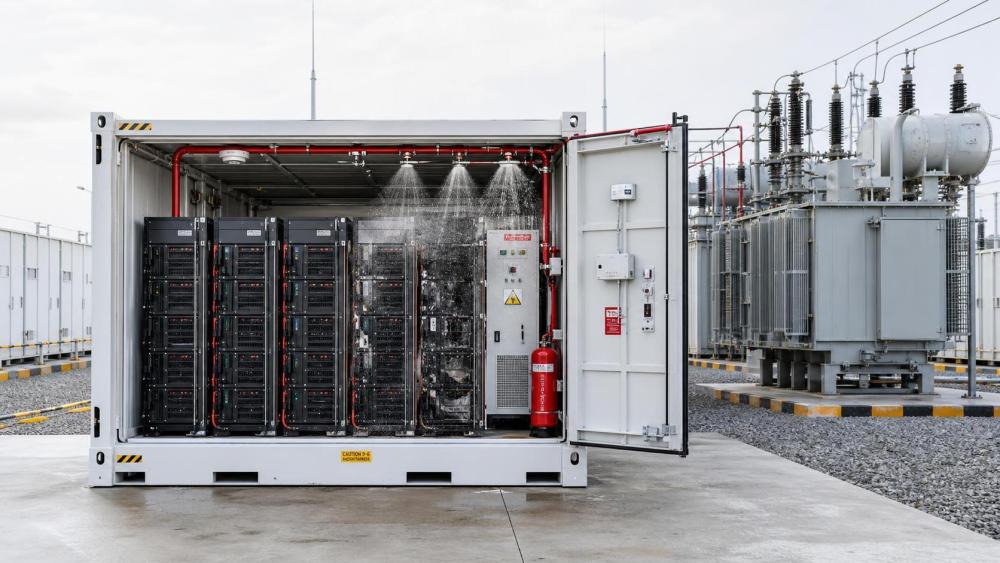
Containerized and cabinet-based installations near critical assets
Outdoor placement does not automatically remove the need for fire suppression. A containerized BESS located beside a substation control building, a transformer, a hospital, a data center, an industrial process line, or a public boundary can create an unacceptable exposure risk even when the units are outdoors.
In these cases, the design team must consider radiant heat, fire spread between containers, emergency vehicle access, wind direction, drainage, cable routes, and the potential loss of adjacent grid equipment. An outdoor system may rely on adequate spacing and passive separation in one location, while a tighter site may require active suppression, water supplies, remotely operated isolation, or a different layout altogether.
Sites with restricted emergency response capability
Remote renewable plants, islands, mines, ports, and industrial sites often have limited firefighting resources. A municipal brigade may be distant, unfamiliar with battery incidents, or unable to provide sustained water supply. This does not automatically mean that every BESS needs an onboard suppression system, but it changes the risk calculation.
Where response times are long, early detection, remote monitoring, controlled shutdown, robust compartmentation, and a clear plan for preventing fire spread become more important. The project’s emergency response plan should be realistic about who will arrive, what equipment they will have, how they will identify a developing event, and whether they can safely intervene.
Standards that shape the decision
For projects involving battery energy storage systems, compliance is built from a framework rather than a single certificate. In the United States, NFPA 855 is a central installation standard for stationary energy storage systems. It is commonly considered alongside the International Fire Code (IFC), the International Building Code (IBC), NFPA 70/NEC, and local amendments. Requirements can vary by occupancy, system size, battery technology, indoor or outdoor location, and whether the installation is in a dedicated energy storage space.
UL 9540 addresses the safety of the energy storage system and equipment as an integrated system. It should not be confused with a site fire protection approval. UL 9540A, meanwhile, is a test method used to evaluate thermal runaway fire propagation characteristics. Its results can inform decisions about separation, fire suppression, ventilation, gas management, and installation limits. UL 9540A is not a standalone product certification; it is evidence used by engineers, manufacturers, and AHJs to understand hazards under defined test conditions.
Other standards may be relevant depending on geography and project scope, including IEC standards, national electrical rules, insurer guidance, and fire brigade requirements. For example, IEC 62933 series documents may be relevant in grid-scale storage contexts, while local authorities may impose stricter provisions than the base standard. The key lesson is that “certified batteries” do not automatically mean “approved installation.”
What quality and safety managers should verify before approving a design
A disciplined review is more valuable than a generic checklist because every site has different constraints. Still, several questions should be answered and documented before procurement or commissioning.
- What battery system is actually being installed? Confirm cell chemistry, module and rack arrangement, nominal and maximum energy, enclosure type, and whether the supplied configuration matches the configuration represented in test reports.
- What is the credible failure scenario? Identify initiating faults, expected gas release, flame behavior, propagation pathways, and the consequences for nearby equipment and people.
- What evidence supports the protection concept? Review system listings, relevant thermal runaway test data, manufacturer installation instructions, fire engineering analysis, and AHJ correspondence.
- Is the suppression agent appropriate for the hazard? Verify what it can and cannot achieve. Some agents may suppress visible flames but provide limited cooling. Water-based systems may offer strong cooling benefits but require suitable drainage, water supply, electrical coordination, and runoff planning.
- How will the system detect an abnormal condition? Detection may include BMS alarms, smoke detection, heat detection, gas sensing, or a combination. Alarm logic, false-alarm management, and links to site control systems should be tested.
- Can the installation be isolated safely? Emergency stop controls, DC isolation, AC disconnection, communications loss behavior, and remote shutdown must be clear to operators and responders.
- Will responders understand the site? Provide signage, site plans, hazard labels, access routes, contact information, and a response plan developed with the local fire service where possible.
Choosing between water, clean agents, aerosols, and passive controls
No single technology is universally “best” for BESS fire protection. Water sprinkler or deluge systems can cool exposed batteries and surrounding structures, helping limit propagation and protect adjacent assets. Their design must account for water demand, electrical equipment, drainage, contamination concerns, freezing conditions, and the possibility of extended application.
Clean agents can be suitable for certain enclosed hazards and may reduce damage to sensitive equipment, but their ability to arrest battery thermal runaway must not be assumed. Similarly, condensed aerosol systems can be effective for specific fire scenarios, yet their suitability depends on enclosure integrity, agent distribution, equipment compatibility, and the expected battery failure mode.
Passive measures often carry equal weight. These include fire-rated barriers, spatial separation, noncombustible construction, pressure relief provisions, thermal barriers, cable fire stopping, and container placement that prevents one unit from exposing another. The strongest designs combine passive features with active detection and response rather than placing all confidence in one suppression device.
Common compliance mistakes that create avoidable risk
One recurring mistake is treating a BESS enclosure as a black box. A container may arrive with alarms, HVAC equipment, and an internal suppression package, but the site designer still needs to verify its external clearances, foundation arrangement, cable penetrations, emergency access, and relationship to surrounding equipment. Factory integration does not remove site-level obligations.
Another is using generic test evidence for a different configuration. Changes in cell supplier, module design, rack spacing, state-of-charge limits, enclosure volume, or ventilation arrangement can alter the relevance of thermal runaway test results. Change control is therefore a safety function, not just a procurement function.
Teams also sometimes focus on extinguishment while overlooking flammable gas management. A thermal event can create deflagration concerns before or during visible fire. Detection, ventilation, pressure relief, ignition-source control, and enclosure design must be evaluated together by qualified specialists.
Finally, a commissioned system is not automatically a maintained system. Detection devices need functional testing, suppression cylinders or water systems need inspection, BMS event logs should be reviewed, and replacement battery modules must be controlled. The quality record should show that field modifications have not invalidated the original safety basis.
A defensible decision process
Battery energy storage systems need fire suppression when the applicable code requires it, when the AHJ directs it, or when risk analysis shows that passive measures and early isolation alone cannot adequately protect people, property, and continuity of service. Indoor installations, high-energy lithium-ion arrays with credible propagation risk, tightly spaced container deployments, and sites with limited emergency response are especially likely to require a formal active-protection solution.
For grid operators and equipment owners, the goal should not be to install the most visible suppression technology. It is to establish a layered, test-supported safety case that remains valid from factory acceptance through installation, operation, expansion, and end of life. In a power system moving toward deeper electrification, that discipline protects more than an asset: it protects the reliability of the grid services the asset was built to provide.
Related News
- When do battery energy storage systems need fire suppression?Sep 04, 2026Ms. Elena Rodriguez
- RCEP 3.0 Upgrade Talks Begin with Green & AI Supply Chain ClausesMay 25, 2026Ms. Elena Rodriguez
- 2026 Asia Wood Construction Expo Opens in GuangzhouMay 15, 2026Ms. Elena Rodriguez
- Power equipment procurement mistakes that raise lifetime costMay 07, 2026Ms. Elena Rodriguez