
Evaluating Industrial Generator Runtime Against Load Profiles
A generator can have enough fuel for an outage and still fail to support the required load. A motor start may cause an unacceptable voltage dip, a hot equipment room may reduce available output, or a refueling plan may assume the set can be shut down when the facility cannot tolerate an interruption. Runtime is therefore not a single figure: it is the period for which the complete system can deliver the required power under defined site and operating conditions.
For project managers, the assessment begins with a time-based load profile rather than the total connected equipment rating. The profile determines how much power is needed, when it is needed, and how fuel consumption changes throughout the operating cycle. The resulting schedule must then be checked against the generator’s rating, transient response, fuel supply and maintenance requirements.
Build a load profile that reflects the operating sequence
Start with a load register covering the equipment expected to run during each operating mode. Record running kilowatts, power factor, starting method, expected duty cycle and whether each load is essential. Include generator auxiliaries and site services that may be overlooked, such as ventilation, fuel transfer pumps, battery chargers and control systems. Establish whether these loads are already included in a vendor’s stated output or must be added separately.
Convert the register into a timeline. An emergency sequence may begin with controls and lighting, followed by selected pumps, then cooling equipment once the system has stabilized. A construction site may have a different pattern: welding equipment, compressors and temporary lighting can operate intermittently, with the highest demand occurring for relatively short periods. The maximum simultaneous demand is usually more useful for sizing than the sum of every nameplate rating, but the assumptions behind simultaneity need to be documented.
Keep three views of the profile: sustained demand, short-duration peak demand and expected energy use over the required operating period. Sustained demand helps establish the applicable generator rating; peaks and starting events drive transient checks; energy use informs fuel planning. A profile that captures only average load can conceal a starting problem, while one based solely on the largest peak can exaggerate fuel use.
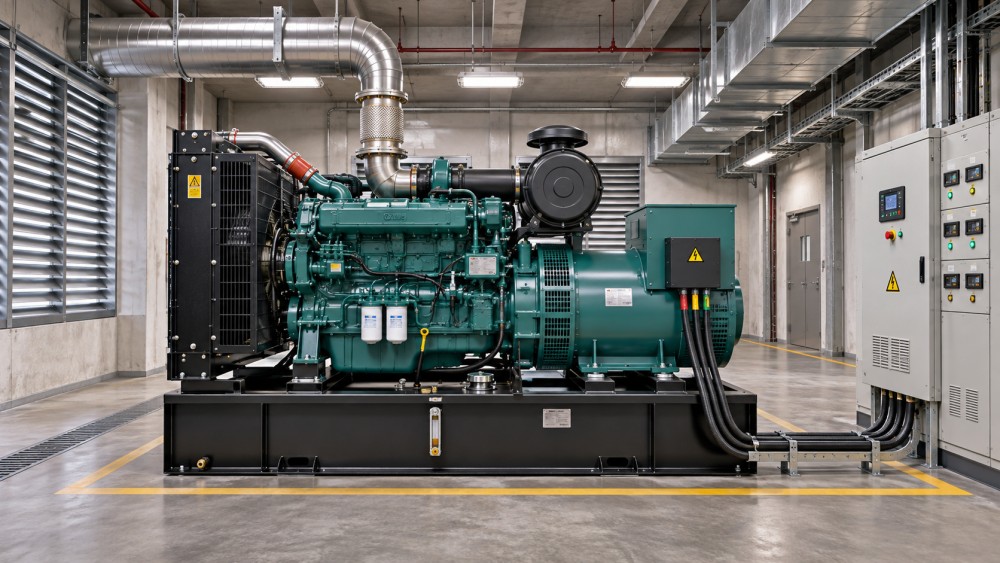
Match the rating to the duty, not just the peak
When comparing an industrial generator set with alternatives, request the output rating together with its declared duty category, operating limits and reference conditions. Standby, prime and continuous ratings are intended for different patterns of operation; their permitted loading and running hours must be confirmed against the applicable rating definition and the manufacturer’s documentation. ISO 8528-1 addresses the application, ratings and performance of reciprocating engine-driven alternating current generating sets; its scope should be checked before applying it to another generator technology. [1]
A set selected for infrequent emergency operation should not automatically be treated as suitable for extended, repeated use at the same output. Conversely, a rating intended for sustained operation may carry different cost and equipment implications. The procurement specification should describe the expected annual operating pattern, outage duration, load variation and any parallel operation so bidders can identify the rating they are offering.
Compare both real power, expressed in kilowatts, and apparent power, expressed in kilovolt-amperes. The relationship depends on power factor: kW equals kVA multiplied by power factor. A load can remain within the engine’s real-power capability while exceeding the alternator’s apparent-power or current capability. Harmonics, phase imbalance and the behavior of large electronic loads can introduce further constraints, so a single nameplate number is not a complete electrical design check.
Oversizing also deserves scrutiny. An oversized set may spend long periods at light load, where fuel use per unit of electricity produced can be less favorable. For diesel engines, the manufacturer should also assess whether the proposed low-load duty requires load management or other operating measures. A smaller set, however, must not be chosen on fuel economy alone if it cannot handle the starting sequence or future essential loads.
Account for temperature, altitude and the installed environment
Ambient temperature and altitude can change the output available from an engine, alternator or cooling system. Hotter intake air and reduced air density at altitude can affect engine performance; high ambient conditions can also limit heat rejection. The correction is equipment-specific. Ask the supplier for a site-rated output or documented derating calculation rather than applying a generic percentage. ISO 3046-1 covers declarations of power, fuel and lubricating oil consumption and test methods for reciprocating internal combustion engines. [2]
The relevant temperature is not necessarily the weather-station reading. For an enclosed installation, consider the air temperature at the engine and radiator inlets, solar exposure, exhaust heat, recirculation and restricted airflow. A rooftop installation may see different conditions from a ventilated plant room. Dust, humidity and corrosive surroundings can influence filtration, maintenance and equipment selection, even where they do not translate into a simple nameplate derating.
Use a consistent set of site assumptions across bids: elevation, design ambient temperature, enclosure arrangement, air inlet and discharge restrictions, and exhaust configuration. Then compare the corrected output with the sustained profile and any applicable overload provisions. A vendor’s rating should not be combined with another vendor’s correction factors unless the responsible manufacturers accept that method.
Calculate runtime from load intervals and usable fuel
Runtime estimates should use the manufacturer’s fuel-consumption data for the selected equipment and rating, corrected or qualified for the proposed operating conditions where appropriate. Divide the expected outage into intervals with a representative load for each. For each interval, multiply the expected fuel consumption rate by its duration; add the results, then account for start-up, testing and any fuel required by associated equipment where applicable.
For illustration only, suppose a project’s preliminary profile contains four hours at a consumption rate of 80 liters per hour and six hours at 50 liters per hour. The modeled generator fuel use is 620 liters. If the documented usable fuel is 800 liters, the difference is 180 liters before allowances for uncertainty, testing or other fuel users. These figures are arithmetic assumptions, not equipment performance claims. They show why dividing tank capacity by a single fuel rate may misrepresent a changing load.
Usable fuel is not necessarily the tank’s nominal capacity. The available quantity depends on the tank geometry, pickup arrangement, low-level operating limit, transfer controls and the fuel that must remain inaccessible for reliable operation. For gaseous fuel, the equivalent question is whether the supply system can maintain the required flow and pressure throughout the event; a liquid-tank calculation is not directly interchangeable with a gas-supply assessment.
Where the outage duration is uncertain, prepare at least a base profile and a more demanding scenario. The latter might include longer operation of cooling equipment, slower load shedding or a delayed fuel delivery. Treat contingency as an explicit project decision: identify the assumption it covers, its quantity and who approves it. This makes it easier to revise the fuel requirement when the load schedule changes.
Check starts, load steps and operating transitions
Motor starting can impose a brief demand well above the motor’s running requirement. The outcome depends on the motor, starting method, mechanical load, generator characteristics and the other equipment already connected. Request a transient analysis or manufacturer review for the largest credible starting event, including the permissible voltage and frequency deviations for sensitive equipment. Starting several motors in sequence may be more practical than increasing generator size solely to accommodate simultaneous starts, provided the process can tolerate the delay.
Large block-load additions and removals also deserve review. A generator that carries the steady load may still struggle to keep voltage or frequency within the limits required by controls, variable-speed drives or other connected devices during a transition. Coordinate any proposed load-shedding logic with the process owner: a theoretically shedable load may support a safety function or be necessary for a controlled shutdown.
If multiple sets operate in parallel, runtime is affected by the control strategy. Running several machines at low load may consume more fuel than concentrating demand on fewer machines, but removing a unit can reduce reserve capacity. Establish the required redundancy, the load at which units start or stop, and the consequences of a failure during transfer. Verify these sequences as part of commissioning rather than assuming the controller’s default settings match the project’s operating plan.
Turn the calculation into procurement and acceptance requirements
A useful purchase specification gives bidders the same load profile and asks them to state their assumptions. It should identify the required rating and site conditions, starting sequence, fuel type, operating duration and any constraints on noise, space or access. Request a load acceptance assessment, site-corrected output, fuel-consumption curve or table, and maintenance intervals for the proposed duty. Where values are estimated, distinguish them from guaranteed figures and define the conditions under which guarantees apply.
For fuel systems, identify the boundary of each supplier’s responsibility: storage, transfer pumps, controls, pipework and any external delivery arrangements. A generator package may meet its own consumption figure while the complete system lacks adequate transfer capacity or a practical way to replenish fuel during an extended event. Also check that maintenance access and service intervals are compatible with the intended duration of uninterrupted operation.
Acceptance criteria should connect back to the design assumptions. Agree in advance on the test load, duration, measurement points, fuel-measurement method and allowable tolerances. A load-bank test can help demonstrate behavior at defined loads, but it does not by itself reproduce every actual motor start, site temperature or fuel-delivery constraint. Field commissioning should also verify the automatic start, transfer, alarms, load sequence and shutdown arrangements applicable to the installation.
For emergency and standby systems, applicable legal requirements depend on jurisdiction and system classification. In the United States, NFPA 110 addresses performance requirements for emergency and standby power systems within its stated scope; the adopted edition and local authority’s requirements must be established for the project. [3] Electrical and fuel-system safety decisions should be reviewed by the responsible qualified designers and authorities, not inferred from a runtime calculation.
The final runtime figure should be issued with its supporting profile, site conditions, usable-fuel basis and operating restrictions. When any of those inputs changes, revisit the calculation before treating the original result as a reliable basis for procurement or an outage plan.
Sources
- [1] International Organization for Standardization, ISO 8528-1, Reciprocating internal combustion engine driven alternating current generating sets — Part 1: Application, ratings and performance.
- [2] International Organization for Standardization, ISO 3046-1, Reciprocating internal combustion engines — Performance — Part 1: Declarations of power, fuel and lubricating oil consumptions, and test methods.
- [3] National Fire Protection Association, NFPA 110, Standard for Emergency and Standby Power Systems.
Related News
- Evaluating Industrial Generator Runtime Against Load ProfilesNov 23, 2026Ms. Elena Rodriguez
- Global Energy Transition Report 2026 Projects $550 Billion in Grid InvestmentNov 08, 2026Ms. Elena Rodriguez
- Where grid automation and transmission solutions deliver the most valueOct 11, 2026Ms. Elena Rodriguez
- Steam Turbine Supplier Evaluation: 7 Critical Quality and Delivery Checks for Procurement TeamsSep 21, 2026Ms. Elena Rodriguez