
US April Jobs Data Boosts HVDC Valve Export Outlook
U.S. nonfarm payroll data released on May 10, 2026 revealed stronger-than-expected labor market strength—particularly in construction—driving renewed demand for high-voltage direct current (HVDC) converter valves used in AI infrastructure power systems.
Event Overview
The U.S. Bureau of Labor Statistics reported 115,000 net new nonfarm jobs in April 2026. Construction employment rose for the second consecutive month, with data center projects explicitly cited as a key growth driver. No further breakdown of project types, regional distribution, or contractor affiliations was provided in the official release.
Industries Affected
Direct Export Enterprises
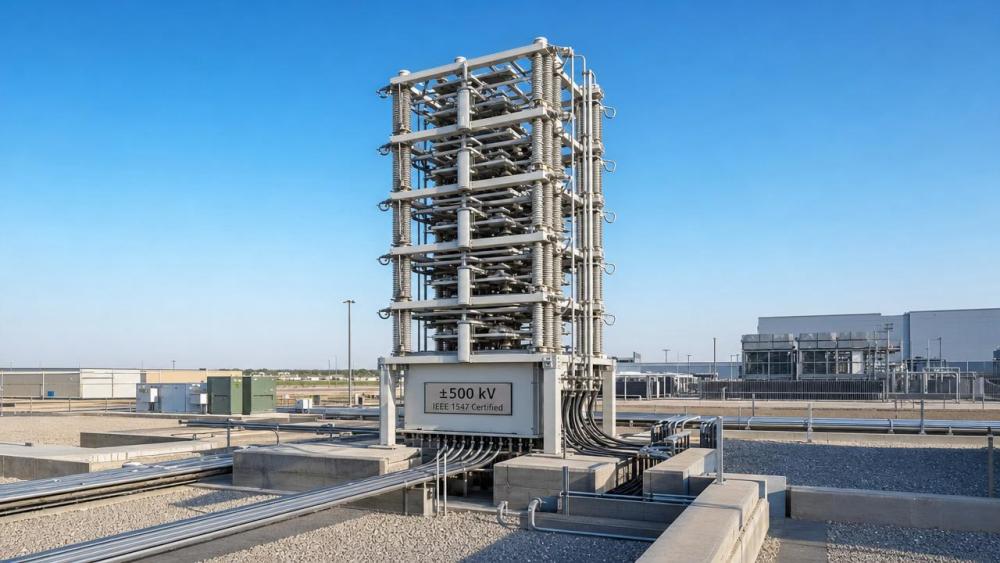
Chinese manufacturers exporting ±500 kV HVDC converter valves to U.S.-based EPC contractors and grid operators face rising near-term order visibility. Impact manifests primarily in tender activity acceleration—not yet confirmed contract awards—and heightened inquiry volume from U.S. procurement teams ahead of Q3 2026 bidding cycles.
Raw Material Procurement Firms
Suppliers of IGBT modules, saturated reactors, and optical trigger units may see modest upstream demand signals beginning in late Q2, though no inventory build-up or price movement has been reported to date. The linkage remains indirect: material demand depends on final equipment orders, not construction hiring trends alone.
Manufacturing & Assembly Facilities
Domestic HVDC valve production lines—especially those certified to IEEE 1547 and ANSI C2-2023 standards—could face tighter capacity utilization starting Q3 if export forecasts hold. Lead time pressure is not yet observed, but quality assurance and export documentation throughput are emerging operational priorities.
Supply Chain & Logistics Service Providers
Certified freight forwarders handling oversized HVDC equipment shipments (e.g., valve towers exceeding 8 m in height) report increased pre-booking inquiries for trans-Pacific routes. Customs classification clarity around HVDC components under HTS code 8543.70 remains critical; misclassification risks have not increased but warrant proactive review.
Key Considerations and Recommended Actions
Monitor Tender Timelines, Not Just Headcount Data
Construction hiring momentum alone does not guarantee HVDC system procurement. Firms should track specific RFPs issued by entities such as the U.S. Department of Energy’s AI Infrastructure Program and private-sector developers like CoreWeave or StackPath—not aggregate labor statistics.
Validate Certification Alignment Early
U.S. grid interconnection requirements for ±500 kV HVDC systems increasingly reference IEEE Std 1159-2020 (power quality) and NERC PRC-024-4 (protection coordination). Exporters should confirm third-party test reports align before engaging in technical bid submissions.
Assess Capacity Buffer Against Q3 Forecast
A 25%+ sequential order increase projection assumes stable supply of qualified personnel and imported core components. Manufacturers should stress-test production plans against potential delays in IGBT wafer deliveries or thermal interface material certifications.
Editorial Perspective / Industry Observation
Observably, the correlation between construction employment and HVDC valve demand reflects infrastructure layering—not direct causation. Data centers require robust AC distribution first; HVDC adoption follows only where ultra-high density, multi-megawatt AI racks justify the capital and complexity premium. Analysis shows that this trend remains concentrated among Tier-1 hyperscalers and federal AI compute initiatives—not broad commercial real estate development. From an industry perspective, the April jobs report serves more as a leading indicator of funding execution velocity than a standalone demand catalyst.
Conclusion
This labor data point does not signal an immediate inflection in global HVDC trade flows—but it does reinforce a structural shift: AI-driven power infrastructure is becoming a measurable, bankable segment within U.S. electrical construction. For exporters, the implication is not urgency, but strategic calibration—aligning technical readiness, certification coverage, and logistics capability with the pace of actual project deployment—not headline metrics.
Source Attribution
Primary source: U.S. Bureau of Labor Statistics, Employment Situation Summary, May 10, 2026 (https://www.bls.gov/news.release/empsit.nr0.htm). Additional context drawn from publicly disclosed RFPs issued by the U.S. General Services Administration (GSA) and DOE’s Office of Science (May 2026). Note: Tender award status, final HVDC system specifications, and export license approvals remain pending and subject to ongoing monitoring.
Related News
- IEC TC115 Releases New HVDC Valve Testing Guide with Mandatory Wideband Harmonic & AI Prediction InterfaceMay 17, 2026High-Voltage Grid Architect
- US April Jobs Data Boosts HVDC Valve DemandMay 16, 2026High-Voltage Grid Architect
- China-Europe Railway Express Surpasses 130,000 TrainsMay 16, 2026High-Voltage Grid Architect
- US April Jobs Data Boosts HVDC Valve Export OutlookMay 15, 2026High-Voltage Grid Architect