
What technical tests verify black start capability?
What Technical Tests Verify Black Start Capability?
Verifying black start capability requires more than confirming that a standby generator can energize a dead bus. A credible demonstration must show that an isolated source can start without external supply, establish stable voltage and frequency, energize selected network assets without unacceptable transients, accept restoration load in the intended order, and coordinate safely with protection and control systems.
For project managers, this distinction matters. A black start scheme may look complete in a single-line diagram yet fail during commissioning because of transformer inrush, insufficient auxiliary power, an unavailable communication path, incorrectly coordinated protection, or battery controls that were designed for grid-connected operation rather than islanded operation. The test programme therefore needs to validate the restoration sequence as a system, not merely the capability of individual assets.
The precise evidence required depends on the grid code, system operator rules, plant technology, and local safety requirements. In some markets, restoration providers must follow formal periodic testing obligations; elsewhere, acceptance criteria are mainly defined in the project specification and operating procedures. The technical principles, however, remain largely consistent.
Start with a testable definition of success
A black start test should be based on a documented restoration boundary. Teams need to agree which source starts first, what auxiliaries it must supply, which bus is energized, which transformer or line is picked up, what critical loads are restored, and where the test ends. Without that boundary, a successful “generator start” can be mistaken for a successful restoration capability.
Acceptance criteria should be expressed in operational terms: start availability, time to establish an energized bus, voltage and frequency limits during load steps, allowable switching transients, protection behavior, communications availability, and the ability to maintain a stable island. Exact thresholds should come from approved engineering studies, equipment limits, and applicable operating requirements—not from generic assumptions copied between projects.
The test plan should also identify credible failure conditions. If the primary cranking battery is unavailable, can a redundant path start the unit? If a station service transformer is energized, does the source retain sufficient voltage margin? If the intended telecom route is down after a widespread event, can local control safely continue? These are not peripheral questions; they determine whether a black start resource is usable when the grid is actually dark.
1. Starting-source and auxiliary power tests
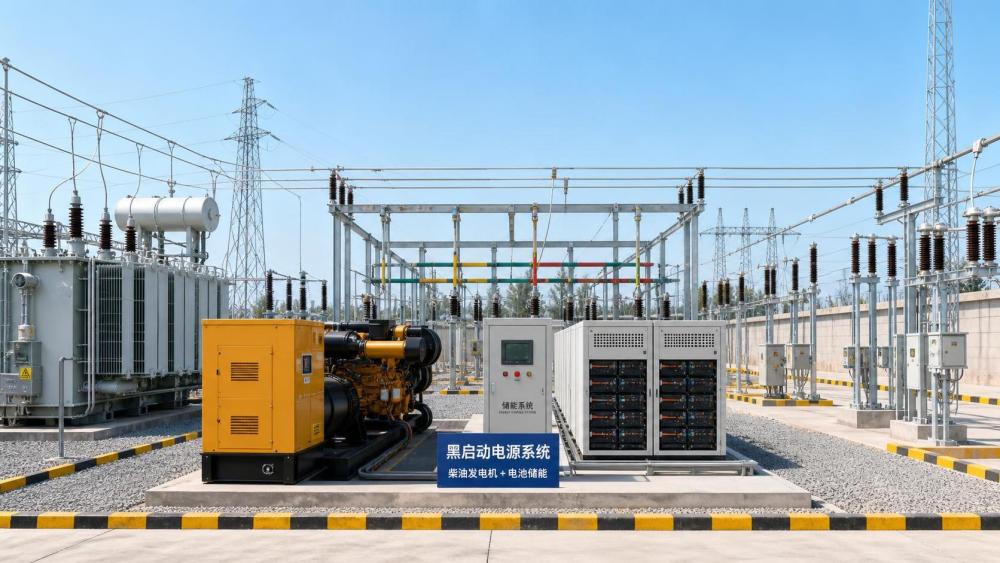
The first technical proof is that the designated source can start independently of the transmission system. For a diesel generator, gas turbine, hydro unit, or combined-cycle plant, this normally includes testing the starting medium, DC battery systems, chargers, fuel supply, lubrication systems, cooling, control power, and essential plant auxiliaries. A unit that can start only after normal station service is restored is not a black start source.
The test should be performed with the expected external AC supplies unavailable or isolated under an approved procedure. Operators need evidence that the emergency or dedicated auxiliary arrangement can carry the actual starting sequence, not only a no-load indication from a control panel. Fuel transfer pumps, ventilation, hydraulic systems, excitation equipment, inverter supplies, and turbine turning gear can each create hidden dependencies.
For battery energy storage systems, the equivalent question is whether the BESS can energize its own controls, cooling, fire-safety interfaces, auxiliary transformers, and power conversion equipment from its available DC energy after a complete loss of grid voltage. State of charge alone is not enough. The usable energy window, auxiliary consumption, thermal operating conditions, and any start-up restrictions imposed by the battery management system need to be understood and tested.
2. No-load voltage, frequency, and grid-forming tests
Once the source is running, it must establish a stable electrical reference. Conventional generators are tested for voltage build-up, excitation response, governor control, frequency stability, and sustained operation at no load. The objective is not simply to reach nominal values, but to demonstrate controllability before network equipment is connected.
For grid-forming BESS, this stage deserves particular attention. The inverter must establish voltage and frequency in islanded mode, maintain a defined reference without an external grid, and behave predictably when load is applied or removed. Test engineers commonly verify transitions into grid-forming operation, active and reactive power limits, current limiting behavior, droop or virtual-machine settings where used, and recovery after disturbances. The tested settings must match the approved restoration philosophy; a BESS configured mainly for grid-following frequency response may not provide the required black start function.
Data capture matters here. High-resolution records from protection relays, plant controllers, disturbance recorders, and BESS controls can show whether a transient was within acceptable equipment duty and whether control interactions were well damped. A control-room trend alone rarely provides enough evidence for diagnosing a marginal response.
3. Load acceptance and load-rejection testing
A black start source must do more than energize an empty bus. It must accept realistic restoration loads in manageable steps. Tests generally begin with small, known loads and progress toward the critical auxiliary and customer loads identified in the restoration plan. Engineers observe voltage dip, frequency excursion, recovery time, reactive power demand, harmonic behavior where power electronics are involved, and the response of governors, automatic voltage regulators, or inverter controls.
Motor starting is often underestimated. Large pumps, compressors, fans, and drives can create an inrush or acceleration demand that is harmless on a strong interconnected grid but severe inside a small restoration island. The test programme should verify the actual starting method—direct-on-line, soft starter, variable-speed drive, or sequenced start—and confirm that the source remains stable. If studies prescribe staggered loading, the control logic and operator procedure must enforce that sequence.
Load rejection is equally revealing. A breaker trip or sudden loss of auxiliary demand can cause overspeed in rotating machinery or DC-link and voltage-control stress in inverter-based resources. Testing controlled and, where appropriate, credible unplanned load loss helps establish whether the island can survive disturbances while restoration is still incomplete.
4. Transformer energization and network charging tests
Energizing transformers and transmission circuits is among the most consequential black start actions. Transformer magnetizing inrush can depress voltage, trigger differential protection if restraint is not coordinated correctly, or destabilize a weak source. Long cables and overhead lines can introduce charging reactive power, while lightly loaded networks may experience overvoltage. UHV and high-voltage restoration paths require particularly careful study because the switching event can involve substantial stored energy and complex insulation coordination considerations.
Testing may use staged energization, temporary network configurations, or validated simulation where full live testing would create disproportionate operational risk. The important point is traceability: the actual switching order, transformer tap position, pre-insertion or controlled-switching arrangement if applicable, shunt reactor status, and source operating mode must match the conditions assessed by the studies.
A sound commissioning record links field measurements to transient, load-flow, short-circuit, and dynamic studies. If the field event differs materially from the model, the discrepancy should be investigated rather than explained away as normal test variation. Black start plans become unreliable when restoration assumptions are never reconciled with installed equipment settings.
5. Protection, interlocking, and control-logic verification
Protection systems must remain selective when fault levels, power direction, and voltage conditions differ sharply from normal grid-connected operation. Conventional overcurrent settings may be less sensitive in an island supplied by a limited-capacity generator or inverter. Directional elements, underfrequency and undervoltage functions, out-of-step logic, transformer differential protection, breaker-failure schemes, and automatic reclosing all require review against the restoration topology.
This verification usually combines relay secondary-injection tests, end-to-end testing for communications-assisted schemes, logic simulation, and functional tests of real trip and block signals. IEC 60255 series requirements are often relevant to protection equipment testing, but the project team must use the specific editions and utility requirements referenced in the contract. It is not sufficient to confirm that every relay works individually; the test needs to prove that the intended scheme works when the system is weak, islanded, and being reconfigured.
Interlocks deserve the same discipline. A permissive intended to prevent unsafe paralleling can inadvertently block a necessary restoration step. Conversely, a bypass introduced for commissioning can remain available after handover. Every temporary setting, bypass, forced point, and altered logic path should be recorded, independently checked, and returned to its approved operational state.
6. Synchronization and island-to-grid restoration tests
Black start capability is incomplete if the restored island cannot be safely connected to the wider network. Synchronizing tests verify voltage magnitude, frequency, phase angle, phase sequence, synchronism-check logic, breaker closing controls, and operator or automatic synchronizer actions. The source must have sufficient control range to match the receiving system without creating unacceptable power swings after closure.
Where multiple islands or resources are expected to merge, the restoration plan should test the communications, dispatch authority, and control responsibility required before tie closure. A technically correct synchronizer cannot resolve conflicting setpoints issued from separate control centers. Smart dispatching systems are therefore part of the black start chain, especially where generation, storage, flexible demand, and transmission switching are coordinated across a broad area.
7. End-to-end operational drills provide the final proof
The strongest evidence comes from an integrated drill that follows the approved restoration procedure from loss of supply to a defined restoration milestone. It does not always need to reproduce a full-system blackout. A carefully bounded live test, supported by real-time simulation or offline studies, can validate the interfaces that matter: field operators, control rooms, generators, BESS controllers, substation automation, protection, telecoms, and switching authority.
Project leaders should treat timing as diagnostic evidence rather than a public performance number. Delays reveal where procedures are unclear, where alarms are poorly prioritized, or where an asset depends on a manual intervention that was not recognized during design. Debriefs should distinguish technical defects from procedural weaknesses; both can prevent successful restoration.
At Global Power Grid Dynamics, black start is best understood at the intersection of heavy generation, UHV equipment, smart control architecture, and high-power storage. The restoration challenge is increasingly shaped by inverter behavior, complex power flows, and the need to rebuild resilient islands before reconnecting them to a larger grid.
Before accepting a scheme, ask for the full evidence trail: approved studies, settings files, test procedures, disturbance records, operator checklists, defect close-out records, and a clear retest strategy after material changes. That discipline turns black start from a claimed equipment feature into a demonstrated capability that can be relied upon under real outage conditions.
Related News
- What technical tests verify black start capability?Sep 04, 2026Dr. Alistair Vaughn
- Which power electronics ratings matter in industrial power conversion?Sep 02, 2026Dr. Alistair Vaughn
- SAMR Releases 2026 Standard Revision List, Accelerating 12 Mandatory GBs for EV Battery RecyclingMay 14, 2026Dr. Alistair Vaughn
- Black start capability is back in focus as grids decentralizeMay 07, 2026Dr. Alistair Vaughn