
Vietnam Tightens PCS Inverter Entry Rules
On June 2, 2026, Vietnam’s Ministry of Industry and Trade (MOIT) issued Circular No. 28/2026/TT-BCT, introducing new compliance conditions for imported grid-connected PCS inverters, including hybrid solar-storage units. From September 1, 2026, affected products must carry a Vietnamese-language energy efficiency label and complete filing for at least one after-sales service center located in Vietnam. For PCS manufacturers, importers, distributors, and service partners, this is worth close attention because non-compliant products may be denied customs entry or ordered for recall, making market access more dependent on localized compliance and service arrangements.
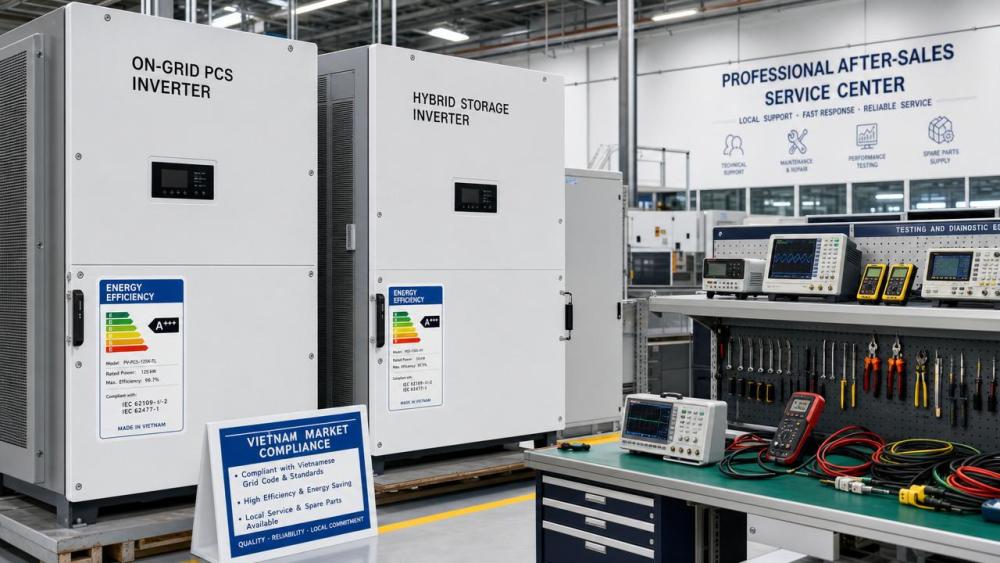
What the new Vietnam rule specifically requires
According to the information provided, MOIT released Circular No. 28/2026/TT-BCT on June 2, 2026.
The rule will take effect on September 1, 2026, and applies to all imported grid-connected PCS inverters, including integrated solar-plus-storage units.
The confirmed requirements include:
- Products must carry a Vietnamese-language energy efficiency rating label.
- The labeling requirement is based on TCVN 12345:2025.
- At least one after-sales service center located in Vietnam must be designated and filed on record.
- The service center must have qualifications equivalent to CNAS.
- Products that do not comply may be refused entry by customs or ordered to be recalled.
The information provided also states that this requirement significantly raises the localization threshold for Chinese PCS suppliers seeking to enter Vietnam’s distribution channels.
Where the impact is likely to be felt first
Import and distribution channels face a stricter gatekeeping stage
From an industry perspective, direct importers and local distributors are likely to feel the impact earliest because customs clearance and channel entry now depend not only on product shipment, but also on labeling readiness and local service filing. What deserves closer attention is that the compliance burden is no longer limited to product documentation; it also extends to operational presence inside Vietnam.
Manufacturers must connect product compliance with service localization
Analysis shows that PCS manufacturers, especially exporters serving Vietnam through distribution partners, may need to treat labeling and after-sales readiness as linked market-entry conditions rather than separate tasks. The business impact is likely to show up in product preparation, partner selection, shipment scheduling, and coordination with local representatives.
After-sales service providers become part of market access
Observably, service providers in Vietnam are no longer only post-sale support participants under this rule. Because at least one locally filed service center with CNAS-equivalent qualifications is required, after-sales capability becomes part of the compliance path itself. This could affect how suppliers structure their local support networks before goods are shipped.
Procurement and project-facing buyers may pay closer attention to execution risk
For procurement teams and downstream buyers, the main concern is likely to be continuity of supply and delivery certainty. If products fail to meet the new conditions, the risk is not only delayed entry but also recall exposure. In practical terms, buyers may need to pay more attention to whether suppliers can demonstrate both compliant labeling and filed local service coverage.
Practical issues companies should review now
Check which product lines fall within the rule
Companies involved in exporting or distributing PCS equipment into Vietnam should first verify whether their products fall within the scope described in the notice, namely imported grid-connected PCS inverters, including hybrid solar-storage units. This matters because the compliance requirement is product-specific and tied to import status.
Prepare labeling and filing as parallel workstreams
Analysis shows that businesses should not treat the Vietnamese-language energy efficiency label and the local after-sales filing as sequential steps to be handled at the last minute. Since both are tied to entry compliance from September 1, 2026, delays in either area may create shipment or channel risks.
Review local service partner qualifications carefully
What deserves closer attention is the requirement that the filed service center in Vietnam must have qualifications equivalent to CNAS. In practice, companies should focus on whether their intended local partner can support the filing requirement as described, because the issue is not only service availability but also whether the partner meets the stated qualification standard.
Keep customer and channel communication aligned with the rule’s timing
For suppliers already planning shipments or channel rollouts, the transition date of September 1, 2026 deserves close attention. A practical priority is to align internal documentation, logistics timing, and customer communication so that expectations on product availability, customs handling, and after-sales arrangements remain consistent with the new requirement.
Why this looks like more than a short-term paperwork change
Observably, this development can be read as more than a simple labeling adjustment. The rule combines two layers of control: product-facing compliance through a Vietnamese-language energy efficiency label, and market-facing compliance through a locally filed after-sales service point. Analysis shows that this combination raises the operational threshold for entry into Vietnam beyond export readiness alone.
At the same time, it is more appropriate to understand this as a clear regulatory signal rather than a fully measurable market outcome at this stage. The confirmed facts establish the new requirements and penalties, but the full commercial effect on supplier strategies, channel selection, and service partnerships still needs continued observation.
How the market may need to interpret this move
Based on the information provided, the immediate significance of the new MOIT rule is that compliance for imported PCS inverters in Vietnam is becoming more localized and more operationally demanding. For companies active in this segment, the issue is not only whether products meet technical and labeling conditions, but also whether local service capacity can be formally put in place on time.
A neutral reading is that this is best understood as a concrete near-term compliance change with longer-term implications for channel access and market-entry strategy. It does not by itself determine market outcomes, but it does change the minimum preparation level required for participating in Vietnam’s PCS distribution landscape.
Basis of this article and points to keep verifying
This article is based on the user-provided news title, event date, and event summary concerning MOIT Circular No. 28/2026/TT-BCT released on June 2, 2026.
For developments of this kind, commonly relevant source types may include official government notices, corporate compliance notices, industry association updates, authoritative media reports, and standard-related documents. The specific official source link was not provided in the input, so the exact text and any subsequent implementation guidance still need continued verification.
Further observation should focus on whether additional official clarification appears regarding implementation details, filing procedures, or the practical interpretation of the CNAS-equivalent qualification requirement.
Related News
- DOE Adds 3 Chinese PCS Suppliers to U.S. QPLJul 15, 2026Energy Storage Strategist
- Saudi SEC Sets First Grid-Forming PCS Approval PathJul 04, 2026Energy Storage Strategist
- J-Power Tender Raises VPP Interface Bar for BESSJun 27, 2026Energy Storage Strategist
- China Ends Export Rebates on Key Battery MaterialsJun 20, 2026Energy Storage Strategist