
How converter valves affect HVDC station availability
How Converter Valves Affect HVDC Station Availability
An HVDC link can have healthy DC lines, sound converter transformers, and a capable control room, yet still lose its ability to transfer power because of a problem inside the converter valve system. That is not surprising: converter valves perform the actual switching work that converts AC to DC and DC back to AC. Their condition directly influences whether an HVDC station can start, remain on load, ride through disturbances, recover after a trip, or operate only at reduced power.
For maintenance teams, “availability” should mean more than the absence of a major valve failure. A station may be technically in service while operating under a temporary power limitation, blocked after repeated alarms, or exposed to a fault condition that makes an unplanned outage likely. Converter valve reliability therefore has to be assessed through several connected systems: semiconductor health, cooling performance, insulation coordination, firing or gate control, protection logic, valve-hall environment, and the readiness of trained people and critical spares.
This is especially relevant as long-distance UHVDC corridors, offshore connections, interconnectors, and renewable-energy integration projects place more operational pressure on power-electronic equipment. A valve problem is rarely just a component problem. It can become a grid dispatch issue, a maintenance-window issue, and, in constrained systems, a power-security issue.
Why converter valves are a direct availability driver
Converter valves are arranged in valve halls and operate at high electrical stress, high switching duty, and tightly controlled thermal conditions. In a line-commutated converter (LCC) HVDC station, valve groups typically rely on thyristors and AC-system voltage for commutation. In voltage-source converter (VSC) schemes, insulated-gate bipolar transistor (IGBT) submodules provide independently controlled switching and can support different grid functions. The technologies differ, but the maintenance principle is the same: the valve is not an isolated assembly. Its availability depends on the integrity of an operating chain.
A disturbance in that chain may produce different outcomes. A minor cooling deviation can trigger an alarm and a controlled power reduction. A failed semiconductor, insulation flashover, control communication loss, or protection operation can block a valve group and trip a pole. Depending on the link design, the station may retain partial transmission capability, transfer through another pole, or lose the affected route entirely. The practical consequence depends on redundancy, topology, operating point, and the protection philosophy agreed for the project.
For that reason, maintenance planning should not focus solely on catastrophic failure prevention. It should also identify conditions that narrow operating margins: rising cooling-water conductivity, uneven valve temperatures, recurring gate-unit alarms, drift in optical communication quality, contamination around insulation interfaces, or a growing number of bypassed modules. These are often the conditions that turn a manageable defect into an unavailable station at an inconvenient time.
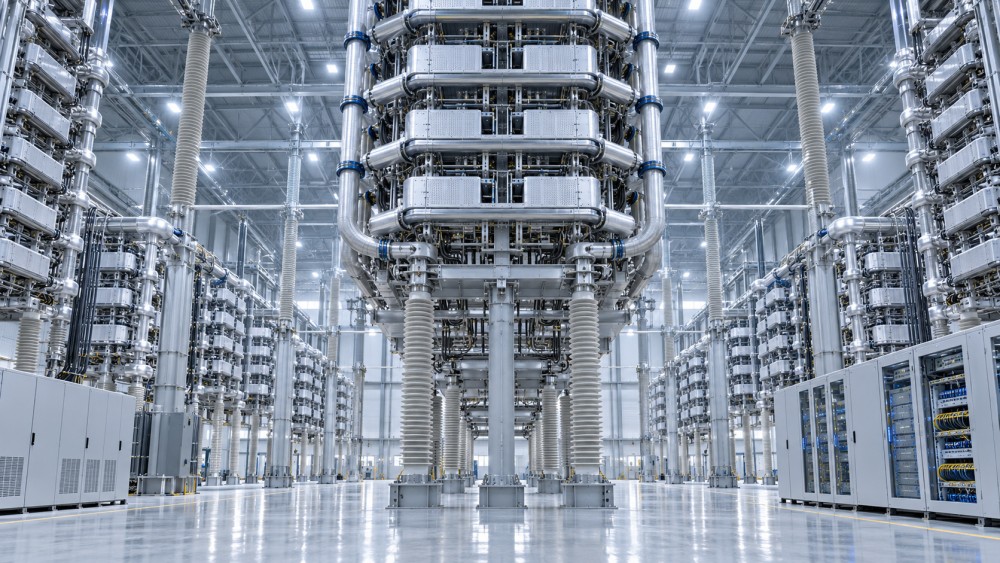
The five reliability paths that maintenance teams need to connect
Thermal management is part of the electrical condition
Valve cooling systems are sometimes treated as auxiliary equipment. Operationally, they are not. Semiconductor losses become heat, and that heat must be removed consistently across parallel branches, valve sections, and individual cooling paths. Low flow, blocked strainers, pump degradation, heat-exchanger fouling, air entrainment, poor water chemistry, or sensor errors can create local temperature differences before a station-level temperature alarm becomes obvious.
Temperature trends matter more than a single acceptable reading. A stable average temperature may conceal a widening difference between similar valve sections. In practice, teams should compare inlet and outlet conditions, flow indications, pump duty behavior, conductivity, pressure trends, and temperature distribution across comparable equipment. The acceptable limits must remain those specified by the original equipment documentation and station operating procedures; they should not be replaced by generic numbers from another project.
Cooling-system work also requires disciplined cleanliness control. A maintenance activity that introduces contamination or leaves a small leak unresolved can create later electrical and corrosion risks. The best outage is not merely short; it is closed out with the cooling circuit returned to a stable, verified condition.
Semiconductor health and the meaning of redundancy
Thyristors in LCC valves and IGBTs in VSC systems are designed for demanding duty, but they are not maintenance-free in the broader system sense. Their usable life is influenced by thermal cycling, electrical transients, gate-drive performance, cooling uniformity, mechanical interfaces, and the quality of diagnostic coverage. A semiconductor alarm should therefore be investigated as a possible system symptom rather than treated automatically as a single-device defect.
VSC stations may continue operating after selected submodule failures if their design provides module redundancy and the control system permits bypassing. This capability supports availability, but it is not a reason to defer root-cause analysis indefinitely. Every bypassed module changes the remaining operating margin. The relevant question is not only “Can the station run?” but also “At what power, under what contingency, and until when?”
LCC valve maintenance has its own concerns, including thyristor firing integrity, voltage-sharing arrangements, damping components, and the ability to withstand commutation-related stresses. Repeated commutation failures or abnormal valve protection events deserve review together with AC-system conditions, converter-transformer behavior, and control records. Replacing a valve component without examining the triggering network event can leave the underlying exposure unchanged.
Insulation condition is influenced by the valve-hall environment
High-voltage insulation performance depends on more than insulation material selection. Humidity excursions, dust, conductive deposits, water leaks, loose shielding, degraded grading components, and poor workmanship after interventions can all affect electrical stress distribution. Valve halls are controlled environments, but control systems need verification. A failed HVAC unit, blocked air path, or poorly managed access door may appear unrelated to converter availability until contamination or condensation contributes to a fault.
After intrusive work, inspection discipline matters. Teams should confirm clearances, fastening, bonding, cleanliness, optical-fiber routing, and the reinstatement of covers and barriers. Visual inspection is not superficial when it is based on known failure mechanisms. It is one of the few opportunities to catch installation-related risks before energization.
Controls and protection can either contain a defect or extend an outage
Modern converter stations depend on control, protection, synchronization, measurement, and communication systems that act within very short timeframes. A valve may be electrically healthy but unavailable because a gate-control channel is not ready, a fiber-optic path is degraded, a measurement signal is implausible, or an interlock remains active after a previous disturbance.
Protection records are valuable, but they should be read in sequence rather than as isolated alarm messages. The first event, the blocking command, the equipment response, the failed or successful restart attempt, and any repeated warning pattern can point to very different corrective actions. A trip code alone rarely proves the root cause. Misinterpreting a protection operation may lead to unnecessary component replacement and delay restoration.
A practical maintenance view of availability risk
The most effective maintenance programs combine condition evidence with operational consequence. A defect with a low probability of escalation may still deserve early action if it could remove a critical transmission corridor during a high-demand period. Conversely, an issue that is technically noticeable but fully covered by verified redundancy may be scheduled for the next approved outage. Neither decision should be made from an alarm screen alone.
A further challenge is distinguishing an equipment-originated trip from a system-originated event. AC voltage depressions, harmonic conditions, external faults, control interactions, and abnormal operating orders can stress the converter without indicating a defect in the valve itself. Maintenance teams need access to synchronized disturbance records, not only local alarms, before assigning responsibility to a valve component.
Spare parts are an availability strategy, not a warehouse question
The duration of a converter-valve outage is often determined by what happens after the fault: diagnosis, approval, access preparation, spare availability, compatibility checks, installation, testing, and return to service. A critical spare that is technically available but lacks documented storage history, matching revision status, test requirements, or qualified installation tools may not shorten restoration as much as expected.
A useful spare-parts review separates fast-moving consumables from long-lead, station-critical assemblies. It should also account for obsolescence in electronic controls, software dependencies, and manufacturer support arrangements. For older HVDC assets, a seemingly simple replacement can become difficult when an original component revision is no longer supported or must be evaluated against the existing control and protection configuration.
Just as important, teams should rehearse the information path. Who can authorize a replacement? Where are the latest drawings and test procedures? What evidence is required before energization? Which specialists must be available remotely or on site? The answers should be clear before a forced outage occurs.
Turning event records into preventive action
Condition-based maintenance for converter valves is not simply about collecting more data. It is about connecting data to mechanisms and decisions. A repeated temperature deviation, for example, becomes useful only when correlated with loading, ambient conditions, cooling configuration, valve location, and earlier maintenance history. A one-time communication alarm may be harmless; a pattern linked to vibration, moisture, or a particular switching state may not be.
This cross-disciplinary view is increasingly necessary in grids with large renewable fleets and energy storage. HVDC stations are expected to respond to changing power flows, weak-grid behavior, and more frequent control actions. The valve system, converter controls, AC network, and dispatch strategy need to be understood together. A maintenance team that sees only the valve hall can miss the operational context that explains repeated stress.
That connected perspective is central to the work tracked by Global Power Grid Dynamics (PGD). Across UHV transmission equipment, smart grid control systems, high-power storage, specialty cables, and heavy generation assets, PGD examines how equipment condition and system behavior meet in real operating environments. For HVDC maintenance, the useful outcome is not a generic reliability claim; it is a clearer understanding of where technical evidence, grid events, and maintenance priorities intersect.
The maintenance question that matters most
When a valve alarm occurs, the immediate question is usually whether the station can return to service. The better follow-up question is whether the same underlying condition can remove the remaining margin tomorrow. Converter valves affect HVDC station availability because they sit at the point where thermal performance, high-voltage insulation, semiconductor switching, digital control, and grid disturbances converge.
A sound maintenance approach therefore combines disciplined inspection, trend-based condition review, accurate event analysis, realistic spare readiness, and outage planning that reflects the actual transmission consequence. The exact priorities will vary with LCC or VSC topology, equipment design, operating duty, and local procedures. But the principle remains consistent: protect the margins around the valve system before a small abnormality becomes a lost power-transfer window.
Related News
- What to verify before selecting a TBEA HVDC converter valveOct 19, 2026High-Voltage Grid Architect
- How converter valves affect HVDC station availabilityOct 18, 2026High-Voltage Grid Architect
- When is HVDC transmission more economical than HVAC for long links?Sep 05, 2026High-Voltage Grid Architect
- EU PPWR Takes Effect for Power Equipment PackagingAug 12, 2026High-Voltage Grid Architect