
Southeast Asia Upgrades GIS Gear Environmental Standards
On May 7, 2026, Thailand, Vietnam, and Indonesia jointly issued the Regional Green Alternative Roadmap for GIS Equipment, mandating the phase-out of sulfur hexafluoride (SF6) gas-insulated switchgear (GIS) in all new substations starting in 2027. This regulatory shift directly impacts manufacturers, exporters, distributors, and supply chain service providers engaged in high-voltage electrical infrastructure across Southeast Asia and global export markets.
Event Overview
On May 7, 2026, the electricity regulatory authorities of Thailand, Vietnam, and Indonesia released the Regional GIS Equipment Green Alternative Roadmap. The roadmap requires that, from 2027 onward, all newly constructed substations in the three countries must use SF6-free GIS solutions—specifically clean air, fluoroketone (C5-FK), or approved gas mixtures. The document references IEC 62271-4:2023 as the technical benchmark. Six Chinese GIS manufacturers have achieved IEC 62271-4:2023 certification and begun batch exports; however, most overseas distributors lack internal capacity to interpret and compare technical parameters against the new requirements.
Industries Affected by Segment
Direct Exporters and OEM Manufacturers
These enterprises face immediate compliance pressure when supplying GIS equipment to Thailand, Vietnam, or Indonesia. Certification status (IEC 62271-4:2023) is now a prerequisite—not just a competitive advantage—for market access. Non-compliant legacy SF6 products will be excluded from tender eligibility for new substation projects after 2026.
Channel Distributors and Regional Resellers
Distributors serving end utilities or EPC contractors in the region are affected due to gaps in technical interpretation capability. As noted in the official announcement, many lack structured methods to map product specifications (e.g., dielectric performance, GWP values, temperature limits) against the roadmap’s functional equivalency criteria—raising risks of misaligned quoting, delayed approvals, or rejected deliveries.
Raw Material and Gas Suppliers
Suppliers of alternative insulating media—including clean air processing units, C5-FK synthesis intermediates, or pre-mixed gas formulations—are seeing accelerated demand signals. However, volume ramp-up remains contingent on downstream OEM qualification timelines and regional grid operators’ procurement schedules—not just policy publication.
Supply Chain Support Providers
Third-party testing labs, certification consultants, and logistics partners specializing in high-voltage equipment are increasingly requested to verify gas composition, conduct type-test alignment reviews, and support documentation for customs clearance under new environmental classification codes. Their role shifts from advisory to operational enablers.
Key Focus Areas and Recommended Actions
Monitor official implementation guidelines and national annexes
The roadmap is a regional framework; each country will issue binding technical enforcement notices and transition timelines. Current guidance does not specify grandfathering rules for partially commissioned projects or retrofit exceptions—these details will emerge in national-level circulars expected before Q4 2026.
Prioritize parameter mapping for top-tier SKUs and key markets
Exporters and distributors should immediately audit their 10–15 highest-volume GIS models against IEC 62271-4:2023 clauses related to gas mixture verification, arc-quenching validation, and low-temperature operation. Focus first on Thailand’s PEA and Vietnam’s EVN—the two largest utility buyers with published 2027–2030 substation expansion plans.
Distinguish between policy signal and procurement reality
While the 2027 deadline is firm, actual tender issuance for SF6-free GIS remains limited to pilot sites as of mid-2026. Most large-scale procurements will begin only after national standards bodies complete alignment with IEC 62271-4:2023—and this process is still underway in Indonesia’s KAN and Vietnam’s QUACERT.
Initiate cross-functional readiness checks across sales, engineering, and logistics
Companies should confirm whether existing test reports cover required ambient temperature ranges (–30°C to +40°C), whether gas cylinder labeling meets new traceability rules, and whether shipping documentation includes GWP declarations per ISO 14067. Delayed corrections at port or site may trigger contractual penalties.
Editorial Observation / Industry Perspective
Observably, this tri-national alignment represents a coordinated regulatory signal—not yet a fully implemented operational regime. Its significance lies less in immediate enforcement and more in its function as a harmonized benchmark: it reduces jurisdictional fragmentation and lowers long-term compliance costs for multinational suppliers. Analysis shows that adoption velocity will depend less on policy text and more on local utility capacity to calibrate protection relays and maintenance protocols for non-SF6 GIS. From an industry perspective, this is best understood as a 12–24 month preparation window—not a sudden cutoff.
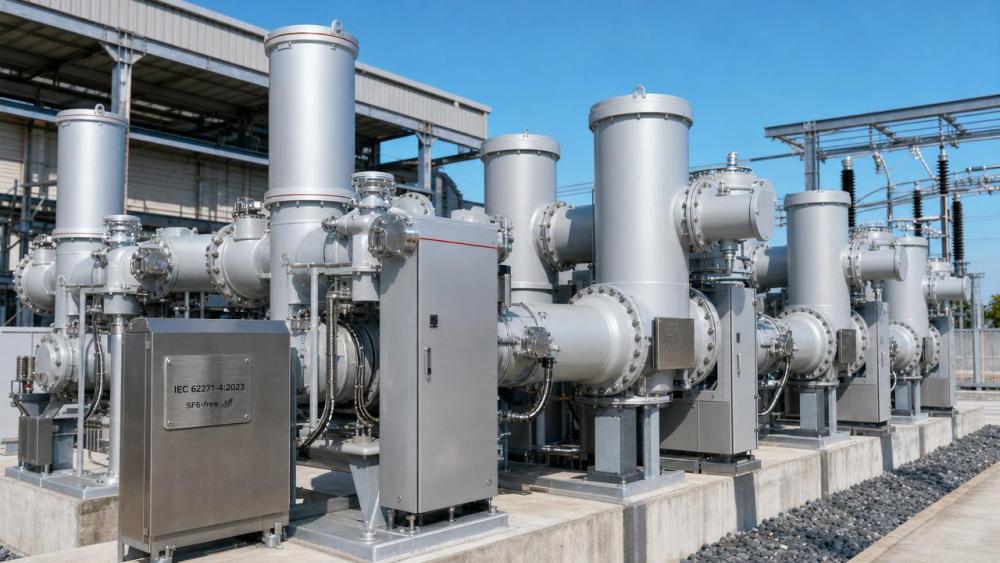
Conclusion: This development marks a structural inflection point for GIS supply chains serving Southeast Asia—not merely a technical specification update. It signals a shift toward lifecycle-based environmental accountability in grid infrastructure procurement. Currently, it is more accurate to view the roadmap as a binding framework with phased execution, rather than an already active restriction. Stakeholders benefit most by treating it as a synchronized calibration exercise across engineering, commercial, and regulatory functions—rather than a standalone compliance event.
Source: Joint Announcement by Electricity Generating Authority of Thailand (EGAT), Vietnam Electricity Group (EVN), and Indonesia’s Ministry of Energy and Mineral Resources (ESDM), dated May 7, 2026. Note: National implementation guidelines and tender templates remain pending; these require ongoing monitoring through official gazettes and utility procurement portals.
Related News