
RCEP Green Power Mutual Recognition Takes Effect
On May 23, 2026, the RCEP Secretariat and the ASEAN Power Grid Coordination Center jointly launched a landmark regulatory alignment initiative—the Green BESS Interoperability Framework. This framework grants China-manufactured liquid-cooled Battery Energy Storage Systems (BESS) fast-track market access across eight ASEAN countries without mandatory local type testing—a move expected to accelerate cross-border deployment of grid-scale energy storage in Southeast Asia’s rapidly decarbonizing power sector.
Event Overview
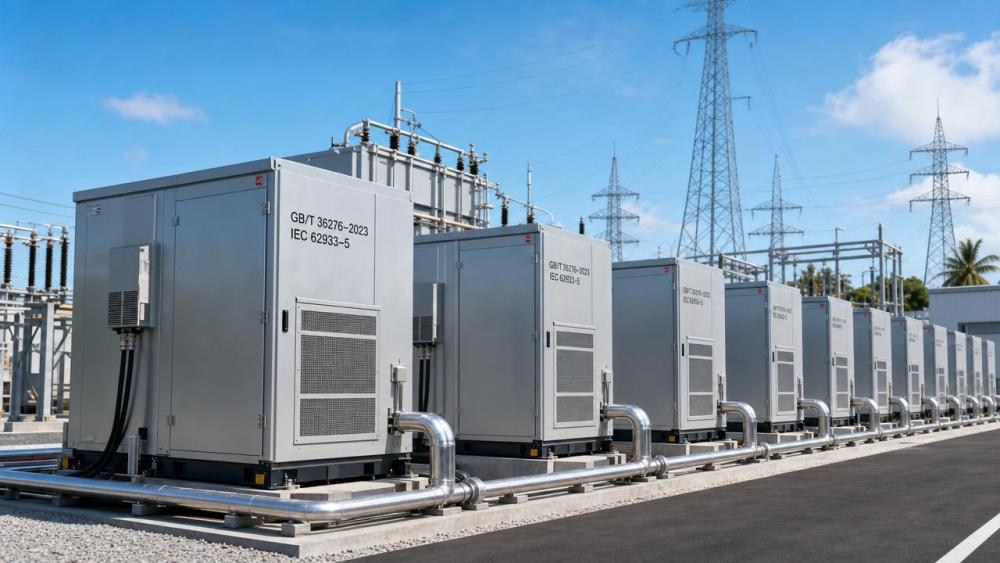
On May 23, 2026, the RCEP Secretariat and the ASEAN Power Grid Coordination Center published the Green BESS Interoperability Framework. It specifies that liquid-cooled BESS systems manufactured in China and compliant with the dual standard GB/T 36276–2023 + IEC 62933-5 are exempt from mandatory national type tests upon import into Singapore, Vietnam, Thailand, Malaysia, Indonesia, Philippines, Cambodia, and Laos. To qualify, units must integrate AI-enabled temperature-coordinated PCS inverters and be traceable to CNAS-accredited laboratories.
Industries Affected
Direct Exporters & Trading Enterprises
These firms face significantly reduced time-to-market—cutting average certification lead time by 8–12 weeks—and lower compliance costs (estimated USD 45,000–75,000 per model). However, eligibility is conditional: only systems meeting both the dual-standard requirement and AI-PCS integration qualify. Non-compliant legacy models remain subject to full national testing regimes.
Raw Material Procurement Firms
Suppliers of thermal interface materials, immersion coolants, and high-reliability battery cells may see demand shifts. The AI-PCS mandate increases demand for silicon carbide (SiC) power modules and embedded AI inference chips—components not traditionally sourced from mainstream battery material supply chains. Procurement teams must now verify upstream component certifications against CNAS-traceable test reports—not just final product conformity.
Manufacturing Enterprises
OEMs and system integrators must revise design control processes to ensure AI-driven thermal coordination logic is validated at the subsystem level before CNAS certification. Notably, the exemption applies only to *complete systems*, not modular components; therefore, ‘mix-and-match’ configurations using non-certified PCS or cooling units void eligibility—even if the battery rack itself meets GB/T 36276–2023.
Supply Chain Service Providers
Certification consultants, logistics validators, and customs brokers need updated technical competence in interpreting the Framework’s annexes—particularly Clause 4.2 on evidence hierarchy (e.g., acceptance of factory witness tests over third-party lab reports under defined conditions). Customs declarations now require explicit declaration of CNAS certificate numbers and AI-PCS firmware version identifiers.
Key Considerations & Recommended Actions
Verify Dual-Standard Compliance Early
Manufacturers should conduct gap assessments between existing product documentation and the combined GB/T 36276–2023 + IEC 62933-5 requirements—noting differences in fire propagation testing thresholds and grid-synchronization response times. Retesting may be needed even for previously certified units.
Secure CNAS Traceability with Full Audit Trail
CNAS accreditation alone is insufficient. Documentation must include timestamped calibration records for test equipment, signed witness reports from accredited labs, and firmware hash verification for AI-PCS controllers—requirements enforceable during post-import抽查 (spot checks) by ASEAN national regulators.
Update Technical Documentation for Eight Jurisdictions
Although type testing is waived, each country retains authority to request localized safety instructions, bilingual labeling (English + national language), and emergency shutdown protocol summaries. Pre-translated, jurisdiction-specific annexes should be prepared ahead of first shipment.
Editorial Insight / Industry Observation
Observably, this Framework does not represent full regulatory harmonization—but rather a pragmatic, standards-based interoperability corridor. Its narrow scope (limited to liquid-cooled BESS, eight countries, and two technical conditions) suggests it functions more as a pilot than a blueprint. Analysis shows ASEAN members retain full authority to withdraw recognition if field failure rates exceed 0.3% annually—a threshold likely to trigger real-time data-sharing obligations under Annex 7. From an industry perspective, the emphasis on AI-PCS integration signals a strategic pivot: interoperability is now being gated not just by safety and performance, but by digital controllability.
Conclusion
This development marks a tangible step toward operational convergence in regional clean energy infrastructure—but one anchored in verifiable technical prerequisites, not political goodwill. It lowers barriers for qualified suppliers while raising the bar for system-level integration rigor. A rational interpretation is that it rewards engineering maturity over volume, favoring vertically integrated manufacturers with embedded certification discipline.
Source Attribution
Primary sources: RCEP Secretariat Official Notice No. RCEP/EGC/2026/08; ASEAN Power Grid Coordination Center Circular APC-2026-05. Both documents are publicly accessible via rcepsec.org and apgcc.org. Note: National implementation timelines, enforcement protocols, and potential expansion to additional countries (e.g., Myanmar, Brunei) remain under active consultation and are subject to revision through Q4 2026.
Related News
- RCEP Green Power Mutual Recognition Takes EffectMay 24, 2026Energy Storage Strategist
- India to Launch First 100-MW Liquid-Cooled BESS PilotMay 23, 2026Energy Storage Strategist
- India to Launch First 100MW Liquid-Cooled BESS DemoMay 22, 2026Energy Storage Strategist
- South Korea Extends Fuel Tax Cut to July 31; Boosts Economics of Liquid-Cooled BESS and PCS InvertersMay 21, 2026Energy Storage Strategist