
Xi’an–Hamburg UHV Train Capacity Expanded to 4 Transformers
On May 17, 2026, China State Railway Group and Deutsche Bahn Cargo jointly announced the expansion of single-train capacity for the Xi’an–Hamburg Ultra-High-Voltage (UHV) equipment dedicated train to four UHV transformers—including 1000 kV oil-immersed and ±800 kV converter transformers—up from three, marking a 33% increase. This development is directly relevant to power equipment exporters, European energy infrastructure project stakeholders, and cross-border rail logistics providers, as it signals measurable improvement in delivery reliability for critical energy transition hardware.
Event Overview
On May 17, 2026, China State Railway Group and Deutsche Bahn Cargo confirmed that the Xi’an–Hamburg UHV equipment dedicated train has increased its per-train carrying capacity to four UHV transformers. The upgrade applies to both 1000 kV oil-immersed transformers and ±800 kV converter transformers. Previously, the service accommodated three units per train. The announcement states this change takes effect immediately and is expected to shorten average delivery lead times by 11–14 days for suppliers including China XD Electric and TBEA.
Impact on Specific Industry Segments
Direct Exporters of UHV Equipment
Manufacturers exporting UHV transformers to Europe—such as China XD Electric and TBEA—are directly affected because the expanded capacity reduces per-unit rail slot constraints. Impact manifests primarily in shorter committed delivery windows and more predictable scheduling for large-batch orders tied to European grid modernization projects.
European Grid Infrastructure Project Contractors
Contractors executing high-voltage transmission upgrades or new interconnector builds in Germany, Poland, or the Nordics face reduced risk of transformer delivery delays. The impact centers on improved milestone adherence—especially for projects with tight commissioning deadlines linked to EU Renewable Energy Directive timelines.
Rail Freight Forwarders & Multimodal Logistics Providers
Firms managing end-to-end China–Europe rail shipments for heavy electrical equipment now operate under revised slot allocation parameters. The impact includes higher utilization efficiency per train, potential adjustments to booking lead times, and increased scrutiny on pre-loading coordination (e.g., dimensional verification, axle load distribution, and customs documentation alignment).
Supply Chain Coordination Units within OEMs
Internal supply chain teams at transformer manufacturers must adapt planning cycles to reflect the new capacity ceiling—not just volume but also physical compatibility (e.g., cradling, securing, and transit clearance). Impact appears in revised internal handover SLAs between production, quality assurance, and logistics departments.
What Relevant Enterprises or Practitioners Should Monitor and Act On
Track official capacity allocation guidelines from both railway operators
China State Railway Group and Deutsche Bahn Cargo have not yet published detailed operational protocols—for example, whether the 4-unit limit applies year-round or only during specific seasons, or whether priority access requires advance contractual commitments. Stakeholders should monitor official notices for such clarifications.
Validate transformer model compatibility with the updated loading configuration
Not all 1000 kV or ±800 kV transformer variants may fit the newly optimized stowage layout. Exporters should request updated technical loading schematics from rail operators before finalizing shipment plans for non-standard models.
Distinguish between headline capacity and actual booked availability
Analysis shows that while nominal capacity has increased by 33%, actual slot availability depends on coordinated demand across multiple OEMs and seasonal European port/rail congestion patterns. Firms should treat the 4-unit figure as an upper bound—not a guaranteed baseline—and maintain buffer planning in Q3–Q4 2026 schedules.
Update internal logistics KPIs to reflect revised lead time benchmarks
With average delivery shortened by 11–14 days, procurement and order management systems should recalibrate promised delivery dates, inventory safety stock levels, and factory dispatch triggers—particularly for contracts referencing Incoterms® 2020 DPU or DAP Hamburg.
Editorial Perspective / Industry Observation
Observably, this capacity expansion functions less as an isolated infrastructure upgrade and more as a calibrated response to documented bottlenecks in European energy hardware supply chains. It reflects growing alignment between Chinese rail operators and European freight partners on prioritizing mission-critical industrial cargo—not general merchandise—on key Eurasian corridors. From an industry perspective, the move signals increasing institutional recognition of UHV equipment as strategic freight, warranting dedicated capacity planning. However, it remains a capacity adjustment—not a systemic resolution—of broader constraints such as terminal handling capacity in Hamburg, cross-border gauge transitions, or customs inspection throughput. Continued observation is warranted on whether similar expansions follow on complementary routes (e.g., Xi’an–Madrid or Chongqing–Warsaw) and how rail operators allocate priority access among competing OEMs.
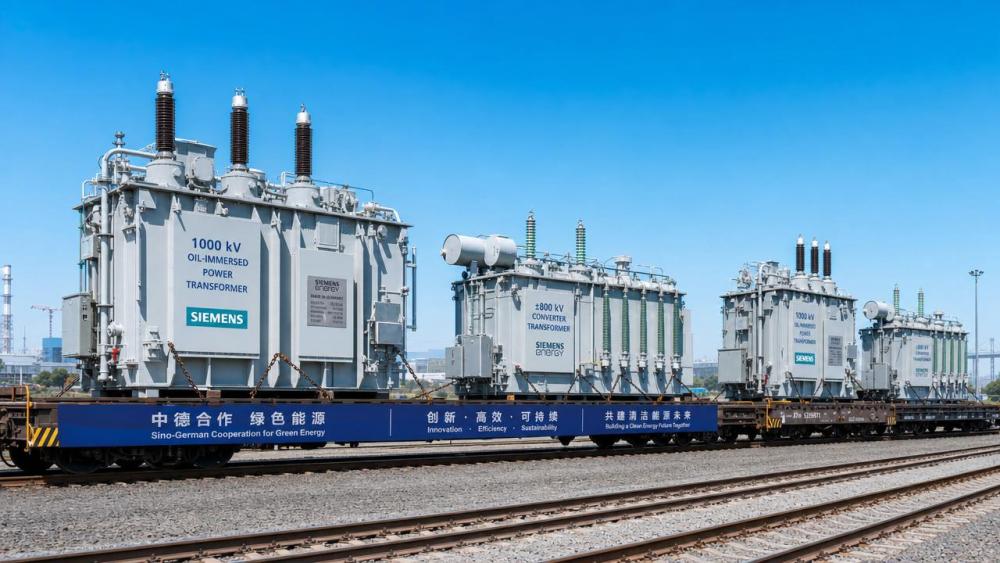
In summary, the Xi’an–Hamburg UHV train capacity expansion represents a targeted, operationally tangible improvement—not a broad market shift. Its primary value lies in enhanced predictability for time-sensitive transformer deliveries into European energy infrastructure programs. For stakeholders, it is better understood as a logistical enabler than a transformative policy development; its real-world utility depends on consistent execution, transparent communication, and integration with parallel efforts in port and customs coordination.
Source: Joint announcement by China State Railway Group and Deutsche Bahn Cargo, issued May 17, 2026.
Note: Operational details—including booking procedures, weight/dimension thresholds per unit, and seasonal applicability—remain pending formal publication and are subject to ongoing observation.
Related News
- US Energy Department Offers $237 Million for Grid Component and Transformer Supply ChainsNov 02, 2026High-Voltage Grid Architect
- Gansu–Zhejiang UHV Line Completes Conductor Stringing Across the YangtzeOct 28, 2026High-Voltage Grid Architect
- Gansu–Zhejiang UHV Project Completes Yangtze River Crossing Conductor StringingOct 27, 2026High-Voltage Grid Architect
- How UHV transformer transport limits shape substation planningOct 20, 2026High-Voltage Grid Architect