
India Tightens UHV Transformer Import Test Rule
On July 10, 2026, India’s Ministry of New and Renewable Energy (MNRE) introduced an immediate tightening of technical entry requirements for imported UHV transformers rated at 800 kV and above. The change centers on mandatory submission of third-party seismic vibration test raw data and spectrum analysis reports under IEC 60076-14:2026, making this a practical compliance issue for manufacturers, exporters, importers, procurement teams, testing providers, and delivery planning functions. The notice is worth close attention because it affects not only product qualification, but also port clearance risk and potential trade scrutiny for non-compliant shipments.
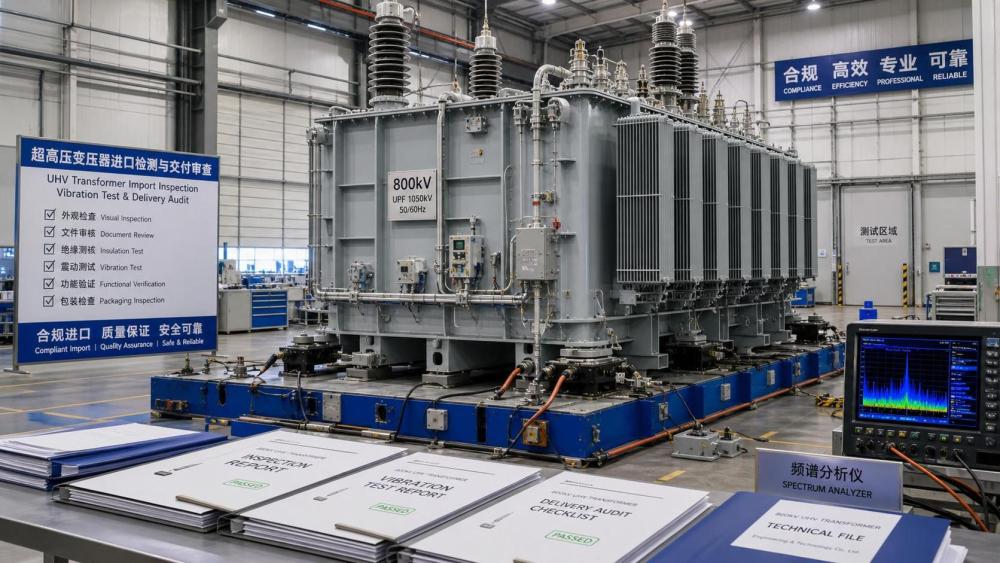
What the New Notice Formally Requires
According to NOTICE No. MNRE/2026/INT/112 issued by MNRE on July 10, 2026, India has imposed temporary stricter technical access measures on all imported UHV transformers with a rated voltage of 800 kV or higher. The notice requires importers to provide original third-party seismic vibration testing data and spectrum analysis reports prepared in accordance with IEC 60076-14:2026. Products that do not meet the requirement will be refused at Chennai Port, and an anti-circumvention investigation will be initiated.
Where the Immediate Pressure Will Appear in the Supply Chain
Technical qualification now reaches the import gate
From an industry perspective, the most direct impact falls on companies shipping UHV transformers into India. The rule change matters because compliance is no longer limited to product specification alignment; it now extends to whether a shipment can present the required test basis at the point of entry. What deserves closer attention is the document chain itself, especially the availability of original data and spectrum analysis materials rather than only summary-level test conclusions.
Procurement and project delivery teams face a documentation risk
For buyers and procurement functions, the practical issue is that technical acceptance and delivery timing may now depend on whether suppliers can support the IEC 60076-14:2026 evidence package in full. Observably, this could affect supplier screening, technical bid review, order confirmation, and shipment release decisions. Teams involved in tendering or sourcing may need to check whether existing technical files are sufficient for the new requirement before locking delivery milestones.
Testing and certification-related service providers become more central
Testing bodies and other compliance-related service participants may also be affected because the notice explicitly points to third-party seismic vibration testing, original data, and spectrum analysis reports. Analysis shows that the focus is not only on having a test report, but on whether the testing record can support regulatory review in a traceable form. This raises the importance of report completeness, data integrity, and alignment with the cited IEC standard.
Trade and logistics exposure increases for non-compliant shipments
For importers, exporters, and supply chain service providers, the rule change creates a more immediate delivery and customs-handling risk. The confirmed fact that non-compliant products can be refused at Chennai Port means the issue is tied directly to shipment execution. In practical terms, document readiness, pre-shipment review, and consignee-side compliance checks become more important than under a less specific import requirement.
What Companies Should Check Now
Review whether existing test files meet the cited standard
Analysis shows that companies handling affected products should first confirm whether their current seismic vibration testing materials were prepared under IEC 60076-14:2026 and whether original third-party data and spectrum analysis records are available. Where documentation exists only in summary form, that gap may become a compliance problem under the notice.
Recheck bid files, purchase terms, and shipment documents
What deserves closer attention is the consistency between technical bid submissions, procurement contracts, and import documentation. If a supplier commitment refers generally to standard compliance but does not clearly support the required test data package, the risk may surface late in the delivery process. For ongoing transactions, this is a point that merits immediate file review.
Watch for further wording on enforcement practice
Because the notice describes a temporary tightening measure, companies should continue monitoring how the requirement is expressed in subsequent official language, implementation practice, or transaction-facing documents. At this stage, the provided information confirms the requirement and the consequence of non-compliance, but does not provide broader procedural detail beyond that.
Prepare for added scrutiny where documentation is incomplete
Observably, the reference to anti-circumvention investigation means the issue is not limited to simple document deficiency. Companies involved in export compliance, import handling, and after-sales traceability should pay attention to whether technical records are complete, internally consistent, and attributable to the shipped product batch or unit set.
How This Change Is Best Understood at This Stage
Analysis shows that this development is better understood as an active enforcement signal rather than a distant policy discussion. The requirement is described as taking effect immediately, and the consequence at Chennai Port is explicit. At the same time, it is still more appropriate to understand this as a rule change that requires continued observation, because the available input does not yet establish how widely the measure will reshape procurement practice, tender specifications, or broader market behavior beyond the stated import condition.
Why the Market Will Keep Watching This Notice
From an industry perspective, the significance of this notice lies in how a technical testing requirement has been tied directly to import admissibility for a specific high-voltage equipment category. That does not by itself prove a broader market shift, but it does indicate that compliance evidence, testing traceability, and document depth may carry greater weight in affected transactions. For now, it is more appropriate to read the notice as an implemented access condition with immediate operational consequences, while reserving judgment on its longer-term market impact until further execution details and industry responses become clearer.
Basis of This Article and What Still Needs Verification
This article is based on the user-provided news title, event date, and event summary relating to MNRE’s July 10, 2026 notice on imported UHV transformers. For events of this type, commonly relevant source categories may include official ministry notices, regulatory releases, customs or trade administration information, industry association updates, standard organization documents, and reporting by authoritative trade media. A specific official source link was not provided in the input, so the exact source document path still requires ongoing verification. Further observation is also needed regarding detailed implementation language, certification and testing interpretation, tender document changes, industry feedback, and how affected companies execute against the requirement in practice.
Related News
- US Energy Department Offers $237 Million for Grid Component and Transformer Supply ChainsNov 02, 2026High-Voltage Grid Architect
- Gansu–Zhejiang UHV Line Completes Conductor Stringing Across the YangtzeOct 28, 2026High-Voltage Grid Architect
- Gansu–Zhejiang UHV Project Completes Yangtze River Crossing Conductor StringingOct 27, 2026High-Voltage Grid Architect
- How UHV transformer transport limits shape substation planningOct 20, 2026High-Voltage Grid Architect