
How does transformer export certification testing affect shipment approval?
A transformer can be mechanically complete, packed, and ready for dispatch, yet still remain blocked from shipment approval because its export certification file is incomplete, inconsistent, or linked to an unresolved test deviation. For a project manager working against a substation energization date, this is not merely a quality-document issue. It can hold up port release, letter-of-credit documentation, insurance acceptance, site logistics, and the sequence of downstream installation work.
Transformer export certification testing affects shipment approval by providing the evidence that the supplied unit meets the contractual specification, applicable destination-market requirements, and agreed factory acceptance criteria. Approval normally depends on more than a passing electrical test. The manufacturer, purchaser, inspector, certification body, freight team, and sometimes customs authorities may all need a consistent package: approved drawings, test records, nameplate information, certificates, inspection releases, and shipping documents that identify the same transformer and the same final configuration.
Problems often arise late because teams treat testing as a factory event and export approval as a logistics event. In practice, they are connected. A test report that does not match the final tap-changer arrangement, bushing type, cooling equipment, or serial number may prevent release even where the transformer itself is technically sound.
Why a passed test is not always enough for release
Routine and type-related testing demonstrate different things, while shipment approval asks a broader question: can this particular transformer be released for the intended destination and contract? A factory may report acceptable winding resistance, ratio, insulation, impedance, dielectric, and functional results. The buyer’s inspector may still withhold a release if required witness points were missed, a certificate has not been issued, corrective actions are open, or the packing configuration differs from the approved transport plan.
For export projects, approval is usually built from four linked evidence streams:
- Technical conformity: The transformer rating, vector group, insulation level, impedance, losses, tap range, cooling method, accessories, and protection interfaces conform to the approved specification.
- Test conformity: Required routine, special, witnessed, or additional tests have been completed using the agreed methods, with results reviewed against acceptance limits.
- Certification and regulatory conformity: The project has the certificates, declarations, inspection records, or conformity documents required by the purchase contract and destination market.
- Traceability and shipment integrity: The tested transformer can be tied without ambiguity to the nameplate, packing list, preservation condition, transport drawings, and shipping release.
A gap in any one stream can stop or qualify shipment approval. The impact depends on the contract. Some purchasers permit a conditional release for a minor documentary correction; others prohibit dispatch until the final certificate package is accepted. Project teams should therefore define the release threshold before factory testing begins, not when the vessel booking deadline is already approaching.
The approval gate begins before the factory acceptance test
The most reliable way to avoid export delays is to convert the contract into a document-and-test matrix early in manufacturing. This matrix should distinguish what must be submitted for review, what must be approved before testing, what must be witnessed, and what must be available before shipment. It should also state who has authority to issue the final release.
Early alignment is especially important where a transformer is designed for a market with local grid codes, utility practices, safety expectations, environmental restrictions, or third-party inspection requirements. A general declaration of conformity may not satisfy a contract that calls for a particular independent inspection record. Conversely, asking for a certificate late in the process may reveal that the selected component or test sequence does not support the requested evidence.
The project manager should establish these points in writing:
- The governing technical specification and any hierarchy between it, purchase order documents, and approved deviations.
- The applicable testing standard or agreed test procedure, including tolerances and any customer-specific measurements.
- Which tests require advance notice, remote observation, physical witnessing, or independent attendance.
- The exact certificate and report formats required for export, customs, owner acceptance, and payment milestones.
- The serial-number and component traceability method for the transformer, bushings, on-load tap changer, oil, instruments, and major auxiliaries.
- The release sequence between factory acceptance, corrective-action closure, pre-shipment inspection, packing approval, and dispatch authorization.
Without this alignment, teams may discover that one party considers a scanned test summary sufficient while another expects signed full reports, calibration references, and a formal inspection release. The physical shipment then waits for paperwork that could have been planned weeks earlier.
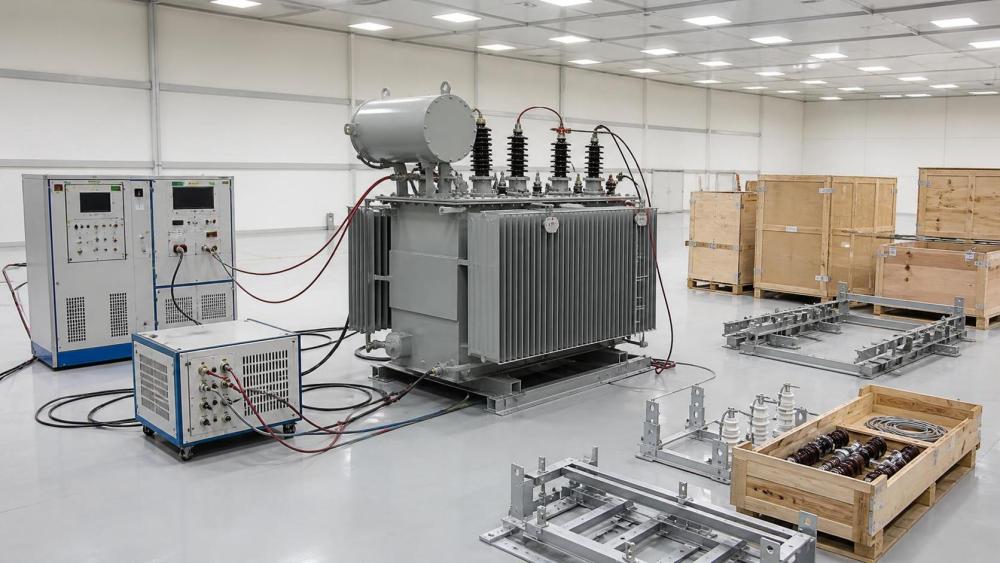
What certification testing usually proves to the approving parties
Transformer export certification testing is not one single test. It is a controlled body of evidence. The specific scope changes with voltage class, transformer design, project requirements, and destination rules, but the approval team generally needs confidence in electrical performance, dielectric integrity, correct assembly, and safe delivery condition.
Electrical and dielectric evidence
Routine testing commonly verifies that the manufactured unit performs as specified. Depending on the agreed scope, records may cover winding resistance, voltage ratio and vector group, impedance, insulation resistance, applied and induced voltage tests, partial discharge measurement where required, and functional checks of controls and alarms. Loss measurements, temperature-rise evidence, sound-level results, short-circuit capability evidence, or impulse-related records may also be requested where the contract calls for them.
Approval reviewers do not only look for a “pass” statement. They check whether the tested configuration is the final configuration and whether the values are credible against the approved design. A ratio result is less useful if the test report does not identify all relevant tap positions. A dielectric record may trigger questions if the stated bushing arrangement differs from the latest approved drawing. A test report should make the unit, method, conditions, instruments, and results sufficiently clear for a reviewer who was not present at the factory.
Accessory and functional evidence
Export approval can be delayed by equipment around the active part rather than by the core-and-coil assembly itself. Tap-changer control cabinets, cooling fans and pumps, temperature indicators, gas relays, pressure devices, marshalling kiosks, auxiliary wiring, and monitoring interfaces may require functional verification. Where the transformer will connect to a digital substation or a remotely controlled grid, the agreed signal list and communications configuration can be as important to release as the high-voltage tests.
These interfaces deserve careful control after testing. A late wiring change, substituted instrument, or revised protection contact arrangement may be legitimate, but it creates a question: does the existing test record still represent the final exported equipment? The answer should be documented through a targeted re-test, addendum, or approved concession as appropriate.
Where shipment approval commonly breaks down
Most release problems are not dramatic technical failures. They are mismatches between evidence, configuration, and approval timing. The following table helps separate issues that may be corrected administratively from issues that can require further engineering or testing.
A nonconformance should not be hidden within email traffic or treated as a minor factory matter. Even a small discrepancy can become significant when it affects safety, performance, certification scope, or contractual traceability. The practical question is not simply whether the transformer can operate; it is whether the approving party has documented grounds to accept shipment without creating unresolved responsibility later.
Managing a failed, marginal, or disputed result
When a result is failed or challenged, immediate shipment pressure can lead to poor decisions. Repeating a test without understanding the original setup may produce a second record that is harder to explain. The better sequence is controlled investigation.
First, preserve the original test data, instrument records, connection arrangement, ambient conditions where relevant, and calibration status. Next, verify whether the measured value was compared with the correct acceptance criterion. Some apparent failures result from an incorrect reference value, a configuration misunderstanding, or a transcription error; these still require formal correction, but they do not carry the same engineering implications as a genuine design or manufacturing issue.
Where the issue is real, the manufacturer should identify the likely cause, proposed correction, and effect on adjacent characteristics. The purchaser or independent inspector then needs enough information to decide whether the transformer requires repair, repeat testing, additional examination, a concession, or rejection. A release should be tied to that disposition. Shipping before the disposition is approved may transfer a manageable factory issue into a costly site issue, where access, lifting, rework conditions, and commissioning resources are much more constrained.
Marginal results deserve the same discipline. A value that technically passes but sits close to an agreed boundary may be acceptable, yet it should be reviewed alongside design tolerances, test uncertainty, previous factory data, and the intended duty. The project team should avoid inventing a new acceptance rule after the test, but it should also avoid assuming that a barely acceptable result has no schedule or reliability implications.
Build the document package around the shipment, not around departments
Engineering, quality, certification, logistics, and commercial teams often maintain separate records. Export approval becomes more predictable when one controlled release dossier links them. Before dispatch, the dossier should allow a reviewer to answer three simple questions: What unit was tested? What exact configuration will be shipped? Has every contractual condition for release been closed or formally accepted?
Useful contents generally include the approved technical documents, final nameplate data, routine and additional test reports, witness or inspection records, nonconformance dispositions, applicable certificates or declarations, calibration references where requested, preservation and packing records, transport dimensions and weights, lifting instructions, and the packing list. Not every project needs every item, but the package should not leave the reviewer to reconcile conflicting revisions manually.
Document revision control is particularly important after the factory acceptance test. A drawing changed after testing may affect no tested characteristic at all, or it may affect a critical interface. The change record should state which is true. Treating every late revision as harmless invites questions; treating every revision as a reason to re-test wastes time. A brief engineering impact assessment gives the approval authority a defensible basis for release.
How project managers can protect the shipping date
The most effective control is to work backward from the required dispatch date and separate physical completion from documentary completion. A transformer may need time for oil processing, dismantling of transport-sensitive accessories, preservation, packing, inspection, and certificate issuance after electrical testing. The ship date should not be scheduled on the assumption that all approvals happen immediately after the last test measurement.
Before the factory acceptance test, confirm that the latest approved drawings, settings, bill of materials, and test procedures are available to everyone who needs them. During testing, record attendance, deviations, retests, and verbal agreements in controlled minutes rather than relying on informal recollection. After testing, track open items by release impact: items that block shipment, items that must close before commissioning, and items that are informational only. That distinction prevents a minor formatting correction from receiving the same escalation as an unresolved dielectric test failure.
Finally, do not issue an unconditional shipping instruction while certificate status or nonconformance disposition remains unclear. Where the contract permits conditional release, define its boundaries: which documents remain outstanding, who accepts the risk, whether original certificates must follow the cargo, and what event cancels the release. Clear conditions are safer than an ambiguous “approval in principle.”
In export transformer projects, certification testing is therefore both a technical verification step and a shipment-control mechanism. When test evidence, final configuration, and export documentation point to the same unit without unresolved exceptions, approval can move efficiently. When they do not, the delay is usually not caused by logistics alone; it is the visible result of a conformity question that should be closed before the transformer reaches the site.
Related News
- US Energy Department Offers $237 Million for Grid Component and Transformer Supply ChainsNov 02, 2026High-Voltage Grid Architect
- Gansu–Zhejiang UHV Line Completes Conductor Stringing Across the YangtzeOct 28, 2026High-Voltage Grid Architect
- Gansu–Zhejiang UHV Project Completes Yangtze River Crossing Conductor StringingOct 27, 2026High-Voltage Grid Architect
- How UHV transformer transport limits shape substation planningOct 20, 2026High-Voltage Grid Architect