
EU Rule Takes Effect for UHV Transformer Exports
On July 22, 2026, the European Union began mandatory enforcement of IEC 62271-209:2026 for UHV transformers supplied with gas-insulated switchgear (GIS) entering the EU market. The change matters not only to transformer manufacturers, but also to export operations, customs clearance, bidding eligibility, and supply-chain coordination, because the newly required type testing is now tied to CE marking access rather than treated as a secondary technical step.
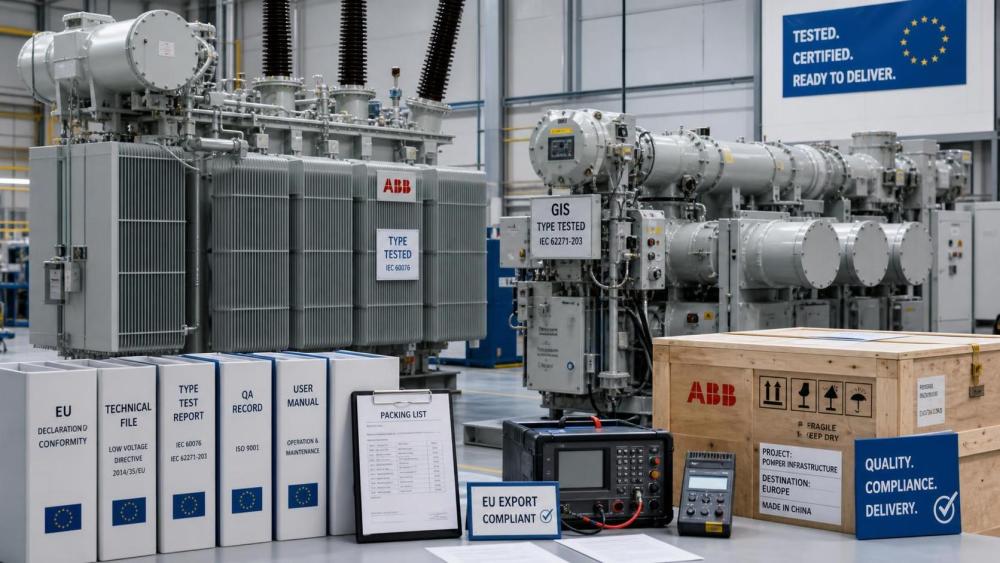
What Has Changed in the EU Market Access Process
The confirmed change is that, from July 22, 2026, the EU formally requires all UHV transformers used with GIS and entering the EU market to pass newly added type tests covering partial discharge endurance and compatibility with SF₆ alternative gases under IEC 62271-209:2026.
The certification has also become a prerequisite for CE marking. Based on the information provided, this directly affects customs clearance for exports to Europe and project bidding qualifications for Chinese UHV transformer manufacturers.
Where the Immediate Pressure Is Likely to Appear
Export-facing manufacturers will face a tighter compliance gate
From an industry perspective, manufacturers that ship UHV transformer products to the EU are the first group exposed to the rule change. The likely impact is concentrated in product qualification, pre-shipment documentation, and whether an item can proceed into the CE marking process. What deserves closer attention is whether existing export-ready products already align with the new type-test requirement or require additional certification work before shipment or tender participation.
Project bidding and commercial teams may see eligibility risks first
Because the certification is described as a precondition for CE marking and as directly affecting bidding qualifications, commercial teams involved in EU projects may encounter the issue before production lines do. The practical pressure point is whether technical submissions, tender documents, and customer-facing compliance materials remain valid under the new enforcement condition.
Customs and delivery coordination become a business risk point
Observably, the rule is not only a laboratory or engineering matter. It also affects export clearance. That means logistics planning, shipment timing, and document readiness may become more sensitive for orders linked to the EU market. Supply-chain and trade service teams should therefore watch for any mismatch between shipment schedules and certification status.
What Companies Should Watch Now
Check whether targeted EU-bound products fall within the new testing scope
The first practical issue is product scope. Companies should review whether their EU-bound UHV transformer offerings are supplied with GIS in a way that brings them under the newly enforced requirement, and whether current certification files already reflect the added tests for partial discharge endurance and SF₆ alternative gas compatibility.
Separate technical readiness from document readiness
Analysis shows that a product may be commercially prepared for export while still facing documentation gaps under the new rule. Firms should pay close attention to whether type-test evidence, CE-related materials, and export documents are aligned, since the enforcement point now affects both regulatory access and transaction execution.
Reassess tender participation timelines
For companies pursuing European projects, bidding strategy now needs to be checked against certification timing. The core issue is not only whether a product can ultimately comply, but whether compliance can be demonstrated at the point required by the customer or procurement process.
Keep customer and supplier communication tightly aligned
What deserves closer attention is communication across the chain. Manufacturers, component partners, certification-related service providers, and customers may all need a shared view of what the new enforcement date means for qualification status, lead times, and delivery commitments. This is especially relevant where ongoing orders or active bids depend on uninterrupted EU market access.
Why This Looks Like More Than a Routine Compliance Update
As an editorial observation, this development is better understood as an active market-access threshold rather than a minor revision in technical paperwork. The reason is clear from the confirmed facts: the required certification is now linked directly to CE marking and, by extension, to export clearance and bidding access.
At the same time, it would be premature to treat the event as a complete reshaping of the sector. Based on the provided information alone, it is more appropriate to understand this as a concrete compliance change with immediate operational effects, while the broader commercial impact still requires observation.
How the Industry Should Read This Moment
The significance of this update lies in where it takes effect: at the point where technical conformity meets trade execution. For companies involved in UHV transformer exports to Europe, the rule should currently be read as a near-term operational requirement and a longer-term signal that certification pathways tied to gas compatibility and endurance testing deserve closer monitoring.
A neutral reading is that the rule has already created a clear compliance condition, but the full extent of its business impact will depend on how companies, customers, and project workflows adapt in practice.
Basis of This Article and What Still Needs Verification
This article is based on the user-provided news title, event date, and event summary. For this type of development, commonly relevant source categories may include official regulatory notices, company disclosures, industry association updates, authoritative media coverage, and standards organization documents.
No specific official source link was provided in the input, so the exact official reference still needs ongoing verification. Follow-up attention should focus on any further official wording, implementation clarifications, or market-side application details related to certification, CE marking, customs handling, and project qualification.
Related News
- US Energy Department Offers $237 Million for Grid Component and Transformer Supply ChainsNov 02, 2026High-Voltage Grid Architect
- Gansu–Zhejiang UHV Line Completes Conductor Stringing Across the YangtzeOct 28, 2026High-Voltage Grid Architect
- Gansu–Zhejiang UHV Project Completes Yangtze River Crossing Conductor StringingOct 27, 2026High-Voltage Grid Architect
- How UHV transformer transport limits shape substation planningOct 20, 2026High-Voltage Grid Architect