
China-UK Export Control Working Group Holds 2nd Meeting in London
On May 18, 2026, the China–United Kingdom Export Control Working Group convened its second meeting in London—a pivotal development for global power infrastructure exporters navigating tightening dual-use technology controls. The meeting signals a shift toward structured regulatory alignment, particularly for high-sensitivity electric power equipment subject to overlapping national export regimes. Its implications extend across supply chain tiers, from component suppliers to system integrators serving UK and EU markets.
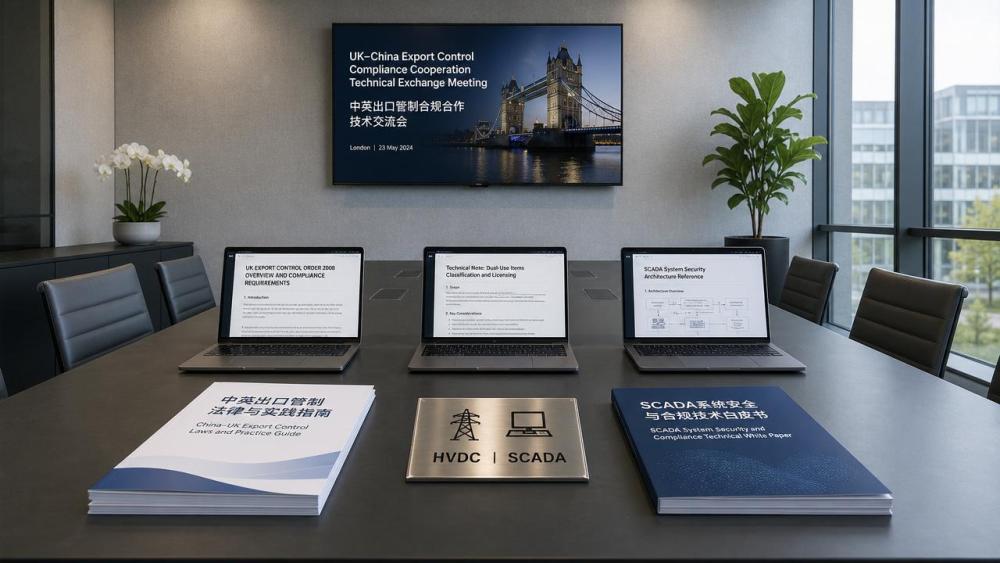
Event Overview
On May 18, 2026, Chinese and UK authorities held the second meeting of the China–UK Export Control Working Group in London. The session focused on harmonizing rules for dual-use technology exports and enhancing supply chain resilience. Participants agreed to strengthen classification guidance and licensing coordination for HVDC (High-Voltage Direct Current) converter valves, SCADA (Supervisory Control and Data Acquisition) systems, and WAMS (Wide-Area Monitoring Systems) analytical platforms—items designated as high-sensitivity power equipment under both jurisdictions.
Industries Affected
Direct Trading Enterprises
Exporters of HVDC converter valves or integrated SCADA/WAMS solutions face revised compliance expectations when shipping to the UK and, by extension, the EU. While no new licensing requirements were announced, the agreement introduces formalized consultation pathways and potential fast-track pilot mechanisms—meaning faster license processing may become available, but only for firms with demonstrably robust internal export compliance programs. Delays remain likely for entities lacking documented classification procedures or end-use verification protocols.
Raw Material Procurement Firms
Suppliers of specialized semiconductors, optical sensors, or hardened control chips used in HVDC valves or SCADA hardware must now assess whether their components fall under updated joint classification criteria. Though raw materials themselves are rarely controlled, their integration into listed end-items triggers traceability obligations. Procurement teams will need to collect and retain enhanced technical documentation—not just for finished goods, but for subassemblies—to satisfy downstream compliance audits.
Manufacturing Enterprises
OEMs producing HVDC converter stations or grid automation systems must update internal export control classifications, especially where firmware, configuration tools, or remote diagnostics capabilities are bundled with hardware. The inclusion of SCADA and WAMS platforms underscores that software-defined functionality—including real-time data ingestion, model-based control logic, and cyber-physical interface layers—is now treated as integral to export-controlled status. Manufacturing QA workflows must therefore integrate export classification checkpoints at design, firmware release, and final test stages.
Supply Chain Service Providers
Logistics operators, customs brokers, and third-party compliance consultants supporting power equipment exports will see increased demand for jurisdiction-specific documentation support—particularly for UK-specific End-Use Statements and EU dual-use annex cross-referencing. Notably, the working group’s emphasis on ‘licensing coordination’ implies future mutual recognition of certain due diligence steps; service providers should prepare to validate and certify client compliance readiness, not merely process paperwork.
Key Focus Areas and Recommended Actions
Review and Update Internal Product Classification Matrices
Firms should re-evaluate all HVDC valve variants, SCADA deployments, and WAMS analytics modules against the newly emphasized sensitivity criteria—including embedded AI inference engines, wide-area synchronization protocols, and cyber-resilience features—using both China’s Catalogue of Dual-Use Items and the UK Strategic Export Control List.
Strengthen End-Use Verification Protocols
Given the working group’s focus on ‘supply chain stability’, regulators are likely to prioritize verifiable end-use assurance. Exporters should implement standardized questionnaires, site visit records (where feasible), and contractual clauses restricting re-export or military use—especially for sales involving UK-based distributors reselling into broader European markets.
Engage Early with National Export Licensing Authorities
While formal fast-track pilots have not yet launched, the meeting confirms intent to develop them. Companies with active UK/EU export plans should proactively register interest with both China’s Ministry of Commerce (MOFCOM) and the UK’s Export Control Joint Unit (ECJU), submitting draft classification rationales and compliance program summaries ahead of anticipated pilot eligibility windows.
Editorial Perspective / Industry Observation
Observably, this meeting reflects a tactical recalibration—not a strategic relaxation—of export governance. Rather than lowering barriers, it seeks to institutionalize predictability within existing constraints. Analysis shows that the selection of HVDC valves and SCADA systems is deliberate: these items sit at the intersection of energy security, digital infrastructure, and geopolitical risk perception. From an industry perspective, the emphasis on ‘classification guidance’ suggests regulators anticipate rising classification disputes, especially around software-enabled functionalities previously treated as ancillary. Current more relevant interpretation is that compliance maturity—not product type—will increasingly determine market access speed.
Conclusion
This meeting does not eliminate regulatory friction, but it does mark a transition from ad hoc enforcement to coordinated administration. For the power technology sector, the practical outcome is not reduced scrutiny, but clarified accountability: firms that invest in granular technical documentation, cross-jurisdictional classification literacy, and proactive regulator engagement will gain relative advantage—even amid tightening controls.
Source Attribution
Official statements issued by the Ministry of Commerce of the People’s Republic of China and the UK Department for Business and Trade, May 18, 2026. Joint press summary published via MOFCOM.gov.cn and GOV.UK. Note: Specific implementation timelines for licensing coordination pilots, detailed classification criteria updates, and scope of ‘fast-track’ eligibility remain pending official publication—and are subject to change based on ongoing bilateral technical consultations.
Related News
- What to verify before selecting a TBEA HVDC converter valveOct 19, 2026High-Voltage Grid Architect
- How converter valves affect HVDC station availabilityOct 18, 2026High-Voltage Grid Architect
- When is HVDC transmission more economical than HVAC for long links?Sep 05, 2026High-Voltage Grid Architect
- EU PPWR Takes Effect for Power Equipment PackagingAug 12, 2026High-Voltage Grid Architect