
U.S. Imposes Four-Year Safeguard Duty on Quartz Countertops
On 2026-08-15, the United States began applying a four-year safeguard duty to imported quartz countertop products under HS codes 6810.99.0020/40 and 7020.00.6000. The measure exempts 15 FTA partners, including Australia, Canada, and Mexico, as well as some Caribbean and non-WTO developing countries, while leaving major exporters such as China, Vietnam, and India outside the exemption list. For procurement, trade compliance, and downstream specification work in decorative panels, GIS switchgear protective substrates, and customized enclosures for smart substation facilities, this is a rule change worth close attention.
What the safeguard measure covers
The confirmed facts are limited to the safeguard duty itself, its effective date of 2026-08-15, the product scope identified by HS codes 6810.99.0020/40 and 7020.00.6000, and the stated exemption framework for certain FTA partners and some Caribbean and non-WTO developing countries. The measure applies for four years. Based on the information provided, China, Vietnam, and India are among the major exporters not covered by the exemption list.
Where the pressure will likely show up first
Import channels and trade paperwork
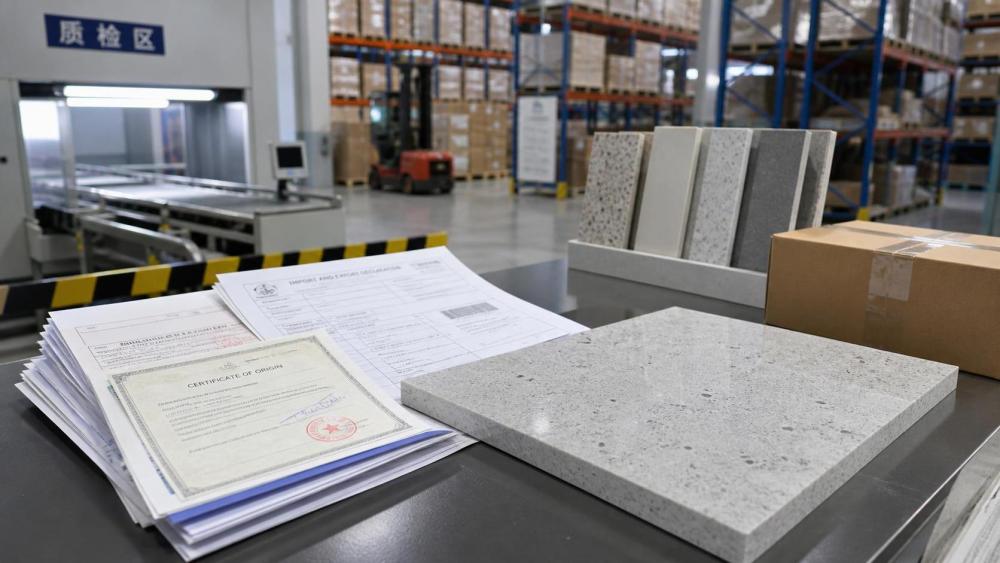
Direct importers are likely to feel the earliest impact because the duty changes the landed-cost calculation for covered quartz countertop shipments. At this stage, the practical issue is not only tariff treatment, but also whether product classification, origin claims, and exemption eligibility are documented cleanly enough to support customs clearance. The measure makes trade documentation and origin verification more consequential than before.
Purchasing and substitute-material checks
For procurement teams, the main question is whether existing sourcing plans still work under the new duty structure. Analysis suggests buyers that relied on covered suppliers may need to reassess cost, delivery timing, and specification continuity. This is especially relevant where quartz countertop products are used as decorative panels, protective substrates, or customized outer shells in power equipment projects, because the material change can affect both budget and technical alignment.
Project delivery and downstream integration
Engineering contractors and equipment integrators may need to revisit material selection, lead times, and acceptance documentation. In projects tied to UHV substations, GIS switchgear protection, or smart substation enclosures, the concern is not only price, but also whether alternate supply routes preserve the required technical characteristics and delivery commitments. At this stage, that should be treated as a compliance and procurement review item, not a foregone operational disruption.
What companies should check now
Confirm tariff treatment by origin and code
Companies should first verify whether their products fall under the listed HS codes and whether any claimed exemption actually applies. The provided information shows a selective exemption structure, so origin and classification checks are the first control point.
Review supplier files and supporting documents
Where shipments depend on exemption eligibility, firms should review origin certificates, commercial invoices, product descriptions, and internal classification records. The goal is to avoid mismatches between the declared origin path and the tariff treatment applied at entry.
Revalidate technical substitutes before changing suppliers
For users of quartz-based decorative or protective components, substitute material evaluation should include both compliance and engineering review. A lower-cost or duty-free source is only useful if it still fits the specification, fabrication process, and project acceptance requirements.
Track further execution details
The provided facts do not include the operational enforcement guidance behind the safeguard duty. It is therefore more appropriate to watch for implementation details, customs handling practice, and any follow-up clarification that may affect how exemption claims are tested in practice.
How to read this signal
From an industry perspective, this is best understood as a live trade-rule change rather than a general market trend. The measure already has an effective date and a defined product scope, so it should be treated as an active compliance input. What still needs observation is how the duty is administered in practice, especially around origin proof, exemption screening, and any knock-on effects on sourcing from affected exporters.
The broader takeaway is straightforward: when a tariff measure touches a material that sits inside both building-product supply chains and power-equipment customization workflows, the impact is often felt in procurement discipline and documentation quality before it is reflected in delivery outcomes.
Bottom line for the sector
This development should be handled as an implemented trade measure with immediate procurement and compliance consequences for covered quartz countertop products. For affected importers, manufacturers, and project integrators, the main task is to confirm product scope, test origin eligibility, and reassess sourcing paths before the duty flows into quotes, contracts, and delivery schedules.
Source basis and open points
This article was generated from the user-provided title, event date, and event summary. No specific official source link was included in the input. For events of this type, relevant source categories typically include official notices, customs or trade authority updates, regulatory releases, and industry association statements.
Further verification should continue to focus on policy text, execution guidance, customs treatment, certification or origin proof requirements, and market feedback from affected companies.
Related News
- Which Asian Grid Code Differences Affect Substation Equipment Selection?Sep 11, 2026
- U.S. Imposes Four-Year Safeguard Duty on Quartz CountertopsAug 15, 2026
- EU Sets New GIS F-Gas Rule From August 15Aug 04, 2026
- IEC 62271-305:2026 Takes Effect for EU-Bound GISJul 20, 2026