
CBAM Broadens to Hydrogen and Chemicals From October 2026
From October 1, 2026, the CBAM reporting scope is formally extended to six newly added categories: hydrogen, ammonia, organic chemicals, plastics, aluminum products, and certain downstream steel products. For companies trading, sourcing, manufacturing, and delivering these goods, the update is worth close attention because the new rules require ISO 14064-certified Scope 1, 2, and 3 emissions data across the full value chain, while non-compliance may lead to additional tax charges and customs clearance delays.
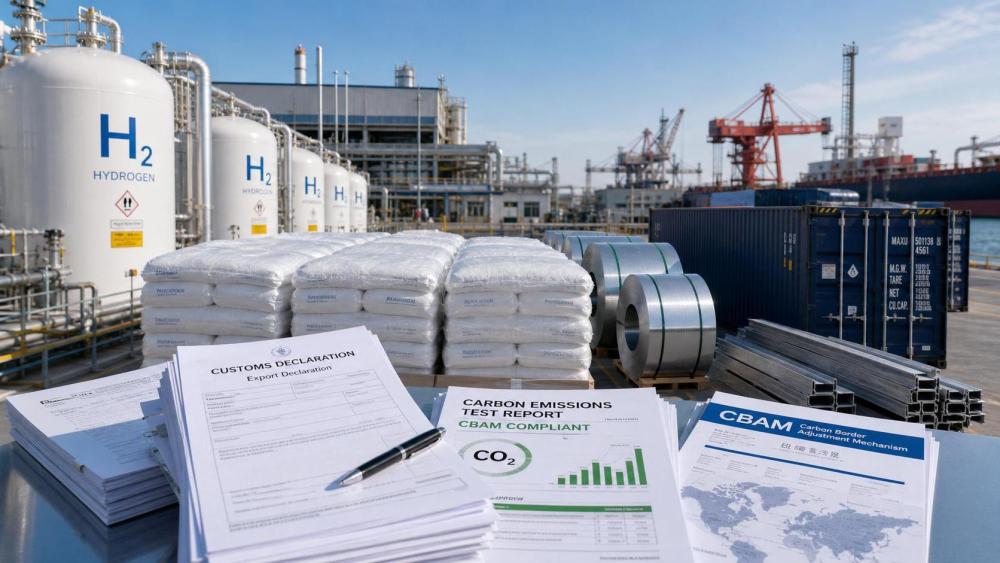
What the new CBAM scope now covers
According to the policy interpretation released by the Carbon Neutrality Association on June 11, 2026, the latest CBAM implementation rules expand the declaration scope from October 2026 to include hydrogen, ammonia, organic chemicals, plastics, aluminum products, and certain downstream steel products.
For these newly covered categories, companies are required to submit full-chain carbon emissions data covering Scope 1, Scope 2, and Scope 3, and the data must be certified under ISO 14064. The disclosed compliance risk is also clear: companies that do not meet the requirement may face added tax burdens and delays in customs processing.
Where the pressure is likely to appear first
Export-facing traders and direct sellers
From an industry perspective, direct trading companies and exporters are likely to feel the impact early because declaration scope changes affect shipment readiness, document preparation, and communication with customers. What deserves closer attention is whether product classifications now fall within the newly added categories and whether supporting carbon data can be delivered in time for cross-border transactions.
Upstream sourcing and materials coordination
For procurement teams and companies managing raw-material inputs, the issue is not only whether a finished product is covered, but also whether upstream suppliers can provide the full-chain emissions information required for Scope 1, 2, and 3 reporting. Analysis shows that supplier data availability and certification readiness may become immediate operational checkpoints.
Manufacturing and processing operations
Manufacturers and processors tied to hydrogen, ammonia, organic chemicals, plastics, aluminum products, and relevant steel downstream products may need to pay closer attention to how production emissions are documented and passed through the chain. The practical impact is likely to concentrate on internal data collection, third-party verification coordination, and delivery timing.
Logistics, customs, and supply chain service providers
Observably, service providers involved in customs filing, shipping coordination, and supply chain execution may also be affected because incomplete or non-compliant documentation can translate into customs delays. For these players, the key change is procedural: compliance information becomes more tightly linked to shipment flow and clearance predictability.
What companies should monitor now
Whether products fall into the expanded categories
The first practical question is product scope. Companies should review whether their goods, components, or processed outputs are now captured by the newly added hydrogen, ammonia, organic chemicals, plastics, aluminum products, or certain downstream steel product categories, because classification directly affects declaration obligations.
Readiness of ISO 14064-certified emissions data
The second focus is documentation readiness. The rule, as summarized in the provided information, points specifically to ISO 14064-certified Scope 1, 2, and 3 emissions data. That means companies should not only consider internal emissions accounting, but also whether value-chain information can be assembled in a form that supports compliance.
Contracting and delivery risk around customs timing
What deserves closer attention is the connection between compliance and execution risk. Since the stated consequence of non-compliance includes customs clearance delays, companies may need to review lead times, document submission checkpoints, and communication with customers or intermediaries before shipment.
Difference between policy text and business implementation
Analysis shows that another important issue is the gap between a rule taking effect and a company being operationally ready for it. Even where the policy direction is already clear, businesses still need to follow how declaration requirements are interpreted in actual transactions, document handling, and supplier coordination.
How this development should be read at this stage
As an editorial observation, this update is more than a narrow product-list adjustment because it links CBAM coverage expansion with stricter full-chain emissions disclosure requirements. It is more appropriate to understand this as a concrete compliance signal rather than a distant policy discussion, especially for companies already dealing in the newly added categories.
At the same time, it should not be overstated as a fully settled end-state for every affected business scenario. Observably, the immediate significance lies in compliance preparation, data coordination, and transaction execution, while further market interpretation will still depend on how companies and counterparties implement the requirements in practice.
A near-term compliance shift with longer-term implications
Taking the available facts together, the October 2026 CBAM scope expansion matters because it brings additional product groups into a more demanding reporting framework and raises the cost of incomplete preparation. A neutral reading is that this is both a short-term operational change and a longer-term signal of tighter carbon data expectations across affected supply chains. For now, it is more appropriate to understand the development as an actionable compliance update that still warrants continued observation as implementation unfolds.
Basis of this article and follow-up points
This article is based on the user-provided news title, event date, and event summary concerning the October 1, 2026 CBAM rule change and the June 11, 2026 policy interpretation by the Carbon Neutrality Association. For this type of industry update, commonly relevant source categories include official announcements, company disclosures, industry association releases, authoritative media reports, and standards-related documents.
A specific official source link was not provided in the input, so continued verification is still necessary. Follow-up attention should remain on any further official wording, implementation clarifications, and practical compliance expectations for the newly added categories.
Related News
- Which Asian Grid Code Differences Affect Substation Equipment Selection?Sep 11, 2026
- U.S. Imposes Four-Year Safeguard Duty on Quartz CountertopsAug 15, 2026
- EU Sets New GIS F-Gas Rule From August 15Aug 04, 2026
- IEC 62271-305:2026 Takes Effect for EU-Bound GISJul 20, 2026