
Red Sea Crisis Tightens XLPE Submarine Cable Capacity on Asia-Europe Routes
Amid escalating Red Sea shipping disruptions, specialized container capacity for cross-linked polyethylene (XLPE) submarine cables on key Asia–Europe trade lanes has tightened sharply, pushing spot freight rates up 37% week-on-week as of May 15, 2026. The bottleneck stems from rerouted vessel deployments and reduced port call efficiency in the Suez Canal corridor—impacting a critical logistics node for high-value energy infrastructure components used in offshore wind integration and ultra-high-voltage (UHV) flexible HVDC transmission projects.
Event Overview
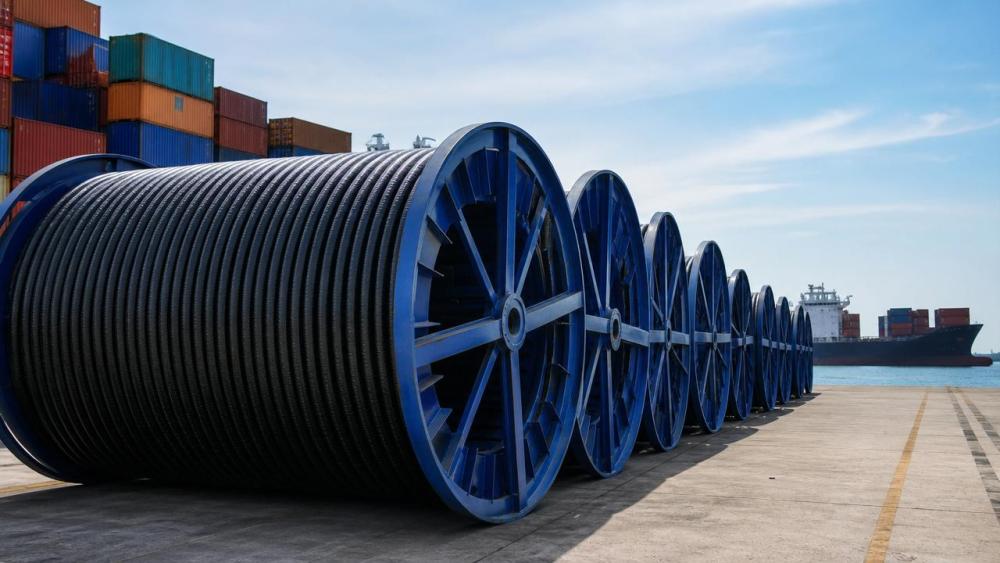
As of May 15, 2026, data indicates that Red Sea maritime congestion continues to intensify. Dedicated vessel capacity for XLPE submarine cables on primary Asia–Europe routes is severely constrained. Spot ocean freight rates rose 37% over the prior week. These cables are widely deployed in offshore wind grid connection and cross-regional UHV flexible HVDC transmission projects. Delivery lead times have extended by 2–4 weeks across multiple origin ports. Buyers in Europe, the Middle East, and Southeast Asia now face heightened pressure to secure booking slots early and assess Chinese suppliers’ local warehousing capabilities and multimodal transport responsiveness.
Impact on Industry Subsegments
Direct trading enterprises — particularly those engaged in cable export/import between China and EU/MEA markets — face immediate margin compression due to volatile freight costs and scheduling uncertainty. Contractual delivery commitments are increasingly at risk, especially where Incoterms place freight responsibility with the seller (e.g., CIF or DAP). Delayed vessel turnarounds also complicate customs clearance timelines and working capital cycles.
Raw material procurement enterprises — including cable compounders sourcing XLPE insulation compounds, copper/steel armoring suppliers, and sheath polymer producers — experience secondary ripple effects. Longer cable delivery windows delay raw material drawdown schedules, increasing inventory carrying costs and reducing forecast accuracy. Some upstream suppliers report requests for extended payment terms from downstream cable manufacturers under pressure.
Manufacturing enterprises — especially submarine cable OEMs and system integrators — confront dual constraints: inbound shortages of specialty materials (e.g., water-blocking tapes, HDPE sheathing) and outbound bottlenecks in finished-goods shipment. Production planning becomes reactive rather than predictive, and just-in-time assembly for project-critical deliveries (e.g., offshore wind array interconnections) is increasingly untenable without buffer stock or alternative routing options.
Supply chain service providers — such as freight forwarders specializing in heavy-lift and project cargo, customs brokers with energy-sector expertise, and multimodal logistics operators — see rising demand for contingency planning support. However, their ability to offer reliable alternatives is limited by scarce deep-sea capacity, tight inland rail/road availability in key EU transshipment hubs (e.g., Rotterdam, Hamburg), and inconsistent documentation turnaround at congested Red Sea-adjacent ports.
Key Considerations and Recommended Actions
Secure dedicated capacity early—and verify equipment specifications
Given the scarcity of XLPE-dedicated containers (often requiring temperature-controlled, vibration-dampened, and corrosion-resistant units), buyers should engage carriers directly—not only via forwarders—to confirm slot allocation and equipment compliance well before production completion. Blank sailing announcements remain frequent; contractual clauses covering force majeure and freight escalation caps warrant urgent review.
Evaluate localized inventory buffers with Chinese suppliers
For European and Middle Eastern procurement teams, assessing Chinese manufacturers’ regional warehousing (e.g., bonded logistics parks in Ningbo, Qingdao, or Guangzhou) and their ability to stage pre-tested cable reels for rapid dispatch may reduce exposure to ocean delays. This requires transparent dialogue on stockholding cost allocation and quality traceability protocols.
Explore multimodal alternatives—not just maritime
While ocean remains dominant, analysis shows that select routes combining rail (e.g., China–Europe rail via Kazakhstan and Belarus) plus short-sea feeder services into Baltic or Black Sea ports can compress total transit time by 5–8 days versus current diverted Cape Route sailings—provided cable reels meet rail loading certifications and transshipment handling standards.
Editorial Perspective / Industry Observation
Observably, this episode highlights how geopolitical stress on maritime chokepoints is no longer merely a shipping-cost issue—it is reshaping infrastructure procurement logic. XLPE submarine cables sit at the intersection of energy transition timelines and global supply chain resilience. Current capacity strain is not simply cyclical; it reflects structural underinvestment in specialized maritime assets for energy-critical cargoes. From an industry perspective, the 37% freight surge is less a pricing anomaly and more a market signal: traditional linear supply models are reaching diminishing returns for mission-critical power infrastructure. A shift toward modularized, pre-certified cable kits and distributed manufacturing nodes—rather than sole reliance on centralized Asian production hubs—is gaining traction among Tier-1 European utilities and EPC contractors.
Conclusion
The Red Sea disruption’s impact on XLPE submarine cable logistics underscores a broader inflection point: energy infrastructure deployment is becoming inseparable from geopolitical supply chain intelligence. For stakeholders across the value chain, the takeaway is not urgency alone—but strategic recalibration. Short-term mitigation matters, but long-term viability will hinge on diversifying routing, rethinking inventory architecture, and aligning procurement KPIs with infrastructure resilience—not just cost or speed.
Source Attribution
Data cited is drawn from publicly reported figures issued by the Shanghai Shipping Exchange (SSE), the Baltic Exchange’s Project Cargo Index (PCI), and verified carrier advisories (Maersk Line, CMA CGM, and Hapag-Lloyd) as of May 15, 2026. Ongoing monitoring is recommended for updates on Egypt’s Suez Canal Authority (SCA) traffic management protocols, EU Commission’s proposed Critical Raw Materials Act implementation timeline, and IEC TC 20/SC 20A’s upcoming revision of IEC 60502-2:2024 for submarine cable type testing under extended transit conditions.
Related News
- National Grid to Invest Up to £400 Million in Extending IFA Link to 2050Oct 30, 2026Transmission Materials Fellow
- Is Submarine Cable Repair More Expensive per Kilometer Than Overhead Line Repair?Sep 10, 2026Transmission Materials Fellow
- Which maintenance practices support offshore cable failure prevention?Oct 18, 2026Transmission Materials Fellow
- EU Requires EN 50684:2026 for XLPE Subsea CablesAug 02, 2026Transmission Materials Fellow