
EU Ends Low-Value Relief, Reshaping Small XLPE Cable Shipments
From July 1, 2026, the EU will apply a fixed EUR 3 customs charge per goods category to all low-value direct-mail parcels entering the bloc after removing the previous tax relief for cross-border parcels below EUR 150. For suppliers and buyers dealing with XLPE submarine cable samples, spare parts, and technical validation shipments, this is not just a tariff update but a practical change in how small-batch exports, trial orders, after-sales delivery, and customs timing need to be assessed.
What Changes on 1 July 2026
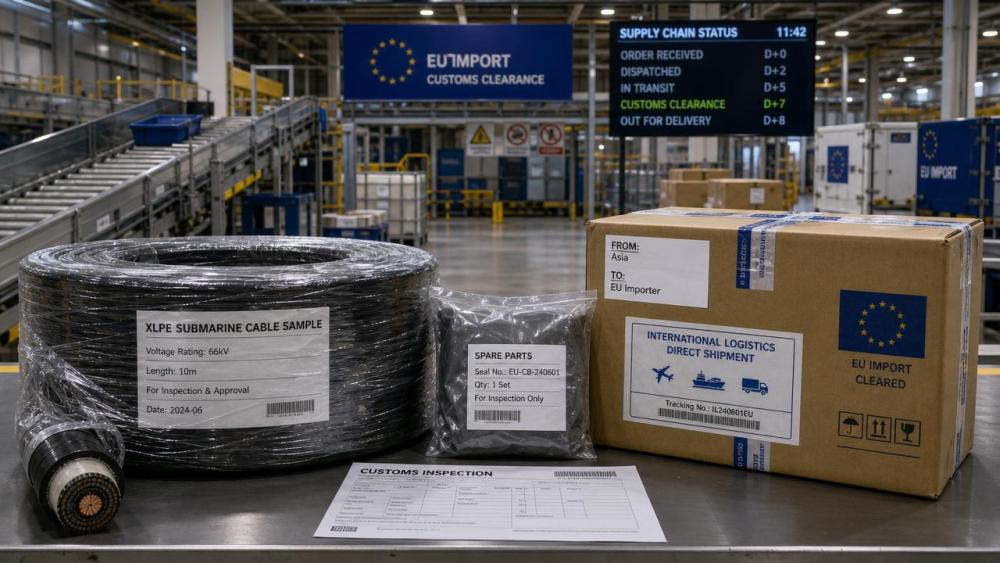
The confirmed change is that the Council of the European Union has formally abolished the tax exemption previously applied to cross-border small parcels valued below EUR 150. Starting on July 1, 2026, all low-value direct-mail parcels entering the EU, including XLPE submarine cable samples, spare parts, and goods sent for technical verification, will be subject to a fixed EUR 3 customs charge for each goods category. The information provided also indicates a direct effect on European distributor trial purchases, end-customer inspection of small quantities, and the pace of after-sales spare-parts delivery, with customs cost and timing requiring reassessment.
Why Smaller Shipment Flows Face Immediate Pressure
Trial orders and distributor sampling become less straightforward
From an industry perspective, distributors using low-value direct shipments for trial orders may face a more visible cost layer on small consignments. The operational impact is likely to appear in quotation structure, sample dispatch decisions, and the commercial viability of frequent low-volume shipments. What deserves closer attention is whether existing purchasing routines for validation lots still make sense once customs charges are built into the landed cost.
Technical verification cargo may need tighter shipment planning
For exporters sending XLPE submarine cable samples or technical verification goods, the change matters because these shipments are often time-sensitive and limited in quantity. Analysis shows that even where the cargo itself is small, customs treatment can affect documentation planning, product categorization, and delivery scheduling. Companies involved in testing support or specification alignment should therefore review whether current shipment splits and declared goods structures remain efficient under the new rule.
After-sales spare parts logistics may feel the timing effect first
After-sales service providers and suppliers supporting installed projects may be affected where spare parts are dispatched in small parcels for urgent replacement or service continuity. Observably, the key issue is not only the fixed charge itself, but also whether customs handling for low-value parcels becomes less convenient than before. Businesses relying on fast-response parcel flows should pay attention to clearance preparation, handover timing, and the possibility that small emergency shipments now require a different delivery arrangement.
Supply chain service providers will need clearer document discipline
Logistics coordinators, customs service providers, and export operations teams may see greater pressure on classification consistency and parcel documentation. Since the rule applies by goods category, the practical focus shifts to how low-value shipments are structured and declared. Analysis shows that companies involved in repeated sample, spare-part, or verification dispatches should pay closer attention to internal document accuracy and to how shipment contents are presented for customs purposes.
Operational Issues Companies Should Watch Closely
Recalculate landed cost for low-volume exports
It is more appropriate to understand this policy as a direct trigger for recalculating customs-related costs on small consignments. Exporters, distributors, and buyers should review whether previous assumptions for low-value direct-mail shipping still hold, especially for samples, technical validation goods, and after-sales parts.
Review shipment batching and delivery rhythm
Analysis shows that the rule may affect how often small parcels are sent and whether certain consignments should remain split into multiple direct shipments. Companies should pay attention to the balance between delivery speed, customs cost, and the operational purpose of each shipment, rather than treating all small deliveries as routine.
Check supporting documents tied to product description
Where technical goods are shipped for verification, testing, or service support, product descriptions and supporting paperwork may become more important in practice. What deserves closer attention is whether internal teams handling sales, logistics, and technical coordination are aligned on the shipment purpose and document set used at export and clearance stages.
Track how the rule is reflected in customer-side processes
The information provided confirms the policy change, but it does not set out detailed execution practices. For that reason, companies should continue monitoring how customers, distributors, and service partners in the EU reflect this change in purchasing procedures, receiving arrangements, and expectations for lead time on low-value shipments.
How This Should Be Read at This Stage
Observably, this is more than a policy headline and should be read as a landed rule change with direct operational consequences for low-value parcel trade into the EU from July 1, 2026. At the same time, it is also a development that still requires follow-up observation in practice, because the provided information does not include detailed implementation language, customs handling nuances, or market-side execution patterns. From an industry perspective, the most useful reading today is that companies should not assume small direct shipments will continue to move under the same cost logic as before.
What the Market Should Take From It
The practical significance of this update lies in its effect on small-batch trade flows rather than on large project cargo. For XLPE submarine cable suppliers and related trade participants, the immediate issue is the need to reassess customs cost, delivery timing, and shipment structure for samples, spare parts, and technical verification goods. It is more appropriate to understand this development as an implemented rule change that already warrants operational review, while some execution details still deserve continued observation.
Basis of This Article and What Still Needs Verification
This article is generated from the user-provided news title, event date, and event summary. For developments of this kind, relevant information is often cross-checked against official notices, regulator publications, customs or trade authority information, industry association updates, standard-setting documents, and reporting by authoritative media. No specific official source link was provided in the input, so the exact official reference still needs ongoing verification. Further attention should remain on implementation details, customs interpretation, document expectations, procurement-side adjustments, tender document changes, industry feedback, and how companies execute under the new rule in practice.
Related News
- National Grid to Invest Up to £400 Million in Extending IFA Link to 2050Oct 30, 2026Transmission Materials Fellow
- Is Submarine Cable Repair More Expensive per Kilometer Than Overhead Line Repair?Sep 10, 2026Transmission Materials Fellow
- Which maintenance practices support offshore cable failure prevention?Oct 18, 2026Transmission Materials Fellow
- EU Requires EN 50684:2026 for XLPE Subsea CablesAug 02, 2026Transmission Materials Fellow