
HTLS Conductor Prices Jump 12% on Rare-Earth Curbs
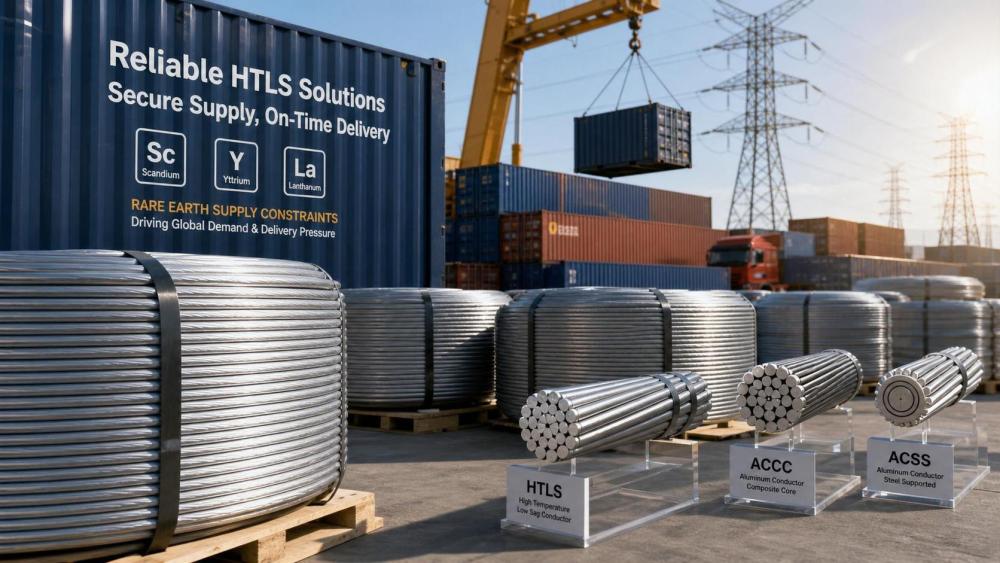
On June 30, 2026, the latest movement in the HTLS conductor market drew attention not only because of a sharp price increase, but because it reflected a trade-rule change with direct operational impact. CRU Group data showed benchmark HTLS conductor prices rising 12% month on month in June 2026, against a backdrop of export restrictions on dysprosium and terbium from China and Myanmar. Because these elements are used in ACCC and ACSS conductors, the change is relevant for procurement, delivery scheduling, budget control, and project execution across the transmission supply chain, especially where UHV line projects depend on timely material availability.
What the June price move confirms
The confirmed facts are limited but clear. Benchmark prices for high-temperature low-sag conductors increased 12% month on month in June 2026, according to CRU Group data. The stated driver was export restrictions on dysprosium and terbium from China and Myanmar. These materials are identified in the input as key alloying elements for ACCC and ACSS conductors. At the same time, procurement teams in North America, the GCC, and Southeast Asia reported longer lead times and revised budget forecasts for UHV line projects.
Where the pressure is likely to appear first
Procurement teams face a tighter trade and delivery environment
From an industry perspective, procurement functions are among the first to feel the effect of export-related restrictions because the issue moves quickly from upstream material access into quoting, sourcing, and delivery commitments. The most immediate exposure is likely to be in purchase timing, supplier confirmation, and budget alignment for HTLS-related orders. What deserves closer attention is whether tender documents, supply contracts, or internal approval processes now require more frequent updates to reflect price validity periods and delivery assumptions.
Manufacturing and project execution may see knock-on scheduling risk
For manufacturers and project delivery teams, the reported extension in lead times suggests pressure on production planning and shipment coordination rather than a purely financial issue. Where ACCC and ACSS conductors are specified, teams may need to watch for changes in component availability, production sequencing, and handover timing. Analysis shows that even without new certification rules being stated in the input, compliance-related documentation, technical submittals, and specification matching can become more sensitive when supply conditions tighten.
Cross-border supply chain service providers need closer document control
Supply chain service providers, including those handling trade execution and logistics coordination, may be affected because export restrictions often translate into greater scrutiny over material origin, shipment timing, and supporting paperwork. Observably, the practical concern is not only whether goods move, but whether procurement and delivery records remain consistent with changing supplier commitments. Businesses involved in contract performance should therefore pay attention to document completeness, version control, and any change notices tied to delivery schedules.
Practical watchpoints for companies now
Review specification and material dependency exposure
Companies using or procuring ACCC and ACSS conductors should first identify where project designs, bids, or supply plans depend on inputs linked to dysprosium and terbium. This is not yet evidence of a universal execution outcome, but it is a practical screening step for contracts and projects that may be exposed to further supply-side constraint.
Check whether procurement documents still match market reality
Analysis shows that revised budget forecasts and longer lead times can quickly make existing procurement assumptions outdated. Teams should pay attention to quotation validity, lead-time language, technical bid alignment, and any clauses tied to delivery acceptance. Where tendering or contract review is underway, consistency between commercial terms and current supply conditions deserves immediate checking.
Keep compliance and technical records ready for tighter scrutiny
Although the input does not provide detailed enforcement measures, companies should watch for whether customers, contractors, or project owners begin asking for more detailed technical documents, test records, origin-related paperwork, or updated delivery confirmations. It is more appropriate to understand this as a risk-management requirement than as a confirmed new compliance regime.
Monitor execution signals rather than assume a settled outcome
What deserves closer attention is whether the trade restrictions cited in the event lead to broader changes in procurement practice, supplier qualification, or project scheduling language. Businesses should avoid treating the current price move as an isolated market fluctuation if later tender files, technical requirements, or delivery expectations begin to incorporate the new constraints more explicitly.
Why this reads as an execution signal, not just a price story
Observably, this development is more significant than a routine monthly price increase because the reported trigger is a restriction affecting access to key alloying inputs. Analysis shows that the market response already extends into lead times and project budgeting, which means the issue has moved into execution territory. At the same time, the available facts do not yet establish a fully defined regulatory outcome across all markets, so it is more appropriate to understand the event as a concrete signal of tightening conditions that still requires follow-up observation.
How the market should read this stage
The immediate industry meaning of this event is that a trade-rule change linked to rare-earth supply has begun to affect HTLS conductor pricing and project planning in visible ways. A rational reading is that the impact is already real at the procurement and scheduling level, while the full downstream effect on compliance practice, tender wording, and supplier performance still needs to be watched carefully. For companies active in HTLS, ACCC, ACSS, and UHV project delivery, the current stage is best understood as an implemented market constraint with evolving execution consequences.
Basis of this report and what still needs verification
This article is based on the user-provided news title, event date, and event summary. For developments of this kind, commonly relevant source categories may include official announcements, regulator releases, customs or trade authority information, industry association updates, standard-setting documents, and reporting from established industry media. A specific official source link was not provided in the input, so further verification remains necessary. What still needs continued observation includes possible policy detail, enforcement interpretation, procurement document changes, technical and certification-related requirements, industry feedback, and how companies ultimately execute under the revised supply conditions.
Related News
- Do HTLS Conductors Require Existing Tower Structures to Be Replaced?Sep 09, 2026Transmission Materials Fellow
- How do HTLS conductors increase capacity without new towers?Sep 05, 2026Transmission Materials Fellow
- DOE HTLS Supplier List Adds 3 Chinese VendorsJul 12, 2026Transmission Materials Fellow
- DOE Tightens HTLS Import Review on CFCC TraceabilityJul 10, 2026Transmission Materials Fellow