
TÜV Rheinland Updates WAMS Certification:北斗 Timing Validation Required
On May 9, 2026, TÜV Rheinland updated its certification requirements for Wide Area Measurement Systems (WAMS), mandating that all Phasor Measurement Units (PMUs) deployed for dynamic grid monitoring in Europe must embed time synchronization modules validated against China’s BeiDou-3 B1C signal—with timing deviation ≤100 ns. GPS-only calibration is no longer accepted. This shift directly impacts manufacturers, integrators, and certification service providers active in the power system instrumentation and smart grid infrastructure sectors.
Event Overview
On May 9, 2026, TÜV Rheinland issued a revision to its WAMS certification framework. The update requires that any PMU device intended for use in European transmission system operator (TSO) applications must demonstrate microsecond-level time synchronization performance verified specifically via the BeiDou-3 B1C frequency band. The acceptable timing deviation threshold is set at ≤100 nanoseconds. GPS-based time source validation alone is explicitly excluded from compliance.
Industries Affected by Segment
PMU Equipment Manufacturers (especially Chinese exporters)
These firms are directly affected because their existing PMU designs—particularly those relying on GPS-only or dual-GPS/Galileo timing modules—no longer meet the updated TÜV Rheinland requirement. Impact manifests in product recertification timelines, firmware development cycles, and potential delays in EU market access.
Smart Grid System Integrators & TSO Contractors
Integrators specifying or deploying PMUs in European grid modernization projects must now verify BeiDou timing compatibility at the component level prior to procurement. Non-compliant devices may trigger rejection during third-party conformity assessment or fail on-site commissioning audits.
Timing Module & GNSS Receiver Suppliers
Suppliers providing OEM timing modules (e.g., chipsets, embedded receivers) to PMU makers face revised qualification demands. Modules previously certified only for GPS L1 C/A or Galileo E1 must now undergo additional BeiDou B1C signal acquisition, tracking, and holdover performance testing under TÜV Rheinland’s updated test protocol.
Third-Party Certification & Test Laboratories
Labs offering GNSS timing validation services must establish traceable BeiDou-3 B1C reference time chains and demonstrate measurement uncertainty ≤30 ns to support client submissions. Absence of BeiDou-capable infrastructure limits eligibility as an authorized TÜV Rheinland test partner.
Key Focus Areas and Recommended Actions for Stakeholders
Monitor official TÜV Rheinland documentation updates
Track the publication of the formal test specification document (e.g., TÜV RL WAMS-TS-2026-05), which will define exact test conditions, environmental profiles, and acceptance criteria for BeiDou B1C validation. Early access enables alignment of internal verification protocols.
Verify BeiDou B1C firmware readiness and lab interoperation status
Confirm whether current PMU firmware supports BeiDou-3 B1C signal acquisition in standalone mode (i.e., without GPS fallback), and assess interoperability with accredited BeiDou timing labs—including mutual recognition status between Chinese national metrology institutes (e.g., NIM) and EU notified bodies.
Distinguish between certification policy change and immediate enforcement deadlines
The May 9, 2026 announcement signals a new baseline requirement, but transition periods may apply. Stakeholders should confirm whether grandfathering applies to already-certified units or if all new submissions after a defined cut-off date (e.g., Q4 2026) must comply unconditionally.
Prepare for hardware/firmware revalidation and supply chain coordination
Initiate cross-functional reviews involving R&D, quality assurance, and procurement teams to identify components requiring redesign or requalification. Where applicable, engage GNSS module suppliers early to secure access to BeiDou-3 B1C–enabled reference designs and evaluation kits.
Editorial Perspective / Industry Observation
Observably, this update reflects a broader trend toward multi-constellation resilience and geopolitical diversification in critical infrastructure timing systems—not merely a technical recalibration. Analysis shows it functions primarily as a regulatory signal rather than an immediately enforceable mandate, given typical certification lead times and phased implementation patterns in grid equipment standards. From an industry perspective, the requirement underscores growing interdependence between global GNSS infrastructure governance and regional power system cybersecurity frameworks. Continuous monitoring is warranted, particularly regarding potential harmonization efforts between ENTSO-E’s WAMS guidelines and future revisions to IEC 61850-90-5.
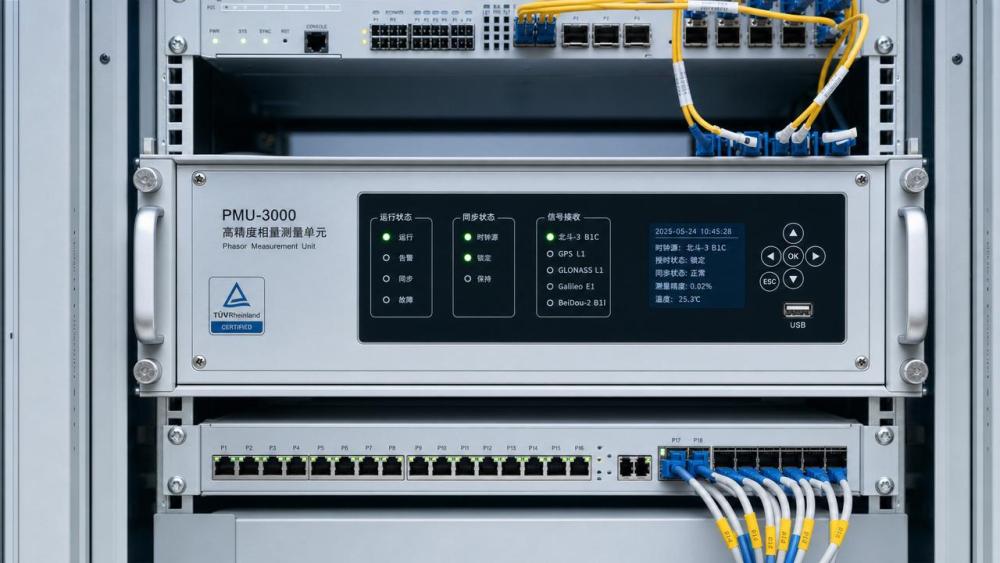
Conclusion: This TÜV Rheinland update does not represent a sudden market barrier, but rather a calibrated step toward stricter timing sovereignty requirements in European grid-edge instrumentation. It is more accurately understood as an early-stage alignment signal—prompting technical preparation and ecosystem coordination—rather than an operational disruption. Stakeholders are advised to treat it as a medium-term compliance milestone requiring structured engineering response, not an emergency contingency.
Source: TÜV Rheinland official announcement (May 9, 2026); no further technical annexes or enforcement timelines have been publicly released as of the announcement date. Ongoing observation is recommended for subsequent publication of test methodology documents and transitional provisions.
Related News
- How to Validate Grid Stability After Adding Large-Scale SolarSep 09, 2026Grid Automation Expert
- NEOM Opens Phase II WAMS Analytics TenderJul 12, 2026Grid Automation Expert
- ANEEL Speeds Tariff Incentives for WAMS Grid ProjectsJul 08, 2026Grid Automation Expert
- India Sets Q2 2027 WAMS Rule for >220kV SubstationsJul 07, 2026Grid Automation Expert