
KEPCO Launches Emergency WAMS Terminal Procurement for 2026 Summer Peak
On May 15, 2026, Korea Electric Power Corporation (KEPCO) issued an urgent tender (Ref: KEPCO-EM-2026-051) to procure 500 wide-area measurement system (WAMS) real-time analysis terminals ahead of the 2026 summer load peak — signaling a critical infrastructure upgrade driven by grid stability concerns amid rising renewable intermittency and electrification-driven demand surges.
Event Overview
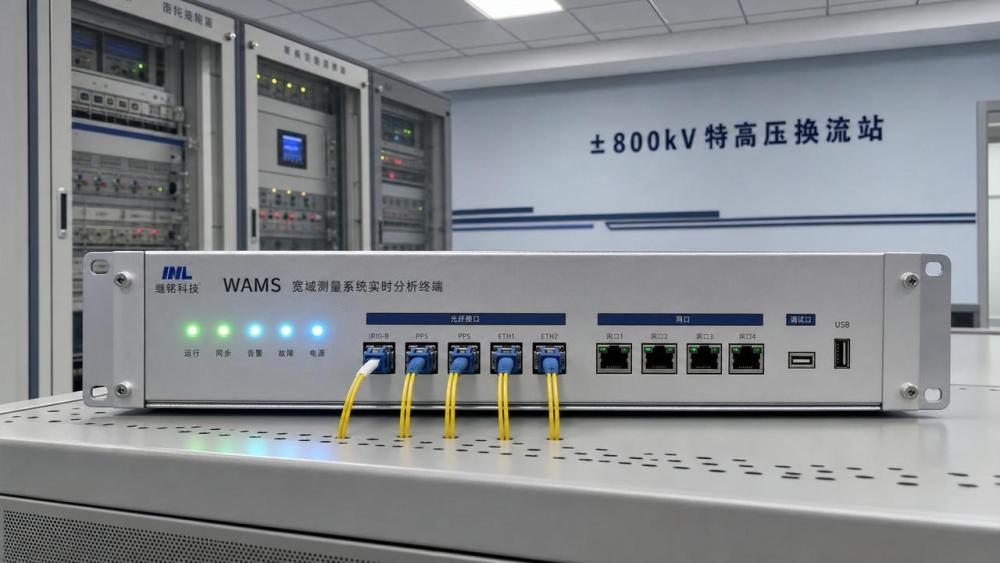
KEPCO announced the tender on May 15, 2026, requiring delivery and commissioning of all 500 WAMS real-time analysis terminals by end-June 2026. The specification mandates support for millisecond-level phasor measurement unit (PMU) data stream processing and AI-powered anomaly clustering. Compliance with both IEC 61850-90-5 and IEEE C37.118.2 communication protocols is explicitly required. The tender is open to international bidders, including manufacturers certified under applicable Korean technical acceptance frameworks.
Industries Affected
Direct trade enterprises: Export-oriented power automation equipment distributors and authorized agents face accelerated qualification timelines and tighter documentation requirements — particularly regarding protocol conformance test reports and KOREA Electric Association (KEA) type-approval pathways. Revenue visibility improves short-term, but margin pressure arises from expedited logistics and local certification support costs.
Raw material procurement enterprises: Suppliers of high-reliability FPGA modules, ultra-low-latency Ethernet PHYs, and industrial-grade timing ICs (e.g., IEEE 1588v2-compliant oscillators) may see stepped-up order inquiries — yet exposure remains constrained unless already embedded in KEPCO-qualified vendor supply chains. Lead time volatility increases due to compressed project windows.
Manufacturing enterprises: Chinese and other non-Korean WAMS terminal OEMs with existing IEC 61850-90-5/IEEE C37.118.2 dual-stack capability gain a rare near-term market entry opportunity — but only if they can demonstrate operational validation under Korean grid conditions (e.g., KEPRI test reports or prior KEPCO pilot references). Manufacturing scale-up must align with June 2026 hard deadline, limiting flexibility.
Supply chain service enterprises: Third-party testing labs accredited for KEPCO interoperability verification (e.g., KTL, KERI, or internationally recognized equivalents with KEPCO mutual recognition) are likely to experience surge demand for protocol conformance and cyber-resilience assessments. Translation, technical documentation localization, and Korean regulatory liaison services also become time-sensitive value-adds.
Key Focus Areas and Recommended Actions
Verify protocol stack readiness against both standards
Vendors must confirm not only dual-protocol firmware support but also field-proven synchronization accuracy (<1 μs timestamp jitter) and resilience to packet loss under 100-ms network latency — per KEPCO’s unpublished but referenced ‘Grid Stability Assurance Guideline v2.1’.
Pre-validate with KEPCO-recognized test centers
Submission without prior conformance evidence from KERI, KTL, or KEPCO’s own Grid Intelligence Lab significantly reduces bid competitiveness. Bidders should prioritize labs with documented KEPCO acceptance history over general ISO/IEC 17025 accreditation alone.
Prepare localized technical documentation and warranty terms
Korean-language operation manuals, cybersecurity maintenance SLAs (including mandatory 4-hour remote response), and on-site Korean-speaking engineering support commitments are evaluated as pass/fail criteria — not just scoring factors.
Editorial Perspective / Industry Observation
Observably, this tender reflects KEPCO’s strategic pivot toward data-driven grid resilience — moving beyond passive monitoring to predictive, AI-augmented control readiness. Analysis shows the 500-unit volume is not incremental but foundational: it enables KEPCO’s planned 2027 rollout of dynamic line rating (DLR) and adaptive protection schemes across its transmission backbone. From an industry standpoint, the dual-protocol mandate signals convergence rather than fragmentation — suggesting future tenders will treat IEC and IEEE standards as co-required, not alternatives. Current more noteworthy is the absence of domestic Korean manufacturing capacity for such terminals; this creates a narrow but high-stakes window for qualified foreign vendors — one unlikely to repeat at similar scale before KEPCO’s next-generation ‘Smart Grid 3.0’ architecture takes shape post-2028.
Conclusion
This procurement is less a standalone hardware purchase and more a calibrated signal of KEPCO’s accelerating digital grid transformation timeline. For global suppliers, success hinges not on product capability alone, but on demonstrable alignment with Korean operational rigor, regulatory cadence, and real-time grid physics — making responsiveness and contextual competence decisive competitive differentiators.
Source Attribution
Official tender notice published on KEPCO E-Procurement Portal (https://epro.koreapower.co.kr, Ref: KEPCO-EM-2026-051), dated May 15, 2026. Supporting technical specifications referenced in Annex A-3 (‘WAMS Terminal Interoperability Requirements’) and Appendix D (‘Acceptance Testing Protocol’). Note: KEPCO has not disclosed final award date or pre-qualification status; ongoing monitoring of bid clarification responses and evaluation committee announcements is recommended.
Related News
- How to Validate Grid Stability After Adding Large-Scale SolarSep 09, 2026Grid Automation Expert
- NEOM Opens Phase II WAMS Analytics TenderJul 12, 2026Grid Automation Expert
- ANEEL Speeds Tariff Incentives for WAMS Grid ProjectsJul 08, 2026Grid Automation Expert
- India Sets Q2 2027 WAMS Rule for >220kV SubstationsJul 07, 2026Grid Automation Expert