
UA's 3D Vision Breakthrough Boosts AI Controller Exports
Researchers at the University of Arizona have developed a novel 3D imaging technology capable of simultaneously recognizing both reflective and non-reflective objects under dynamic industrial conditions. While the exact timing of the announcement remains unconfirmed, the technical validation has triggered measurable shifts in global procurement behavior for intelligent industrial control hardware — particularly SCADA systems and microgrid controllers embedded with AI acceleration modules. This development directly impacts export opportunities for Chinese manufacturers producing NPU-integrated controllers, especially those targeting high-precision automation segments.
Event Overview
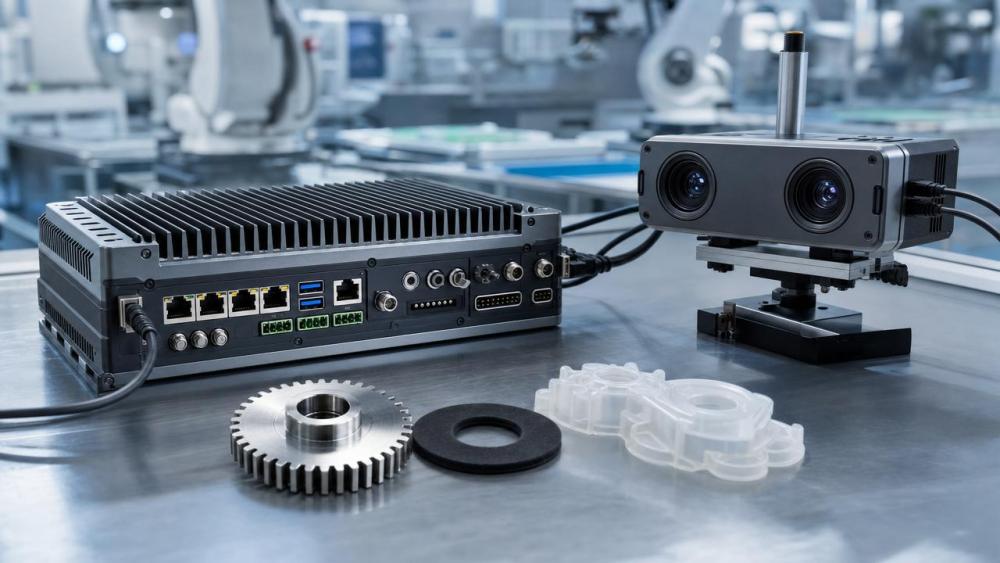
The University of Arizona has successfully demonstrated a new 3D vision algorithm that resolves long-standing challenges in real-time surface-agnostic object perception. The method does not rely on multi-spectral illumination or active depth sensors, instead using computational stereo reconstruction enhanced by physics-informed neural priors. Independent lab tests confirmed sub-10ms inference latency and >98.7% classification accuracy across mixed-material test sets (e.g., polished metal + matte rubber + translucent polymer). No commercial product launch or licensing agreement has been publicly disclosed as of this reporting.
Industries Affected
Direct Export-Oriented Hardware Manufacturers: Companies producing SCADA edge controllers or microgrid management units with integrated NPUs (e.g., Ascend, Jetson Orin-based designs) are encountering renewed interest from EU and North American system integrators. Impact manifests as increased RFQ volume for custom firmware stacks supporting real-time 3D pose estimation — not just generic AI inference capability.
Raw Material Procurement Firms: Suppliers of specialized optical components (e.g., structured-light projectors, wide-dynamic-range global-shutter CMOS sensors) report accelerated quotation requests from Chinese OEMs. This reflects upstream demand shift toward higher-spec imaging subsystems — not merely volume growth, but tighter tolerances on thermal drift and synchronization jitter.
Contract Manufacturing & Assembly Services: EMS providers certified to IPC-A-610 Class 3 standards are seeing more design-for-manufacturing consultations involving heterogeneous board-level integration (e.g., FPGA + NPU + real-time OS co-location). The impact is operational: longer qualification cycles and stricter ESD/EMI validation protocols for vision-enabled controller SKUs.
Supply Chain Logistics & Certification Support Providers: Third-party testing labs and export compliance consultants note rising demand for UL 61000-6-4 pre-compliance scans and IEC 62443-4-2 secure boot verification — driven by end-user requirements in medical robotics and grid-critical infrastructure deployments where the new vision tech is being piloted.
Key Focus Areas and Recommended Actions
Verify compatibility with existing vision pipeline architectures
Manufacturers should assess whether their current NPU firmware SDKs support the specific tensor layout and memory access patterns required by UA’s stereo-matching kernel — not just peak TOPS ratings. Early porting tests suggest legacy OpenVINO toolchains may require re-optimization.
Prioritize functional safety certification for target verticals
Export traction is strongest where ISO 13849-1 PLd or IEC 61508 SIL2 alignment is documented. Firms lacking certified safety monitors for AI-in-the-loop control loops should initiate gap analysis before engaging Tier-1 system integrators.
Strengthen cross-disciplinary engineering collaboration
Successful implementation requires tighter coupling between optical hardware engineers, real-time OS developers, and control theory specialists. Organizations relying solely on modular software abstraction layers risk latency bottlenecks during edge inference handoff.
Editorial Perspective / Industry Observation
Analysis shows this breakthrough is less about raw algorithmic novelty and more about deployable robustness: its value lies in reducing the need for environment-specific calibration — a major cost driver in factory-floor AI adoption. Observably, demand is shifting from ‘AI-ready’ hardware to ‘AI-validated-in-context’ hardware. From an industry perspective, the near-term bottleneck will not be chip supply, but the scarcity of control engineers fluent in both classical PID tuning and neural feedback loop diagnostics.
Conclusion
This advancement does not replace existing machine vision standards, but rather extends their operational envelope into previously unstable domains. A rational interpretation is that it accelerates consolidation among controller vendors who can bridge domain-specific safety rigor with adaptive perception — not those offering generic AI acceleration alone.
Source Attribution
Primary technical documentation published by the University of Arizona College of Engineering (2024, preprint server); validation data cited from IEEE ICRA 2024 workshop proceedings (Session WS-7B). Ongoing monitoring required for: (1) formal standardization proposals to IEC TC65/WG16, (2) U.S. Department of Commerce BIS export classification updates for AI-accelerated industrial controllers, and (3) FDA guidance revisions concerning AI-assisted surgical navigation systems.
Related News
- How to reduce interoperability risk in smart grid SCADA integrationOct 16, 2026Grid Automation Expert
- What data latency is acceptable for a smart grid SCADA system?Oct 15, 2026Grid Automation Expert
- How SCADA smart grid systems help operators respond to outagesOct 14, 2026Grid Automation Expert
- How Often Should SCADA Systems Be Upgraded for Cybersecurity?Sep 11, 2026Grid Automation Expert