
World's First Commercial Liquid-Cooled PCS Inverter System Enters Operation
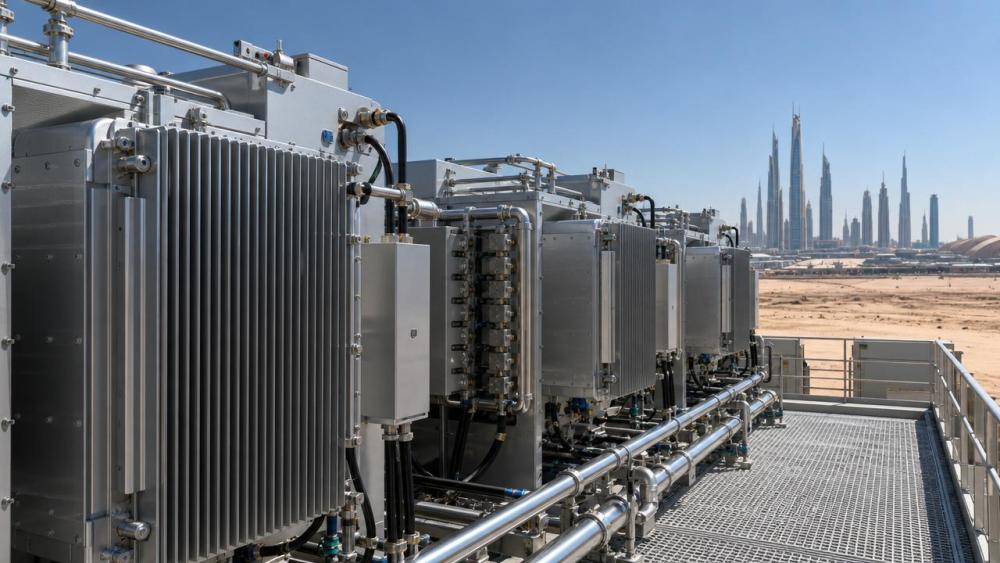
On May 4, 2026, ACWA Power commissioned the world’s first 1.2 GW liquid-cooled power conversion system (PCS) inverter cluster in NEOM, Saudi Arabia — featuring dual-phase immersion cooling modules and adaptive power allocation AI algorithms supplied by Chinese manufacturers. This milestone signals the entry of liquid-cooled PCS technology into gigawatt-scale commercial deployment, with Chinese thermal management subsystems and control software now serving as core enablers in major overseas solar-plus-storage projects. Stakeholders in power electronics manufacturing, thermal management supply chains, and international EPC services should closely monitor implications for technology integration, export compliance, and system-level qualification requirements.
Event Overview
On May 4, 2026, Saudi-based ACWA Power launched the world’s first commercial 1.2 GW liquid-cooled PCS inverter cluster in NEOM新城. The system integrates dual-phase immersion cooling modules and self-adaptive power distribution AI algorithms provided by Chinese suppliers. No further technical or contractual details have been publicly disclosed beyond this confirmation.
Industries Affected by Segment
Power Electronics Manufacturers (PCS, Inverters, Grid-Tied Converters)
These firms face intensified pressure to validate liquid-cooling compatibility across high-power, long-duration operation scenarios. Impact manifests in revised thermal design specifications, accelerated adoption of immersion-ready component packaging, and increased demand for co-simulation capabilities between electrical and thermal domains.
Thermal Management Suppliers (Cooling Modules, Dielectric Fluids, Cold Plate Producers)
Suppliers of immersion cooling hardware and fluids are now positioned as critical path enablers—not just auxiliaries—for large-scale energy storage systems. Impact includes tighter qualification timelines for dielectric fluid safety certifications (e.g., UL 94, IEC 61000-4 series), heightened scrutiny of material compatibility with semiconductor substrates, and growing need for field-deployable thermal performance validation protocols.
Control Software & AI Algorithm Developers (Energy Management Systems, Real-Time Optimization)
Software vendors supporting PCS control logic must now demonstrate interoperability with liquid-cooling telemetry interfaces (e.g., temperature gradient mapping, flow-rate feedback loops). Impact centers on expanded functional safety documentation (IEC 61508/62443 alignment), traceability of AI decision pathways under transient grid conditions, and readiness to support edge-computing deployments at substation level.
International EPC and System Integrators
EPC contractors executing overseas utility-scale BESS projects now encounter new interface responsibilities: coordinating thermal subsystem commissioning alongside electrical integration, validating cooling loop integrity pre-energization, and managing cross-border spares logistics for proprietary cooling components. Impact includes revised risk allocation clauses in contracts and expanded scope-of-work definitions for thermal commissioning handover.
Key Focus Areas and Immediate Actions for Relevant Enterprises
Monitor official technical specifications issued by ACWA Power or NEOM Energy Authority
Current project documentation remains limited. Any subsequent release of thermal interface control documents (TICDs), fluid maintenance schedules, or AI algorithm validation reports will directly inform design benchmarks for future bids.
Track certification status of dielectric fluids and immersion module designs in target markets
Regulatory acceptance varies significantly across GCC, EU, and ASEAN jurisdictions. Priority should be placed on verifying whether the specific dual-phase fluid used meets local fire safety, environmental discharge, and transformer oil compatibility standards — not just generic lab test results.
Distinguish between pilot-scale validation and full-system commercial qualification
This NEOM deployment represents a commercial installation, not a demonstration. However, its operational longevity and failure rate data remain unreported. Enterprises should treat early-stage field performance as indicative—not definitive—until ≥12 months of continuous operation data becomes available.
Prepare for extended lead times on immersion-compatible power semiconductors and sensor-integrated cold plates
Supply chain bottlenecks are emerging around gallium nitride (GaN) and silicon carbide (SiC) devices rated for direct-die immersion, as well as MEMS-based flow/temperature sensors qualified for long-term dielectric fluid exposure. Preemptive engagement with wafer foundries and sensor OEMs is advised.
Editorial Perspective / Industry Observation
Observably, this event marks a structural shift—not merely a technical upgrade—in how high-power PCS systems are architected for utility-scale applications. It reflects growing acceptance of liquid cooling as a non-negotiable enabler for >1 MW per cabinet configurations, especially where land constraints or ambient temperature extremes limit air-cooling viability. Analysis shows that while the hardware integration has reached commercial readiness, the broader ecosystem—including standardized maintenance procedures, second-source component availability, and harmonized safety codes—remains fragmented. This milestone is best understood not as a finished outcome, but as a catalyst accelerating parallel development across thermal, electrical, and software layers. Continued attention is warranted as subsequent deployments in South Africa, Chile, and Australia begin reporting commissioning timelines and operational KPIs.
In summary, the NEOM 1.2 GW liquid-cooled PCS deployment establishes a new reference point for thermal architecture in grid-scale power conversion. Its significance lies less in novelty and more in proven scalability—confirming that liquid cooling can transition from niche R&D to bankable infrastructure. For industry participants, this is better interpreted as a signal of converging technical thresholds across multiple subsystems, rather than an isolated procurement opportunity. A measured, evidence-based approach—grounded in verifiable field data and jurisdiction-specific regulatory alignment—remains the most appropriate response at this stage.
Source: Public announcement by ACWA Power (May 4, 2026); no third-party verification or technical white paper has been released as of publication. Field performance metrics, long-term reliability data, and certification documentation remain pending observation.
Related News
- What Are the Common PCS Inverter Failures in High-Humidity Environments?Sep 10, 2026Energy Storage Strategist
- How do PCS inverters affect battery storage round-trip efficiency?Sep 06, 2026Energy Storage Strategist
- DOE Adds 3 Chinese PCS Suppliers to U.S. QPLJul 15, 2026Energy Storage Strategist
- Saudi SEC Sets First Grid-Forming PCS Approval PathJul 04, 2026Energy Storage Strategist