
China's PCS Inverter Exports to Japan Up 37% YoY in FY2026 Q1
On May 14, 2026, Japan External Trade Organization (JETRO) reported a 37% year-on-year increase in quarterly exports of photovoltaic (PV) power conditioning system (PCS) inverters from China to Japan — reaching USD 210 million — driven primarily by accelerated grid-connection approvals for solar power plants and the implementation of Japan’s new Green Investment Tax Deduction scheme. This development is particularly relevant for manufacturers of PV inverters, export-oriented electronics suppliers, Japanese project developers, and certification service providers operating across the solar supply chain.
Event Overview
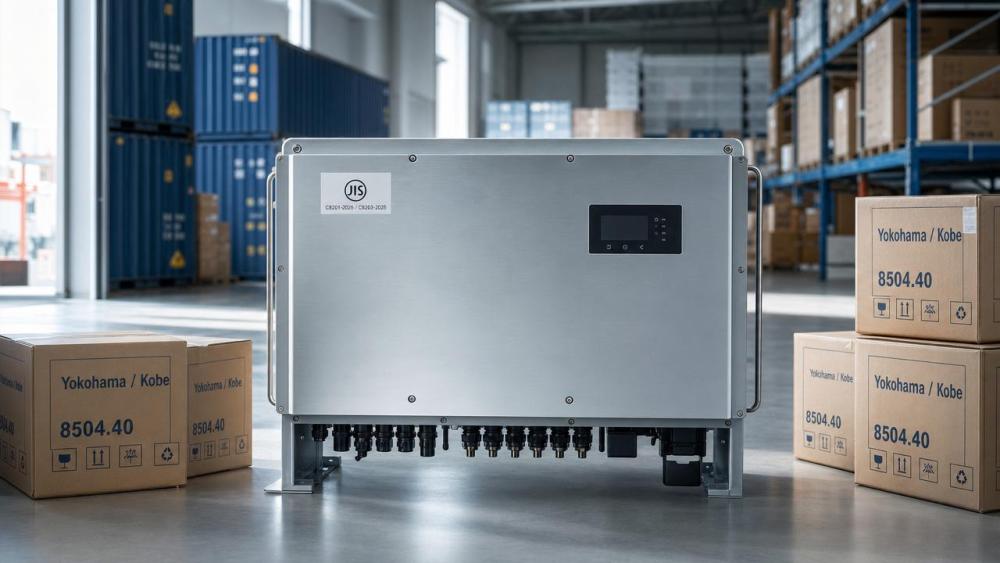
On May 14, 2026, JETRO published its Monitoring Report on Electrical and Mechanical Imports: FY2026 First Quarter. According to the report, Chinese-made PCS inverters exported to Japan totaled USD 210 million in FY2026 Q1 (April–June 2026), representing a 37% increase year-on-year and marking a record high for a single quarter. The report attributes this growth to two key policy developments: expedited photovoltaic plant interconnection approvals by Japan’s Ministry of Economy, Trade and Industry (METI), and the rollout of the Green Investment Tax Deduction program. JETRO also noted that inverters certified to both JIS C 8201-2026 and JIS C 8203-2025 standards were especially favored in the Japanese market.
Impact on Specific Industry Segments
Direct Exporters (China-based PCS inverter manufacturers)
These firms experienced direct volume and revenue uplift due to increased Japanese demand. Impact manifests as higher order volumes, tighter delivery timelines, and intensified scrutiny on compliance documentation — particularly JIS certification validity and traceability of test reports.
Supply Chain & Component Suppliers (e.g., IGBT module, PCB, and cooling system vendors)
Rising export volumes place upward pressure on upstream capacity utilization. Suppliers with exposure to JIS-compliant inverter production lines may see increased orders, but only if their subcomponents meet supporting conformity requirements (e.g., JIS C 5400 series for semiconductors or JIS C 0910 for safety testing).
Japanese EPC Contractors and Independent Power Producers (IPPs)
Faster grid approval timelines reduce project lead times and financing costs. However, procurement teams now face stricter technical validation — especially regarding JIS dual-certification — which may delay vendor selection unless pre-qualified suppliers are available.
Certification and Compliance Service Providers
Demand for JIS C 8201-2026 and JIS C 8203-2025 conformance assessments has risen. Providers offering integrated testing, factory inspection, and METI registration support are seeing higher inquiry volumes — particularly from Chinese exporters seeking faster turnaround.
What Relevant Enterprises or Practitioners Should Focus On
Monitor official updates on METI’s grid-connection acceleration framework
The pace and scope of METI’s administrative streamlining remain subject to regional utility discretion. Stakeholders should track announcements from individual regional transmission operators (e.g., TEPCO, Kansai Electric) — not just METI — to assess real-world deployment velocity.
Verify JIS certification scope and version alignment before shipment
JIS C 8201-2026 and JIS C 8203-2025 are distinct standards covering general safety and grid-support functions respectively. Exporters must confirm that their certificates explicitly reference the 2026/2025 editions — earlier versions (e.g., JIS C 8201-2017) do not satisfy current import requirements.
Distinguish between policy announcement and operational readiness
The Green Investment Tax Deduction is effective for qualifying equipment installed after April 1, 2026, but tax filing and verification procedures are still being finalized by Japan’s National Tax Agency. Exporters and buyers should treat early adoption as conditional until formal guidance on documentation and audit protocols is issued.
Prepare for potential surge-driven logistics and customs bottlenecks
A 37% YoY jump in a single quarter may strain Japanese port handling capacity and customs clearance resources — especially at major entry points like Yokohama and Kobe. Exporters should pre-validate HS code classification (8504.40 for PCS inverters) and ensure commercial invoices clearly state JIS compliance status to avoid delays.
Editorial Observation / Industry Perspective
Observably, this JETRO data point reflects a short-term inflection in trade flow rather than a structural shift — it captures the immediate effect of overlapping regulatory triggers (faster approvals + tax incentives) in one fiscal quarter. Analysis shows the 37% growth is concentrated among a limited cohort of JIS dual-certified suppliers, suggesting market access remains highly conditional on technical compliance, not just price or capacity. From an industry perspective, this trend is best understood as a policy-enabled demand pulse: valuable for near-term revenue, but not yet indicative of broad-based, long-term market liberalization. Sustained growth will depend less on export volume alone and more on how consistently Chinese manufacturers align with evolving Japanese grid codes — including upcoming revisions to JIS C 8203 related to reactive power control and fault ride-through.
Conclusion
This JETRO report signals a timely, policy-driven expansion in demand for compliant PCS inverters in Japan — but one tightly coupled to specific regulatory conditions and certification rigor. It is not evidence of generalized market opening, nor does it imply reduced technical barriers. Instead, it underscores that success in this market continues to hinge on precise standard alignment, proactive regulatory engagement, and responsiveness to administrative implementation — not just manufacturing scale or cost advantage.
Information Sources
Main source: Japan External Trade Organization (JETRO), Monitoring Report on Electrical and Mechanical Imports: FY2026 First Quarter, released May 14, 2026.
Note: Ongoing observation is warranted for METI’s regional grid-approval metrics and the National Tax Agency’s final guidance on Green Investment Tax Deduction substantiation requirements — neither of which were detailed in the May 2026 JETRO report.
Related News
- What Are the Common PCS Inverter Failures in High-Humidity Environments?Sep 10, 2026Energy Storage Strategist
- How do PCS inverters affect battery storage round-trip efficiency?Sep 06, 2026Energy Storage Strategist
- DOE Adds 3 Chinese PCS Suppliers to U.S. QPLJul 15, 2026Energy Storage Strategist
- Saudi SEC Sets First Grid-Forming PCS Approval PathJul 04, 2026Energy Storage Strategist