
U.S. DOE Allocates $420M for Liquid-Cooled BESS Projects, Chinese Supply Chain Key Partner
On May 8, 2026, the U.S. Department of Energy (DOE) announced a $420 million first-phase funding round under its new Advanced Energy Storage Infrastructure Acceleration Program, supporting 12 demonstration projects for liquid-cooled battery energy storage systems (BESS). This development is highly relevant to stakeholders in battery thermal management, power conversion systems, grid-scale energy storage integration, and cross-border clean energy supply chains — particularly those engaged in U.S.-China technical collaboration under evolving regulatory and certification frameworks.
Event Overview
On May 8, 2026, the U.S. Department of Energy (DOE) launched the Advanced Energy Storage Infrastructure Acceleration Program. As part of this initiative, the DOE committed $420 million in initial funding to support 12 liquid-cooled large-capacity battery energy storage system (BESS) demonstration projects. Publicly disclosed information confirms that seven of these 12 projects explicitly incorporate thermal management modules and PCS (power conversion system) integration solutions supplied by leading Chinese enterprises. These suppliers are noted to hold UL 1973 and IEEE 1547 certifications and maintain localized service networks in the United States.
Industries Affected
Direct Trade Enterprises
Companies exporting liquid-cooling thermal management units or certified PCS inverters to the U.S. may experience increased tender participation and project qualification opportunities. The DOE’s selection criteria implicitly prioritize vendors with verifiable compliance (UL 1973/IEEE 1547) and on-the-ground technical support — not just product supply. Impact manifests as higher demand for documentation traceability, U.S.-based engineering coordination capacity, and post-installation service responsiveness.
Manufacturing & Integration Firms
Firms assembling or co-integrating BESS subsystems — especially those combining battery racks, liquid cooling loops, and PCS — face intensified scrutiny on system-level certification alignment. The fact that seven projects selected China-sourced thermal + PCS packages suggests growing market acceptance of pre-validated sub-system integrations. Impact includes pressure to harmonize factory test protocols with U.S. interconnection standards and to allocate resources toward joint commissioning support.
Supply Chain Service Providers
Logistics, customs brokerage, and after-sales technical service providers supporting U.S. BESS deployments must now accommodate tighter timelines tied to DOE-funded milestones. With federal funding disbursed in phases contingent on technical deliverables, delays in component clearance or field technician deployment could affect project drawdown schedules. Impact centers on documentation readiness (e.g., UL certification copies, English-language O&M manuals), spare parts stocking strategies near project sites, and bilingual field engineer availability.
What Stakeholders Should Monitor and Do Now
Track Official Guidance on Certification Pathways
While UL 1973 and IEEE 1547 are cited, DOE has not published detailed eligibility rules for vendor qualification. Stakeholders should monitor upcoming Federal Register notices and DOE program office webinars — especially regarding whether third-party validation of integrated thermal+PCS performance will become mandatory for future funding rounds.
Assess Exposure to Specific Project Sites and Grid Operators
The 12 funded projects are distributed across multiple U.S. ISO/RTO regions. Companies should cross-reference public project lists (once released) with their existing regional service coverage and identify gaps — e.g., limited presence in ERCOT or MISO may constrain near-term participation despite product eligibility.
Distinguish Policy Signal from Immediate Procurement Volume
This $420M allocation supports only 12 demonstration projects — not commercial-scale deployments. Analysis shows this funding round functions primarily as a de-risking mechanism for utilities and developers, not a direct procurement pipeline. Stakeholders should avoid overestimating near-term order volume and instead treat it as a signal for longer-term qualification requirements.
Prepare Documentation and Localization Assets Proactively
Given that local service network capability was highlighted, companies should verify completeness of U.S.-compliant technical documentation (including safety labels, fault ride-through test reports, and cybersecurity architecture summaries), confirm availability of English-speaking application engineers, and document service response SLAs in writing — all prior to engaging with DOE-contracted developers.
Editorial Perspective / Industry Observation
Observably, this DOE announcement is less about immediate revenue generation and more about institutional validation: it signals formal recognition that certain Chinese-supplied liquid-cooling and PCS solutions meet U.S. grid interconnection and safety thresholds — provided they operate within certified configurations and supported service frameworks. Analysis shows the emphasis lies not on origin, but on verifiability, standard alignment, and operational accountability. From an industry perspective, this represents a calibrated step toward modular, pre-qualified BESS subsystem procurement — one that rewards compliance rigor over geographic sourcing alone. It is currently best understood as a policy signal with tangible downstream implications, rather than a completed shift in procurement practice.
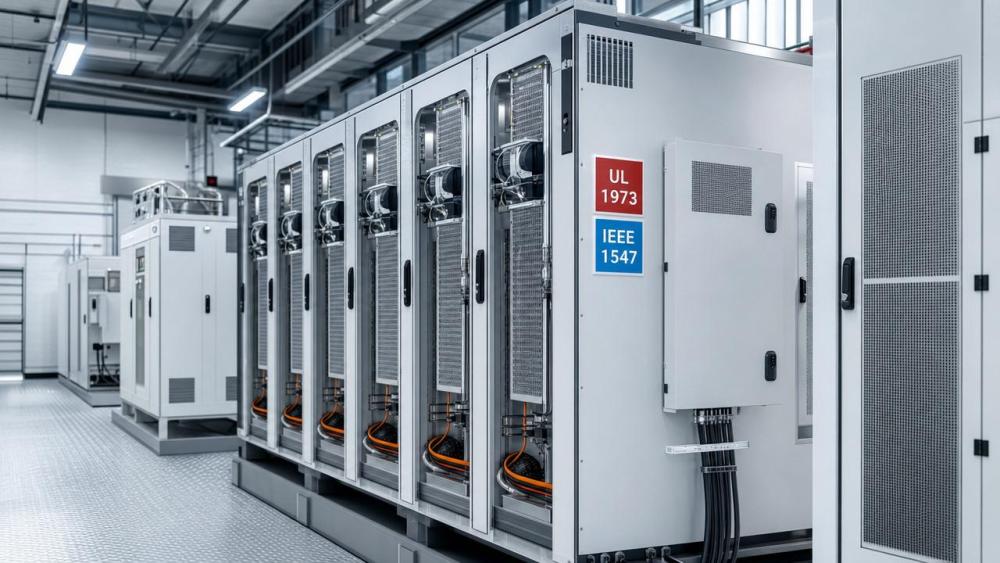
Conclusion: This DOE funding action underscores a functional evolution in U.S. grid-scale storage procurement — where technical interoperability, certification transparency, and localized support capacity increasingly outweigh purely domestic manufacturing assumptions. It does not indicate broad-based relaxation of trade controls, nor does it guarantee market access for non-compliant or non-integrated offerings. Instead, it highlights a narrowing pathway: success hinges on demonstrable adherence to U.S. standards *and* embedded service capability — regardless of component origin. Currently, this is more appropriately understood as a milestone in standards-based collaboration than a pivot in industrial policy.
Source: U.S. Department of Energy (DOE) official announcement, May 8, 2026.
Note: Project-specific locations, utility partners, and vendor names have not been publicly disclosed as of publication. These remain subjects for ongoing observation.
Related News
- Vietnam Sets 2026 Standalone Storage Price Ceiling at VND 3,209.98/kWhNov 12, 2026Energy Storage Strategist
- NTPC Green Energy Tenders 10 GW/40 GWh Storage Systems and Grid-Forming PCSNov 10, 2026Energy Storage Strategist
- Australia’s NEM Battery Storage Reaches Record 20.17 GWhNov 09, 2026Energy Storage Strategist
- India Approves ₹145 Billion VGF Plan for 92 GWh of Energy StorageNov 07, 2026Energy Storage Strategist