
US DOE Adds 3 Chinese Liquid-Cooling Suppliers to BESS White List
On May 12, 2026, the U.S. Department of Energy (DOE) updated its procurement incentive program for liquid-cooled battery energy storage systems (BESS), issuing Version 2.1 of the Qualified Supplier List. The revision formally includes three Chinese thermal management module suppliers — marking a notable shift in eligibility criteria for critical subsystems in federally supported BESS deployments. This update directly affects supply chain dynamics across North American grid-scale storage projects, particularly those leveraging DOE’s $2.3 billion Grid Deployment Office incentives.
Event Overview
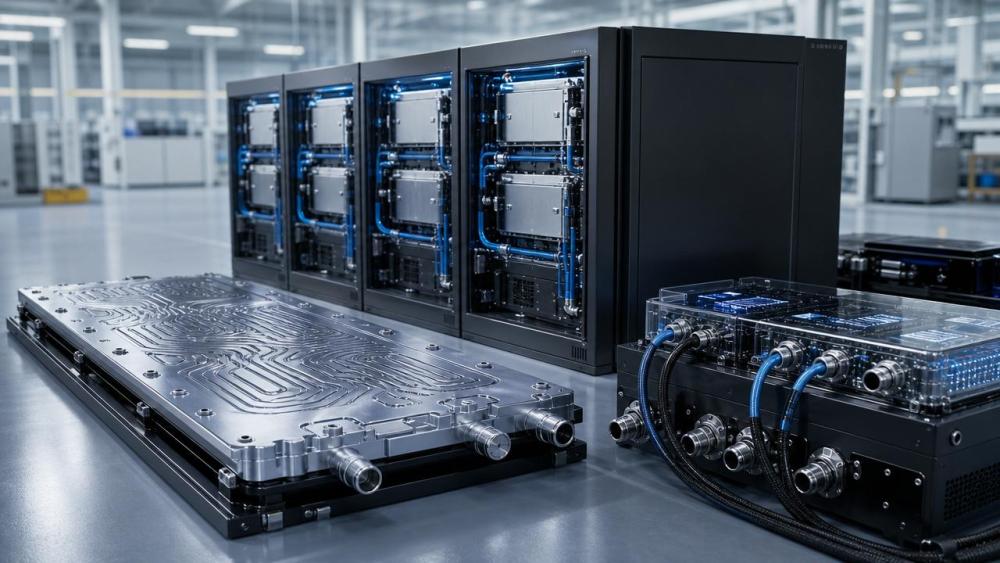
On May 12, 2026, the U.S. Department of Energy (DOE) published the Second Round Liquid-Cooled Energy Storage System Procurement Incentive Program Qualified Supplier List (V2.1). The list adds three China-based suppliers to the qualified roster for thermal management subsystems. These suppliers provide high-efficiency microchannel cold plates, two-phase immersion liquid-cooling cabinets, and AI-driven temperature control algorithm platforms. Under the updated policy, U.S.-based system integrators may now procure fully assembled BESS units incorporating these approved Chinese components without requiring domestic requalification of the thermal subsystem — reducing local integration timelines by approximately 6–8 weeks.
Industries Affected
Direct Trade Enterprises: Export-oriented Chinese thermal management vendors gain direct access to DOE-incentivized project pipelines. Their impact stems from newly recognized qualification status — enabling faster contract execution, reduced compliance overhead, and eligibility for tier-1 OEM partnerships in the U.S. market. Conversely, non-listed competitors face intensified pressure to align with DOE documentation standards or risk marginalization in federal-aided tenders.
Raw Material Procurement Enterprises: Firms sourcing copper alloys, dielectric fluids, and specialized thermal interface materials for microchannel cold plates or immersion cabinets will see increased demand visibility. The listing signals sustained U.S. procurement intent for next-generation cooling hardware — prompting earlier engagement with upstream material suppliers to secure traceability documentation and REACH/UL-compliant certifications required under DOE’s supply chain integrity protocols.
Contract Manufacturing & Assembly Enterprises: U.S. and Mexico-based EMS providers supporting BESS OEMs may adjust production planning to accommodate pre-qualified thermal modules. Since integration cycle time shortens by 6–8 weeks, just-in-time scheduling and inventory buffering strategies for cold plate subassemblies are likely to shift — increasing demand for rapid firmware validation services and thermal safety certification support aligned with UL 9540A and IEEE 1679.3.
Supply Chain Service Providers: Logistics firms offering customs brokerage, technical documentation translation, and DOE-specific compliance auditing (e.g., FAR Part 25.1102 origin verification) will experience higher inquiry volume. The listing triggers new due diligence requirements around component-level country-of-origin declarations and export control classifications — especially where AI algorithm platforms involve dual-use software architecture subject to EAR §734.7.
Key Considerations and Recommended Actions
Verify Subsystem-Level Qualification Scope
Companies must confirm whether their specific product model, firmware version, and fluid compatibility matrix appear in the V2.1 annexes — not just corporate name inclusion. DOE explicitly restricts eligibility to listed configurations; unlisted variants remain ineligible even if produced by the same manufacturer.
Update Technical Documentation for U.S. Integrators
Suppliers should proactively translate and localize test reports (e.g., thermal cycling, dielectric strength, corrosion resistance) into English and align them with UL 9540A Annex D reporting formats. DOE requires integrators to submit full subsystem test summaries during incentive application — delays here can stall project disbursement.
Assess Dual-Use Implications of AI Temperature Control Platforms
For vendors offering AI-driven thermal orchestration software, internal export classification reviews are advised. While the listing confirms end-use acceptability for grid storage, algorithmic features involving real-time load forecasting or adaptive power throttling may intersect with EAR Category 3 (electronics) or 5 (telecom/information security) controls — requiring BIS license exception evaluation prior to software delivery.
Editorial Perspective / Industry Observation
Observably, this update reflects a pragmatic recalibration rather than a strategic pivot: DOE prioritizes technical performance and deployment velocity over geographic sourcing mandates — provided supply chain transparency and safety benchmarks are met. Analysis shows the decision was driven less by trade diplomacy and more by acute industry feedback on thermal subsystem bottlenecks delaying BESS commissioning timelines. From an industry perspective, it signals growing acceptance of ‘modular qualification’ — where subsystems, not just whole systems, undergo independent safety and interoperability validation. That trend may accelerate parallel efforts in Europe (e.g., EU Battery Passport thermal module tagging) and Japan (METI’s JIS C 8715-2 compliance pathway).
Conclusion
This listing does not signify broad easing of U.S. technology controls — but rather a targeted, performance-based opening within a narrowly defined technical domain. It underscores that regulatory recognition increasingly hinges on verifiable engineering outcomes (e.g., cold plate thermal resistance ≤ 0.012 K·m²/W, immersion fluid boiling point stability > 5,000 cycles) rather than origin alone. For global thermal management suppliers, the path forward lies in standardized, auditable, and jurisdictionally mapped compliance evidence — not just product capability.
Source Attribution
U.S. Department of Energy, Qualified Supplier List for Liquid-Cooled BESS Procurement Incentive Program (V2.1), issued May 12, 2026. Available at: energy.gov/gdo/liquid-cooled-bess-white-list. Note: DOE has indicated future updates (V2.2) will expand scope to include hybrid air-liquid cooling architectures; stakeholders should monitor quarterly GDO technical bulletins for timeline adjustments and documentation thresholds.
Related News
- RCEP Green Power Mutual Recognition Takes EffectMay 24, 2026Energy Storage Strategist
- India to Launch First 100-MW Liquid-Cooled BESS PilotMay 23, 2026Energy Storage Strategist
- India to Launch First 100MW Liquid-Cooled BESS DemoMay 22, 2026Energy Storage Strategist
- South Korea Extends Fuel Tax Cut to July 31; Boosts Economics of Liquid-Cooled BESS and PCS InvertersMay 21, 2026Energy Storage Strategist