
DOE Sets 15-Minute UL 9540A Limit for Liquid-Cooled BESS
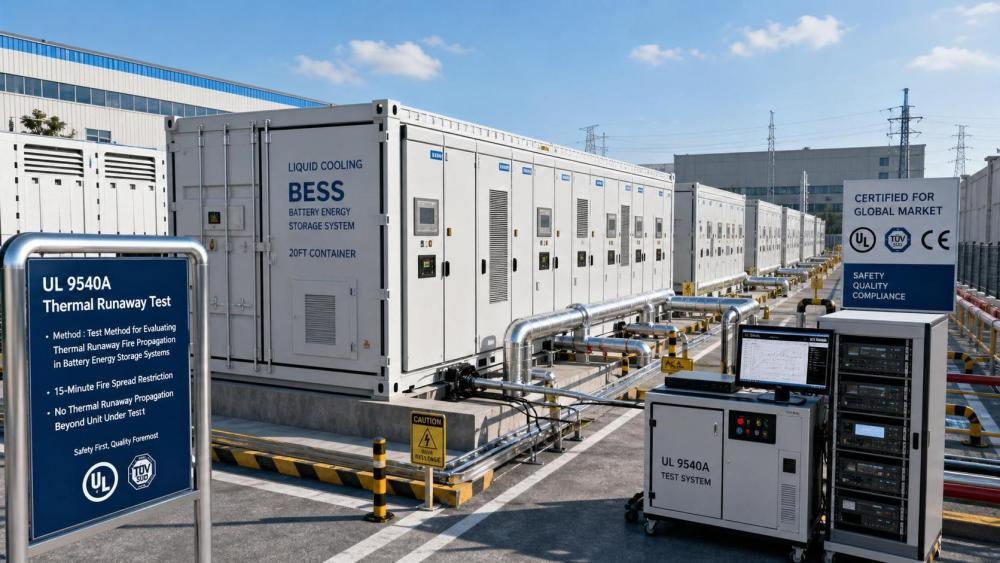
On July 12, 2026, the U.S. Department of Energy updated its technical appendix for large-scale energy storage procurement and introduced a new access threshold for liquid-cooled BESS: thermal runaway propagation time in UL 9540A testing must not exceed 15 minutes. Because the requirement is tied to federally funded projects and is also described as affecting state-level tenders in markets such as California and Texas, the update deserves close attention from system exporters, manufacturers, certification teams, project bidders, and procurement-side decision makers.
What the DOE update formally changed
The confirmed information is limited but clear. The DOE released its 2026 technical appendix for large-scale energy storage procurement on July 12, 2026. In that document, the agency set a 15-minute upper limit for thermal runaway propagation time for liquid-cooled BESS under UL 9540A testing. The requirement is described as a hard eligibility condition for federally funded projects.
The same update is also stated to affect state-level bidding frameworks including CPUC in California and ERCOT in Texas. For Chinese exports of liquid-cooled energy storage systems, the provided information indicates that third-party re-testing and certification must be completed before Q3 2026.
Where the pressure is likely to show up first
Export-facing system suppliers
From an industry perspective, exporters of liquid-cooled BESS are likely to face the most immediate pressure because market access is now tied more directly to a specific UL 9540A performance threshold. The impact is not only on product qualification, but also on bid readiness, customer documentation, and shipment timing for projects connected to U.S. public funding or procurement frameworks influenced by the new rule.
Manufacturing and engineering teams
For manufacturers, the main issue is not simply having a liquid-cooled design, but demonstrating that the tested system can meet the stated thermal runaway propagation limit. What deserves closer attention is the connection between product configuration and certification status. Engineering, compliance, and production teams may need to review whether current certified configurations still align with target U.S. projects and tender requirements.
Project developers and procurement parties
Buyers, developers, and EPC-related procurement functions may also be affected because eligibility rules can narrow the pool of acceptable suppliers. The practical impact is likely to appear in vendor screening, prequalification documents, technical appendices in tender responses, and schedule risk assessments where re-testing is still pending.
Certification and delivery support functions
Service providers involved in testing, certification coordination, export documentation, and delivery planning are also exposed to the change. Observably, once a technical threshold becomes a hard entry condition, documentation quality and timing become part of commercial execution rather than a back-office formality.
What companies should review now
Check whether existing certifications still match target tenders
Companies targeting the U.S. market should first distinguish between having prior certification and meeting the updated procurement condition. The key practical question is whether currently used test reports and third-party certifications remain sufficient for federal projects and for state-level tenders described as being affected by the DOE update.
Reassess Q3 2026 timelines for export programs
The provided information specifically points to a Q3 2026 deadline for third-party re-testing and certification for Chinese liquid-cooled storage exports. That makes timeline management a business issue, not only a compliance issue. Firms with active quotations, framework agreements, or pending deliveries into the U.S. market should review whether certification timing could disrupt bid submission or contract execution.
Separate policy wording from bid implementation
Analysis shows that a procurement threshold and its real-world enforcement in bidding documents are related but not identical. Companies should pay close attention to how federal language is reflected in customer specifications, tender annexes, qualification checklists, and technical clarification rounds, especially where state-level procurement bodies are involved.
Prepare customer communication and evidence packages
Where certification updates are still in process, suppliers and channel-side teams should be ready with clear status communication. In practice, that means organizing test references, third-party certification progress, applicable model lists, and delivery assumptions so commercial discussions are not delayed by incomplete technical evidence.
Why this reads as more than a single-document update
This section is analysis rather than confirmed fact. It is more appropriate to understand the DOE move as a near-term compliance change with broader signaling value. The immediate result is a clearer procurement threshold for liquid-cooled BESS in federally funded projects. The broader signal is that thermal runaway testing outcomes are being translated more directly into market access conditions.
Observably, the development is not yet a full market conclusion on its own. The industry still needs to watch how consistently the requirement is interpreted across procurement bodies, how quickly re-testing is completed, and whether additional tender documents adopt the same framing without modification.
How to read the current stage of impact
At this stage, the update should be read neither as a routine standards reference nor as a final judgment on all liquid-cooled BESS suppliers. The clearer takeaway is that certification readiness, test alignment, and procurement eligibility are moving closer together in the U.S. storage market. For companies already selling into federal or state-linked channels, the issue is immediate. For others, it is a signal that future market entry may depend more heavily on documented thermal safety performance under recognized test methods.
Basis of this article and what still needs verification
This article is based on the user-provided news title, event date, and event summary. The facts cited here rely on the provided description of the DOE update, its date of release, the 15-minute UL 9540A thermal runaway propagation limit for liquid-cooled BESS, its status as a hard threshold for federally funded projects, its stated influence on CPUC and ERCOT tenders, and the Q3 2026 re-testing requirement for Chinese exports.
No specific official source link was provided in the input, so the exact underlying document text and any later clarifications still require continued verification. For this type of development, the most relevant source categories usually include official government procurement documents, regulator or market operator notices, standard-related materials, third-party certification records, company disclosures, and reporting from authoritative industry media. What deserves continued attention is whether later procurement documents keep the same wording and how certification deadlines are applied in practice.
Related News
- Vietnam Sets 2026 Standalone Storage Price Ceiling at VND 3,209.98/kWhNov 12, 2026Energy Storage Strategist
- NTPC Green Energy Tenders 10 GW/40 GWh Storage Systems and Grid-Forming PCSNov 10, 2026Energy Storage Strategist
- Australia’s NEM Battery Storage Reaches Record 20.17 GWhNov 09, 2026Energy Storage Strategist
- India Approves ₹145 Billion VGF Plan for 92 GWh of Energy StorageNov 07, 2026Energy Storage Strategist